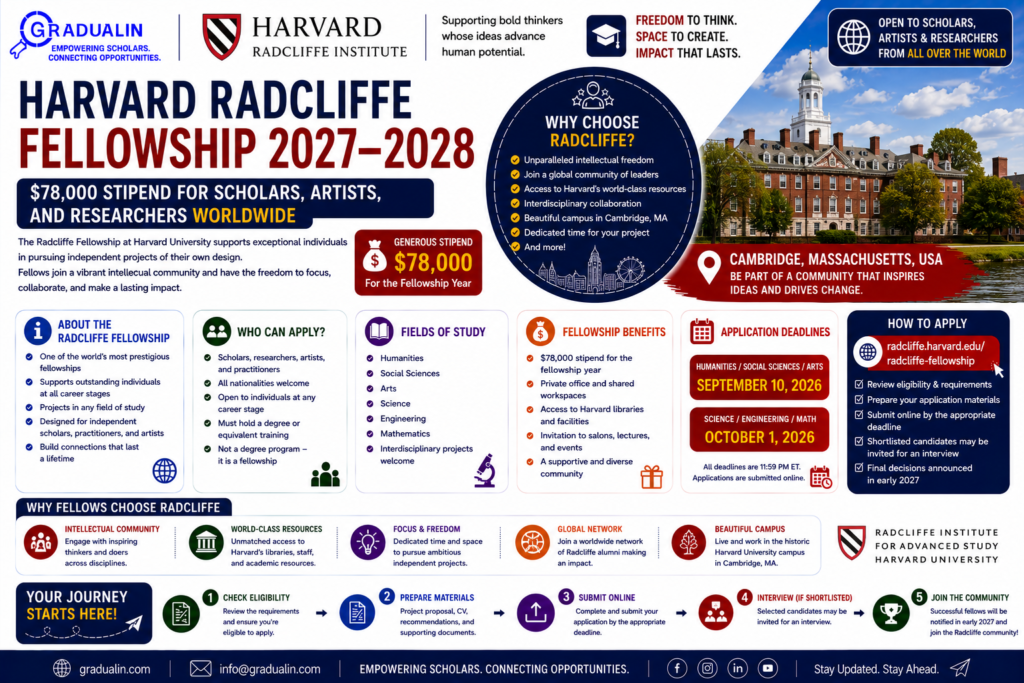

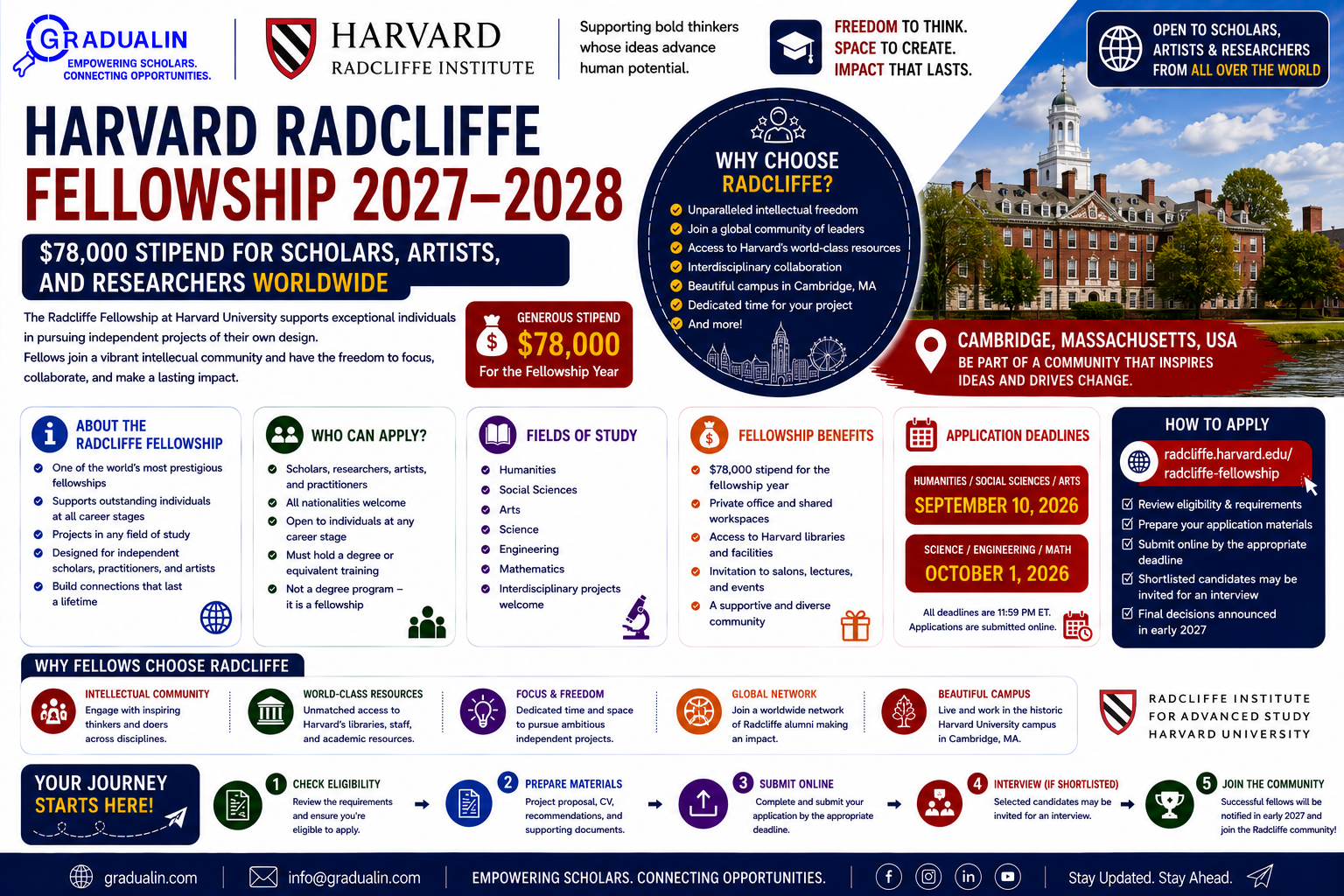
Harvard Radcliffe Fellowship 2027–2028 — $78,000 Stipend for Scholars, Artists, and Researchers Worldwide
One of the most prestigious fellowships in academic and creative life just opened its application window — and the deadline is closer than most people realize. The Harvard Radcliffe Institute Fellowship for 2027–2028 is now accepting applications, with the humanities and social sciences deadline falling on September 10, 2026 — less than two weeks away. The STEM deadline follows on October 1, 2026.
Each year, the Radcliffe Institute selects just 50 fellows from a global applicant pool — scholars, scientists, writers, journalists, and artists who receive a $78,000 stipend, dedicated office or studio space at Harvard, and a full academic year embedded in one of the world’s most intellectually alive research communities. International scholars, including those from Pakistan and South Asia, are eligible to apply.
This guide covers everything you need to make an informed decision about applying — eligibility by discipline, what the fellowship actually involves, how applications are evaluated, and what distinguishes competitive proposals from the rest.
| Detail | Information |
| Institution | Harvard Radcliffe Institute for Advanced Study |
| Country | United States (Cambridge, Massachusetts) |
| Fellowship Type | Residential research fellowship |
| Stipend | $78,000 + $5,000 project expense allowance |
| Duration | One full academic year (September–May) |
| Fellowship Spots | ~50 per cohort |
| Deadline (Humanities/Social Sciences/Arts) | September 10, 2026 |
| Deadline (Science/Engineering/Math) | October 1, 2026 |
| Open To | Scholars, artists, researchers, writers, journalists worldwide |
| Pakistani Scholars Eligible | ✅ Yes — international applicants welcome |
| Official Link | Apply Here |
🎓 About the Harvard Radcliffe Institute Fellowship
The Radcliffe Institute for Advanced Study is Harvard’s interdisciplinary research center — a place deliberately designed to dissolve the walls between disciplines. Founded in 1999 (building on the legacy of Radcliffe College, Harvard’s historic women’s college), it has grown into one of the most coveted fellowship destinations in the world.
The Radcliffe Fellowship is not a postdoctoral placement or a graduate award — it is a mid-to-senior career opportunity for people who have already built meaningful track records in their fields. The 50 fellows selected each year represent the full range of intellectual and creative life: physicists sit alongside novelists, economists share lunches with visual artists, and public health researchers present their work to music composers. That deliberate mix is central to what makes a Radcliffe year distinctive.
Past fellows include novelist Zadie Smith, political scientist and former US Ambassador to the UN Samantha Power, historian Jill Lepore, Senator Elizabeth Warren, and Nobel laureate economist Michael Kremer. The list is a window into what kind of achievement the selection committee looks for — and the company a Radcliffe year puts you in.
Unlike a typical postdoctoral fellowship, which often requires significant teaching or departmental duties, the Radcliffe Fellowship is deliberately protected time. Fellows are expected to work on their own projects, attend weekly cohort talks, and participate in the community. That’s it. The structure is designed to give serious thinkers the rarest resource in academic life: uninterrupted time.
🎓 Fellowship Benefits
- $78,000 stipend for the full academic year (September through May)
- $5,000 project expense allowance — for research travel, materials, archival access, and related costs
- Relocation support — funds available to help fellows move to the Cambridge/Boston area
- Housing assistance — support available, details vary by individual circumstance (verify on official page)
- Childcare funds — available to eligible fellows to support the transition
- Healthcare support — made available as needed
- Office or studio space in Byerly Hall, Radcliffe Yard — private, dedicated workspace
- Full-time Harvard appointment as a visiting fellow — granting access to the Harvard Library system, including the Schlesinger Library’s exceptional collections on women, gender, and society
- Access to Harvard athletic facilities
- Radcliffe Research Partnership — the option to work with Harvard undergraduate research assistants on your project
- Professional development workshops and faculty director engagement throughout the year
- Weekly cohort talks — presenting your work and engaging with 49 peers from across disciplines
For Pakistani and South Asian scholars, the stipend translates to a genuinely livable research income in Cambridge. The $5,000 project expense fund is particularly significant for researchers who need archival access, fieldwork, or travel as part of their project.
🎓 Eligibility by Discipline
The Radcliffe Fellowship has specific eligibility requirements that differ substantially by program area. Read your category carefully before applying.
Humanities and Social Sciences
- Doctorate (PhD, MD, JD, DPhil, DEd or equivalent) received at least four years before appointment — meaning the degree must predate December 2023 for the 2027–2028 cycle
- Published a monograph or at least two articles in refereed journals or edited collections
Science, Engineering, and Mathematics
- Doctorate received at least four years before appointment (pre-December 2023)
- Published at least five articles in refereed journals — the official page notes that most science fellows have published dozens of articles, which signals the actual competitive bar
Nonfiction and Journalism
- Journalism: at least five years of professional journalism experience
- Nonfiction: one or more published books, a book contract, or at least three published longer-form works (not newspaper articles)
Creative Arts
- Fiction: one or more published books, a book contract, or at least three published longer-form pieces
- Poetry: at least 20 poems or a book of poetry published in the last five years; must be completing a manuscript
- Playwriting: a significant body of produced plays or plays under option
- Visual Arts: at least five years as a professional artist, multiple curated group shows, at least two professional solo exhibitions
- Film and Video: a body of independent work exhibited at galleries, festivals, or broadcast
- Music Composition: strong evidence of professional achievement and recent performances (PhD desirable but not required)
Important additional restrictions:
- Currently enrolled degree students are not eligible
- Former Radcliffe fellows (1999–present) are not eligible to reapply
- Pakistani scholars: fully eligible — there are no nationality restrictions. International scholars make up a regular portion of each annual cohort
🎓 Who Should Apply — and Who Probably Shouldn’t
✅ Mid-career and senior scholars with a strong publication record who need protected writing or research time to complete a major project ✅ Creative professionals (novelists, filmmakers, composers, visual artists) with demonstrated track records ready to pursue an ambitious new work ✅ Journalists and nonfiction writers with at least five years of professional experience and a book-length project in progress ✅ Pakistani and South Asian academics at HEC-recognized universities with published international research and a project proposal with genuine interdisciplinary appeal ✅ Researchers whose work connects to Radcliffe’s 2024–2029 focus area: academic freedom, connecting across difference, political polarization, religious pluralism, and institutional trust
❌ Graduate students currently enrolled in degree programs — explicitly ineligible ❌ Early-career researchers who received their doctorate after December 2023 ❌ Previous Radcliffe fellows (1999 onward) — cannot reapply ❌ Applicants without a strong publication or professional record in their discipline — the 50-spot cohort drawn from a global pool makes this highly competitive, and weak CVs are unlikely to advance past the first review
Pakistani academics from disciplines like development economics, public health, postcolonial literature, South Asian history, and environmental science have the strongest natural fit — fields where internationally significant research questions connect directly to the South Asian context.
🎓 Available Program Areas
Applications are accepted across four primary areas, each with its own discipline listing:
- Humanities and Social Sciences — history, economics, anthropology, political science, sociology, linguistics, philosophy, and more
- Science, Engineering, and Mathematics — natural sciences, engineering disciplines, mathematics, and applied sciences
- Nonfiction and Journalism — narrative nonfiction, investigative journalism, science writing, and related forms
- Creative Arts — fiction, poetry, playwriting, visual arts, film and video, music composition
Interdisciplinary projects are actively welcomed. Applicants select a primary discipline from the full discipline listing and may designate a secondary disciplinary area. For 2027–2028, Radcliffe has also explicitly invited proposals connected to science, technology, engineering, and mathematics fields directly impacted by federal research funding cuts — a new and specific area of emphasis worth noting for STEM applicants.
🎓 Required Application Materials
- Completed online application form — submitted through the Radcliffe application portal
- Curriculum vitae — a full academic or professional CV
- 1,400-word project proposal — with bibliography where appropriate; this is the central evaluation document
- Writing or work sample — varies by discipline (see below)
- Three reference letters — referees are contacted directly via email to upload letters to the portal; you provide contact information
Work sample guidance by area:
- Humanities/Social Sciences: unpublished writing related to your project, or a published article/book chapter — max 40 pages
- Science/Engineering/Math: three published articles
- Nonfiction: a recent book chapter, short story, manuscript, or article (~30 pages); journalism applicants may also submit up to 15 minutes of audio/video work
- Fiction: a recent book chapter, short story, manuscript, or article (~30 pages)
- Poetry: up to 10 poems
- Playwriting: one play or section, no more than 30 pages
- Visual Arts: 12 images plus up to 3 moving-image excerpts
- Film/Video: up to 15 minutes of work on Vimeo or YouTube
- Music Composition: one to three samples on Soundcloud/Vimeo/YouTube, accompanied by written scores
For Pakistani applicants: there are no additional document requirements beyond the standard application materials listed above. HEC-attested degrees are not specifically required by Radcliffe — the CV and publications record are what matter here.
🎓 Step-by-Step Application Process
- Confirm your eligibility — check your program area’s specific requirements against the criteria above. Pay close attention to the four-year doctorate rule and publication minimums before investing time in your proposal.
- Register on the portal — create a new account at Radcliffe’s application portal using your name, email, and password.
- Select your program area — choose from Humanities and Social Sciences; Creative Arts; Nonfiction and Journalism; or Science, Engineering, and Mathematics.
- Draft your 1,400-word project proposal — this is the most critical component. It should articulate the intellectual or creative significance of your project, what you plan to accomplish during the fellowship year, and why Harvard’s resources and the Radcliffe community are specifically valuable to this project.
- Prepare your work sample — use the discipline-specific guidelines above. Do not submit more than requested.
- Contact your three referees early — Radcliffe sends referees direct email prompts, but referees need time to write and upload letters. Contact them well before the deadline, especially if they are in different time zones.
- Submit before the deadline — Humanities/Social Sciences/Arts: September 10, 2026, 5 PM ET. Science/Engineering/Math: October 1, 2026, 5 PM ET. Late submissions are not considered.
- Wait for notification — all applicants are notified of results by the end of March 2027.
Practical tip: The project proposal is what separates competitive applications from the rest. The selection committee evaluates the quality and significance of the proposed project as much as the applicant’s record. Your proposal should not be a summary of your previous work — it should articulate a genuinely ambitious project that you could not complete without the protected time and Harvard resources a Radcliffe year provides. Fellows who have described what the fellowship experience adds to a project — access to the Schlesinger Library, interdisciplinary feedback from a diverse cohort, time away from teaching obligations — tend to write more convincing proposals.
🎓 Important Dates
| Milestone | Date |
| Application Portal Open | Now |
| Humanities/Social Sciences/Arts Deadline | September 10, 2026, 5 PM ET |
| Science/Engineering/Math Deadline | October 1, 2026, 5 PM ET |
| Fellowship Year Begins | September 2027 |
| Fellowship Year Ends | May 2028 |
| Applicant Notifications | End of March 2027 |
Bookmark this page — we update deadlines as soon as changes are announced.
🎓 Why Apply — Why the Radcliffe Institute
The Radcliffe Fellowship is not simply a stipend — it is structured access to an intellectual environment that does not exist anywhere else. Fifty fellows from radically different fields share weekly lunches, attend each other’s work-in-progress talks, and cross-pollinate ideas across the full range of human inquiry. A composer and a climatologist at Radcliffe famously began a significant collaboration during their fellowship year. That kind of unexpected connection is not accidental — it is the design.
Cambridge as a base is itself a genuine advantage. Harvard’s library system, including the Schlesinger Library’s extraordinary collections on women, gender, and social history, gives fellows research access that most universities cannot match. The visiting fellow appointment opens doors within Harvard that a standard visitor arrangement would not.
For scholars based outside the United States — including those at universities in Pakistan, India, Bangladesh, and across South Asia — the Radcliffe year offers something that cannot be replicated remotely: a sustained immersion in one of the world’s most productive research environments, with the time and infrastructure to complete a project that has been waiting for exactly this kind of space.
Gradualin Editor’s Note: This is a genuinely elite, highly competitive fellowship — 50 spots from a global applicant pool of thousands. Strong academics and creative professionals with excellent publication records and a clearly formed project have a realistic shot; early-career researchers or those without the required publication history do not. For Pakistani and South Asian scholars who meet the eligibility criteria, the international competitiveness of this fellowship is real but not prohibitive — particularly for applicants whose work engages questions of global significance that connect naturally to South Asian contexts (development, public health, postcolonial history, climate, governance). If you meet the requirements, applying is worth the effort. If you are three years post-PhD, file this for next cycle and build your publication record now.
🎓 FAQ
These questions are based on what students and academics most commonly search about the Harvard Radcliffe Fellowship.
Can Pakistani and South Asian scholars apply for the Radcliffe Fellowship? Yes, fully. The Radcliffe Fellowship is open to applicants from anywhere in the world. There are no nationality restrictions. International scholars — including those currently based at universities in Pakistan, India, Bangladesh, and other South Asian countries — are eligible to apply, provided they meet the discipline-specific eligibility criteria.
Is IELTS or TOEFL required for the Radcliffe Fellowship? No. There is no English language test requirement for the Radcliffe Fellowship. The fellowship is conducted in English, and the application materials (CV, project proposal, work sample) demonstrate language proficiency implicitly.
Can I apply if I received my PhD less than four years ago? No. The eligibility requirement for Humanities/Social Sciences and STEM applicants is a doctorate received at least four years before appointment — meaning before December 2023 for the 2027–2028 cycle. If you received your PhD after December 2023, you are not eligible for this cycle. Check the next cycle’s opening.
Do I need to be a tenured professor to apply? No. Radcliffe explicitly states it accepts applications across career stages and does not require academics to have tenure. What matters is the quality of your publication or professional record and the strength of your proposed project.
Is the $78,000 stipend in addition to my regular salary? This is a question Radcliffe addresses only in general terms — fellows receive the stipend, and some fellows take leave from their home institutions while others negotiate differently. You should clarify the arrangement with your home institution and with Radcliffe’s program office directly. Contact information is available through the request for information form on the official site.
What happened to applicants’ projects in previous years — are there examples of work produced? Yes. Radcliffe maintains a rich public record of fellow stories and projects on its website. Past fellows include the author of widely read books, influential documentary films, landmark scientific papers, and public policy frameworks. Reviewing past fellows’ project descriptions is one of the best ways to calibrate what a competitive Radcliffe proposal looks like.
🎓 Official Source
- Fellowship Overview: Radcliffe Fellowship
- Application Information & Portal: Application Information
- Fellowship Experience: The Fellowship Experience
- FAQ: Fellowship Application FAQ
- Radcliffe Institute Address: 10 Garden Street, Cambridge, MA 02138
🎓 Summary
| Detail | Information |
| Institution | Harvard Radcliffe Institute for Advanced Study |
| Country | United States |
| Fellowship Type | Residential research fellowship |
| Stipend | $78,000 + $5,000 project expense allowance |
| Additional Support | Relocation, housing, childcare, and healthcare funds (as applicable) |
| Duration | One academic year (September–May) |
| Fellowship Spots | ~50 per cohort |
| Program Areas | Humanities & Social Sciences; Science, Engineering & Math; Creative Arts; Nonfiction & Journalism |
| Deadline (Humanities/Arts) | September 10, 2026 |
| Deadline (STEM) | October 1, 2026 |
| IELTS Required | No |
| Pakistani Scholars Eligible | ✅ Yes |
| Currently Enrolled Students Eligible | ❌ No |
| Previous Radcliffe Fellows Eligible | ❌ No |
| Notifications Sent | End of March 2027 |
| Official Link | Apply Here |
The Radcliffe Fellowship sits in a different category from most opportunities listed on Gradualin — it is not for students, and it is not easy to win. But for the right applicant, it is one of the most transformative professional experiences available anywhere in the world. If you are a mid-career scholar, researcher, writer, or artist with a project ready to be completed and a record that reflects genuine achievement, this is worth your time in the next two weeks.
Browse more opportunities in our Scholarships and Guidelines & Resources sections. For those at earlier career stages exploring US-based academic pathways, our guides on Fully Funded Scholarships in the USA 2026 and Fully Funded PhD Scholarships in the UK 2026 are strong next reads. Researchers interested in Europe may also find our Fully Funded PhD Positions in Switzerland 2026 and Study in Germany 2026 — Guide for International Students guides useful for planning the longer arc of an international academic career.
For career-stage opportunities alongside scholarly fellowships, see our Jobs & Internships and Events & Conferences listings.
Stay updated with the latest scholarships, jobs, and opportunities at Gradualin.com — your trusted guide to studying abroad for free.
Author: Faseeh Sultan — PhD Scholar & MSIT | 7 Years in Education