
Free Online Courses from Harvard University 2026 — Enroll Today
Harvard University — the name alone carries weight that no other institution quite matches. What most students in Pakistan and across South Asia don’t realize is that Harvard has quietly made over 129 of its courses available for free online, right now, with no application process, no IELTS requirement, and no tuition fee. You can start learning from Harvard faculty today, from wherever you are.
This guide breaks down exactly what’s available, which courses are worth your time, how the enrollment process works, and what Pakistani and international students should know before they begin.
| Detail | Information |
| Institution | Harvard University |
| Country | United States |
| Course Level | Introductory, Intermediate, Advanced |
| Funding Type | Free to audit (certificates available separately) |
| Total Free Courses | 129+ (as of September 2026) |
| Open To | Anyone worldwide |
| Pakistani Students Eligible | ✅ Yes — no restrictions, no application required |
| Official Link | Browse Free Courses |
📚 What Harvard’s Free Online Learning Actually Is
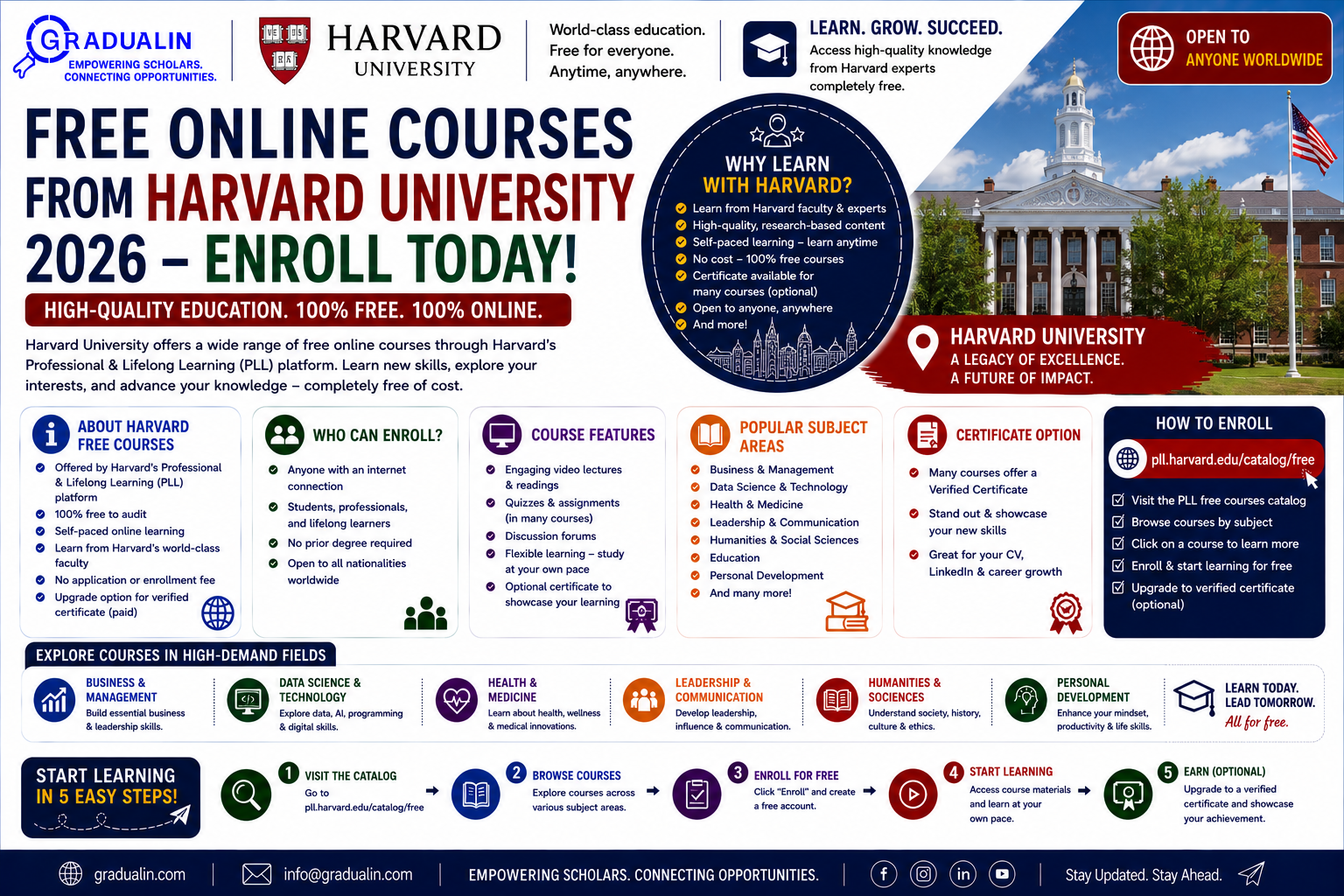
Harvard’s free course catalog sits under the Harvard Division of Continuing Education’s Professional and Lifelong Learning (PLL) platform. These are not watered-down versions of Harvard content — they are actual courses developed by Harvard faculty and delivered through edX and Harvard’s own platform, covering twelve subject areas from Computer Science and Data Science to Humanities, Health, Business, and beyond.
The “free” model here works like this: you can audit the full course content — lectures, readings, assignments — at no cost. If you want a verified certificate at the end showing Harvard’s name, that typically requires a fee (which varies by course). But the learning itself? Completely free.
This is fundamentally different from something like a Coursera free trial or a YouTube playlist. These are structured courses with defined durations, real assessments, and content built by the same faculty who teach Harvard’s on-campus students. CS50, Harvard’s flagship introductory computer science course, has produced millions of learners worldwide and is widely considered one of the best free learning resources on the internet — full stop.
Unlike Coursera’s university partnerships, where free access is often time-limited or feature-restricted, Harvard’s PLL platform makes the audit path genuinely accessible. That said, if a professional certificate or verified completion record matters to you, budget for the certificate fee separately.
📚 Benefits of Enrolling
- Completely free to audit — no credit card, no subscription
- No IELTS, TOEFL, or English test required to access courses
- No application or admission process — create an account and start
- Flexible, self-paced — most courses are available anytime
- Harvard faculty instruction — same professors teaching on campus
- Certificate option — available for a fee on most courses if needed for your CV
- 12 subject areas — something relevant for almost every career path
- Accessible globally — including Pakistan, India, Bangladesh, and all South Asian countries
📚 Eligibility
- Open to anyone worldwide with internet access
- No minimum qualification required — undergraduate students, fresh graduates, and working professionals all enroll
- No age restriction
- Courses taught in English — no formal English test required, but reading and comprehension level should be comfortable
- A free edX or Harvard PLL account is required to enroll
- Pakistani students: fully eligible — there are no nationality restrictions on any of Harvard’s free online courses
📚 Who Should Enroll — and Who Probably Shouldn’t
✅ Students building CV credentials between degree programs ✅ Pakistani graduates who want internationally recognized course names on their LinkedIn ✅ Working professionals upskilling in data science, programming, or business ✅ Anyone who has been curious about Computer Science but never had a structured entry point ✅ Researchers, educators, and healthcare workers looking for specialized short courses
❌ Students expecting a degree, diploma, or formal qualification — these are non-credit courses ❌ Those who need a verifiable certificate immediately and can’t budget for the fee ❌ Learners looking for live, instructor-paced accountability — most courses are self-paced with no cohort
Pakistani students with a B.Sc. or bachelor’s in any field have found CS50 and Harvard’s Data Science series particularly valuable as skill-building additions to job applications at multinational firms and international organizations operating in Pakistan.
📚 Course Categories and Top Picks by Field
Harvard’s 129 free courses span twelve subject areas. Here’s a practical breakdown of what’s available and which courses stand out — based on enrollment numbers, course reputation, and relevance to Pakistani and South Asian job markets:
💻 Computer Science & Programming This is where Harvard’s free catalog genuinely excels. CS50: Introduction to Computer Science is the standout — a 5-week introductory course that has become a global phenomenon. CS50’s Web Programming with Python and JavaScript follows it up with a 12-week deep dive into Django, React, and SQL. CS50’s Introduction to Programming with Python (9 weeks) and Introduction to Programming with Scratch (3 weeks) complete a full beginner-to-intermediate pathway entirely for free.
📊 Data Science Harvard offers a near-complete Data Science series — Statistics and R, Linear Regression, Probability, Wrangling, Inference and Modeling, and a Capstone — essentially a free professional certificate pathway in Data Science if you work through the sequence. Introduction to Data Science with Python is also available as a standalone 8-week course.
💼 Business & Social Sciences Managing Happiness, Strategic Finance for Nonprofit Leaders, Citizen Politics in America, and CitiesX offer a mix of practical and intellectual business and governance content. These are useful for students interested in public policy, management, or social enterprise.
🏥 Health & Medicine The opioid crisis course, Stem Cell Medicine (Parkinson’s Disease), Strengthening Community Health Worker Programs, and Principles of Biochemistry make this a surprisingly strong category for pre-med students, public health professionals, and healthcare workers in Pakistan’s growing health sector.
📖 Humanities Harvard’s humanities catalog is deep: Justice (one of Harvard’s most famous courses, taught by Michael Sandel), Masterpieces of World Literature, Shakespeare courses, Chinese history series, and Rhetoric: The Art of Persuasive Writing and Public Speaking all have genuine academic depth.
🔬 Science Energy and Thermodynamics, Fundamentals of Neuroscience, Principles of Biochemistry, and Science & Cooking (genuinely fascinating — Harvard chefs and researchers exploring physics through food) round out a broad science offering.
📚 How to Enroll — Step by Step
- Go to the course catalog — Visit Harvard’s free courses page and browse or filter by subject area, duration, or difficulty level.
- Select your course — Click on the course that interests you. Read the full description, check the duration and difficulty level, and confirm it’s currently open (most say “Available now”).
- Create a free account — You’ll be redirected to edX or Harvard’s own platform. Create a free account with your email address. No documents, no application form.
- Choose the audit option — When prompted, select “Audit this course” or the free enrollment option. Do not proceed to payment unless you specifically want a verified certificate.
- Start learning — Access all lectures, readings, and exercises immediately. Most courses are self-paced, so you set your own schedule.
- Complete and optionally certify — Finish the course at your own pace. If you want a certificate showing Harvard University on your CV, pay the fee at that stage. For pure learning and skill-building, the audit is sufficient.
Practical tip: CS50 in particular has an extremely active Discord community and open-source problem sets. Completing the problem sets — even without a certificate — builds a real portfolio you can show employers. Several Pakistani software developers have credited CS50 as the course that got them their first international remote job.
📚 Important Notes on Certificates
The certificate question comes up constantly, and it’s worth being direct about it:
- Audit = free, no certificate
- Certificate = paid, exact fee varies by course (typically $50–$300 USD depending on the course — verify on the official page)
- The certificate carries Harvard’s name and is issued by edX or Harvard PLL — it is legitimate and recognized by employers
- For LinkedIn and CV purposes, many students find the audit sufficient when combined with actual skills demonstrated through projects
The certificate is not a Harvard degree, diploma, or academic credit. It is a professional development certificate. That’s still meaningful — but calibrate your expectations accordingly.
📚 Why Harvard’s Free Courses Are Worth Your Time
Harvard is consistently ranked among the top three universities in the world. When CS50’s instructor David Malan teaches you the fundamentals of computer science, you are learning from someone whose course has been refined over two decades and has influenced how universities worldwide now teach introductory programming.
For Pakistani students specifically, the absence of any application barrier is significant. You do not need HEC equivalence, NOC letters, IELTS scores, or financial documentation. You need an internet connection and the time to learn.
The career credential value of listing “Harvard University — CS50” or “Harvard University — Data Science” on a CV is real. At multinational firms, development sector organizations, and tech companies hiring in Pakistan, internationally recognized course names do carry weight — particularly when they demonstrate self-driven professional development.
Gradualin Editor’s Note: These courses are genuinely worth enrolling in — with one honest caveat. Free, self-paced courses have high dropout rates globally because there’s no external accountability. If you’re the kind of learner who finishes what they start, Harvard’s free catalog is an extraordinary resource. If you’ve started and abandoned MOOCs before, consider starting with CS50 specifically — it has better community support and more engaging delivery than most. The effort is worth it.
📚 FAQ
These questions are based on what students most commonly search about Harvard’s free online courses.
Can Pakistani students enroll in Harvard’s free online courses? Yes, fully. Harvard’s free online courses are open to anyone worldwide with an internet connection. There are no nationality restrictions, no application process, and no English test required. Pakistani students can create a free account and start immediately.
Is IELTS required to take Harvard’s free courses? No. Harvard does not require any English language test for its free online courses. The courses are delivered in English, so a good reading and comprehension level helps — but there is no formal language requirement.
Will I get a Harvard degree or diploma? No. These are non-credit, professional development courses. Completing them earns you a certificate (if you pay the fee) or simply the knowledge and skills. They do not contribute to a Harvard degree or any formal academic qualification.
Are the certificates from Harvard’s free courses recognized by employers in Pakistan? The certificates are issued under Harvard University’s name through its official platform. At multinational employers, development sector organizations, and tech companies, they are generally recognized and respected — particularly for skill-demonstrating fields like data science and programming. For government jobs in Pakistan requiring formal degree qualifications, these certificates would not substitute for academic credentials.
How long do the courses take? Course durations range from 1 week (PredictionX) to 16 weeks (Child Protection course). Most popular courses like CS50 are 5 weeks, and the Data Science series courses run 7–8 weeks each. All are self-paced unless otherwise stated.
Which Harvard free course is best for beginners with no technical background? CS50’s Introduction to Programming with Scratch is the gentlest entry point. CS50: Introduction to Computer Science is the gold standard for anyone who wants a rigorous but beginner-accessible pathway into programming and computer science.
📚 Official Source
- Course Catalog: Harvard Free Courses — Browse All 129+
- Harvard Professional & Lifelong Learning: pll.harvard.edu
- edX (Harvard Courses): edx.org/school/harvardx
📚 Summary
| Detail | Information |
| Institution | Harvard University |
| Country | United States |
| Course Level | Introductory, Intermediate, Advanced |
| Funding Type | Free to audit (certificates available separately) |
| Total Free Courses | 129+ (as of September 2026) |
| Subject Areas | 12 — CS, Data Science, Business, Health, Humanities, Science, and more |
| Open To | Anyone worldwide |
| IELTS Required | No |
| Application Required | No |
| Pakistani Students Eligible | ✅ Yes — no restrictions |
| Start Date | Most available immediately |
| Official Link | Browse Free Courses |
For more opportunities like this, explore our full Scholarships and Guidelines & Resources sections. If you’re thinking about formal study abroad, our guides on Fully Funded Scholarships in the USA 2026 and Top 10 Fully Funded Scholarships in Asia 2027 are strong next steps. For those interested in career opportunities alongside learning, check our Jobs & Internships listings.
If programming and data are your focus, also see our Fully Funded PhD Scholarships in the UK 2026 and Fully Funded PhD Positions in Switzerland 2026 — these are strong next steps after building foundational skills through Harvard’s free courses.
You may also find useful context in our Events & Conferences listings for virtual learning events and academic networking opportunities.
Stay updated with the latest scholarships, jobs, and opportunities at Gradualin.com — your trusted guide to studying abroad for free.
Author: Faseeh Sultan — PhD Scholar & MSIT | 7 Years in Education