
📅 Last Updated: September 2026
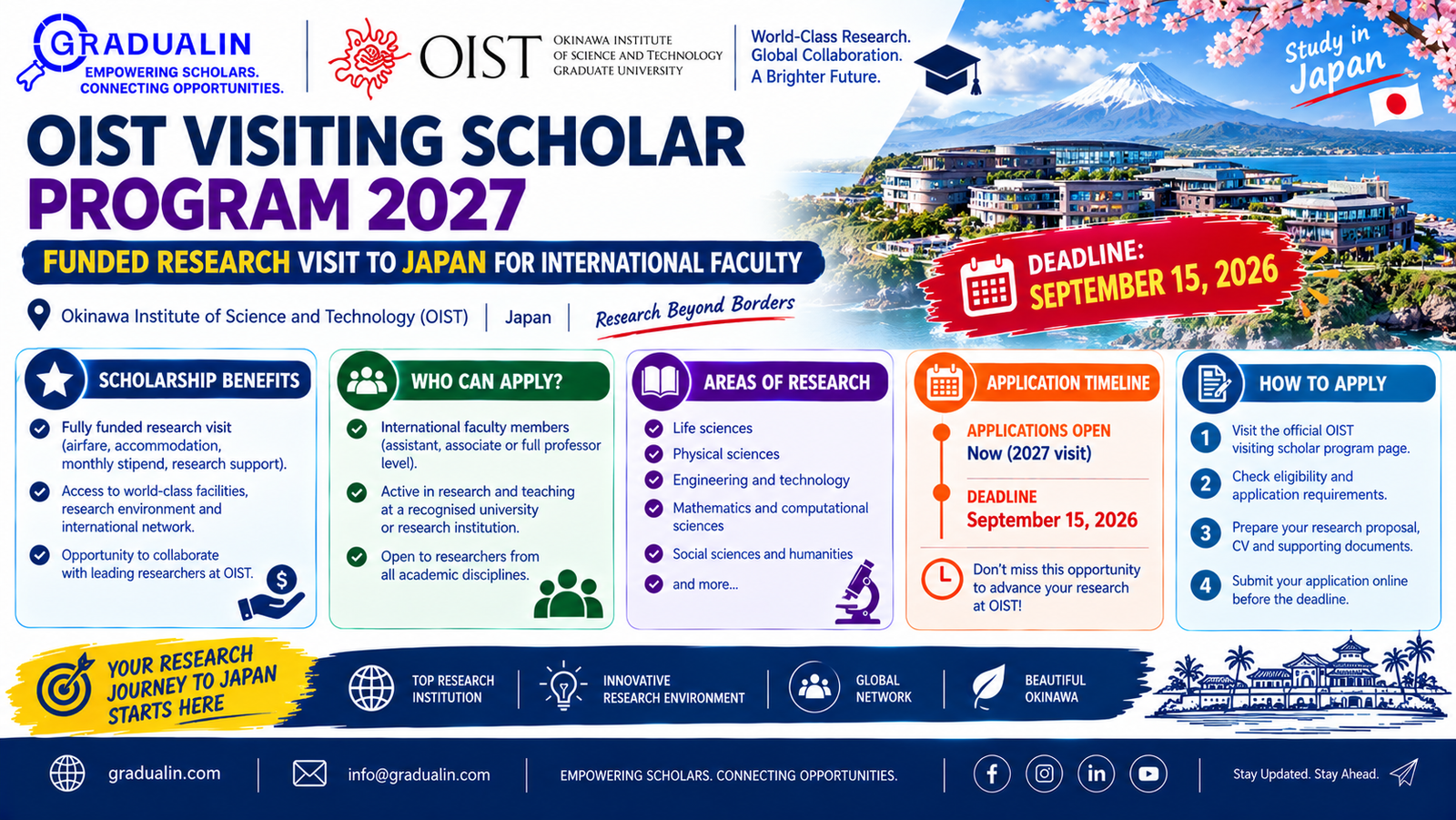
OIST Visiting Scholar Program 2027 — Research in Japan Funded
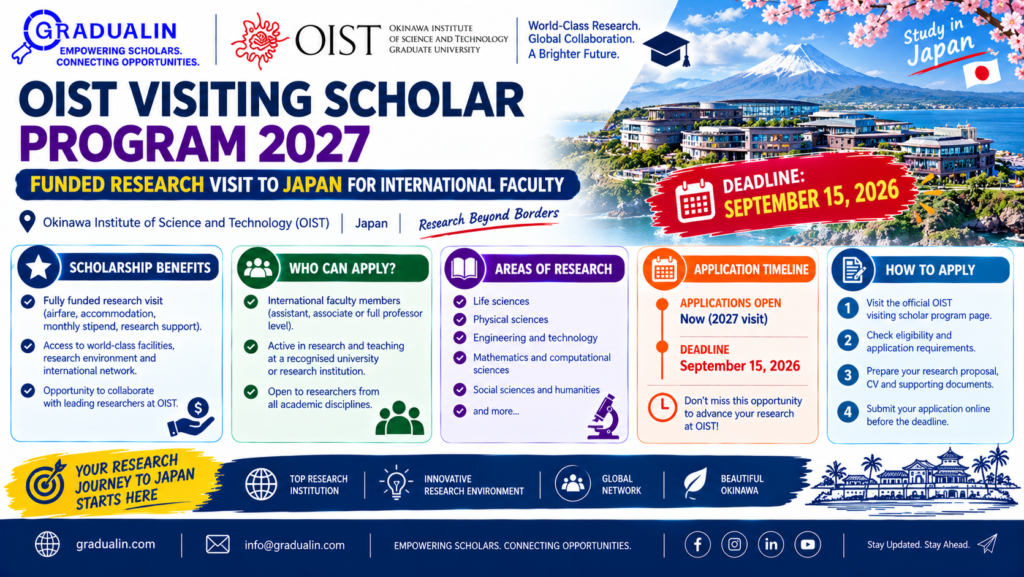
If you hold a faculty or independent research position and have ever wanted to conduct research at one of Asia’s most distinctive science institutions, the OIST Visiting Scholar Program 2027 is one of the most accessible and genuinely funded pathways to do it. The Okinawa Institute of Science and Technology (OIST) in Japan invites independent researchers from any field worldwide to propose a research visit of three to twelve months, with financial and logistical support that can cover airfare, on-campus housing, and office facilities. Pakistani and South Asian faculty members are actively encouraged to apply — OIST is explicitly committed to diversity and underrepresented researchers in its visiting community. The priority deadline is September 15, 2026. This guide tells you everything the official page doesn’t.
| Institution | Okinawa Institute of Science and Technology (OIST) |
| Country | Japan 🇯🇵 |
| Visit Duration | 3 to 12 months |
| Visit Period | April 2027 – March 2028 (FY2027) |
| Funding Type | Partial to full institutional support (subject to available funding) |
| Priority Deadline | September 15, 2026 |
| Open To | International Researchers Worldwide |
| Pakistani Researchers Eligible | Yes — actively encouraged |
| Application Portal | Apply via Interfolio |
🎓 About OIST and the Visiting Scholar Program
The Okinawa Institute of Science and Technology is not a conventional university. It operates without academic departments — a deliberate structural choice intended to break barriers between disciplines and encourage genuinely cross-field collaboration. Founded with significant backing from the Japanese government, OIST has rapidly climbed global rankings and is now recognized as one of the leading research institutions in Asia across the natural sciences, mathematics, computational science, and beyond.
The Visiting Scholars Program is OIST’s primary pathway for bringing established researchers from around the world into this environment for extended periods. Unlike short conference visits or brief sabbaticals, this program is designed for researchers who want to embed themselves in OIST’s research culture — attending seminars, using shared facilities, co-authoring work with OIST faculty, and contributing to the wider academic community through teaching, mentoring, or outreach.
Compared to programs like the Swiss Government Excellence Scholarships or JSPS Fellowships, OIST’s program is unusually flexible: there is no prescribed discipline, no requirement to fit a pre-set thematic call, and visits can range from a single semester to a full academic year. The catch — and it’s worth being honest about this — is that selection is competitive and funding is not automatically guaranteed for the full cost of the visit.
OIST is based on the subtropical island of Okinawa, offering a genuinely unusual environment for research — a place where world-class laboratory facilities coexist with coral reefs, mild weather year-round, and a cost of living that remains manageable compared to Tokyo or Osaka.
🎓 Benefits and Financial Support
- ✈️ Round-trip economy-class airfare for the visiting scholar, subject to a cap (verify exact cap on official website)
- 🏠 On-campus accommodation, subject to availability — OIST maintains residential facilities on-site
- 🖥️ Office space within OIST’s research environment
- 🔬 Access to basic institutional facilities — including shared core research labs and equipment
- 📋 Logistical and administrative support throughout the stay
- 💡 Support from the applicant’s home institution, research grants, or the host Unit is expected to supplement OIST’s contribution where needed
- 👨👩👧 Family-friendly policies — dual career support, on-site bilingual childcare, gender-neutral facilities
- 🏥 On-site health center and post-arrival relocation support
Important: The type and amount of OIST support is determined following selection and may not cover the full cost of the visit. Applicants should plan to identify supplementary funding from their home institution or active grants.
🎓 Eligibility Criteria
- Must hold a faculty position, independent group-leader position, or equivalent appointment at a recognized institution
- Must identify a primary OIST faculty host before applying — this is non-negotiable and is one of the most important parts of the application
- Must demonstrate clear benefit to OIST from the proposed visit, not just benefit to the applicant
- Must propose a visit starting between April 2027 and March 2028
- Current students are NOT eligible — this program is for established researchers only
- English proficiency: No formal English test (IELTS/TOEFL) is required — OIST operates in English and applicants at faculty level are expected to be proficient, but no score submission is mandated
- Pakistani researchers: Fully eligible. OIST explicitly states it seeks applications from women and underrepresented groups internationally — South Asian applicants are within scope of this diversity priority
✅ Strong Candidates
- Faculty members or group leaders with an active research agenda that overlaps with at least one OIST lab
- Researchers planning a sabbatical or extended leave from their home institution
- Scientists at earlier career stages (just past postdoc, newly appointed) who want international exposure before or alongside an independent position
- Researchers from South Asia and developing countries — OIST’s diversity commitment is genuine and documented
- Those with existing collaborations or warm contacts at OIST who can secure a host letter
- Applicants who can bring supplementary funding (grants, institutional support) to reduce the burden on OIST’s budget
❌ Not the Right Fit If
- You are a current PhD or master’s student — explicitly ineligible
- You have no connection to any OIST research unit and no realistic path to securing a host faculty letter
- You are looking for a short visit of under three months — this program targets extended research stays
- You need guaranteed full funding — OIST support is subject to available budget and may be partial
- Your research field has no overlap with OIST’s active units (check the faculty list before applying)
For Pakistani researchers specifically: competition is real but the playing field is more open than most Japan-based programs. OIST’s explicit diversity focus and international faculty composition means South Asian applicants are not at a structural disadvantage — the key differentiator is whether you can identify and engage the right host faculty member.
🎓 Research Fields and OIST Units
OIST has no departments — instead, it operates through approximately 90 research units spanning a wide range of disciplines. Current active areas include:
- Mathematics and Theoretical Science — including topology, quantum geometry, representation theory, and mathematical physics
- Neuroscience and Computational Biology — from invertebrate nervous systems to machine learning models of cognition
- Marine and Environmental Science — coral reef biology, ocean chemistry, biodiversity
- Physics — quantum technologies, condensed matter, photonics
- Chemistry and Materials Science
- Data Science and Computer Science
- Cell and Developmental Biology
The full list of OIST faculty members and their research units is available at oist.jp/research/faculty-members. Reviewing this list before applying is essential — your application is only as strong as your chosen host relationship.
For researchers browsing Scholarships or Guidelines & Resources on Gradualin, this is a genuinely rare opening: most Japan research fellowships are either PhD-focused or require Japanese language proficiency. OIST operates entirely in English.
🎓 Required Documents
- CV with full publication list — standard academic CV format is fine; include grants held and any international experience
- Research proposal — describes the work you plan to do at OIST, why OIST is the right place for it, and what you aim to achieve during the visit
- Identification of proposed OIST host faculty — with a brief explanation of the research connection and what each party gains from the collaboration
- Support letter from the OIST faculty host — submitted directly through Interfolio by the host, not by you; you will need to coordinate this in advance
- OIST engagement plan — a concrete proposal for how you will contribute to the broader OIST community: a course, seminar series, mentoring activity, hands-on lab session, or public outreach
- Proposed visit dates and duration justification — explain why the proposed length (3–12 months) is appropriate for the planned work
- Estimated budget — itemised, covering travel, housing, and any other costs you are requesting OIST to support
- Employment confirmation — documentation of your current position may be requested at a later stage
Note for Pakistani applicants: If your home institution issues employment letters or position confirmations in Urdu or a regional language, prepare an English translation in advance. OIST does not mention HEC attestation as a requirement, but having your institutional credentials clearly documented in English is standard practice for any international research application.
🎓 Step-by-Step Application Process
- Browse OIST faculty — visit oist.jp/research/faculty-members and identify researchers whose work aligns with yours. Read their recent publications before making contact.
- Make contact with a potential host — send a concise, personalized email: introduce yourself, explain your research, and propose a specific collaboration or contribution. Do not send a generic inquiry to multiple faculty at once. Aim to do this at least 2–3 weeks before the deadline if possible.
- Secure the host’s agreement — once a faculty member agrees to host you, they will submit their support letter through Interfolio directly. Coordinate with them on timing.
- Prepare your application documents — CV, research proposal, engagement plan, budget estimate, and visit dates as listed above.
- Submit via Interfolio — all applications must be submitted through apply.interfolio.com/190423. No other submission method is accepted.
- Wait for results — OIST expects to notify applicants by 31 December 2026.
Practical tip: The engagement plan is often the weakest part of applications from researchers who are strong on science but treat it as an afterthought. A concrete, specific plan — “I propose to deliver a five-session graduate seminar on X” or “I will co-supervise two rotation students in Y lab” — signals genuine commitment to OIST’s community, not just a free research stay.
🎓 Important Dates
| Milestone | Date |
|---|---|
| Priority Application Deadline (guaranteed full consideration) | September 15, 2026 |
| Expected Notification of Results | By 31 December 2026 |
| Earliest Visit Start Date | April 2027 |
| Latest Visit Start Date | March 2028 |
| Maximum Visit Duration | 12 months |
📌 Bookmark this page — we update deadlines as soon as changes are announced.
🎓 Why Apply to the OIST Visiting Scholar Program
Very few research residency programs offer the combination that OIST provides: a genuinely world-class research environment, a fully English-language institution in Japan, flexible visit duration, and an explicit welcome for researchers from underrepresented backgrounds. For South Asian academics — particularly those at institutions where international collaboration is difficult to access — a stint at OIST can open doors that a conference trip simply cannot.
The program is competitive but not impossibly selective. The key bottleneck is not the application process itself — it is identifying and securing a willing faculty host. Researchers who approach this step strategically, with a genuine and specific collaboration in mind, have a meaningful edge over those who apply speculatively.
There is also an honest caveat worth stating: OIST’s financial support is subject to available funding and may not cover your full costs. Applicants who can bring partial funding from their home institution or active grants are in a stronger position both at the selection stage and in making the visit practically viable.
🎓 Frequently Asked Questions
These questions are based on what researchers most commonly search about this program.
Is the OIST Visiting Scholar Program open to Pakistani and South Asian researchers?
Yes, fully. OIST explicitly states that it is actively seeking applications from women and underrepresented groups, and its visiting community includes researchers from across South Asia, Southeast Asia, and the wider developing world. There is no nationality restriction. Pakistani faculty members and independent researchers are eligible and encouraged to apply.
Do I need to know Japanese or submit an IELTS/TOEFL score?
No. OIST operates entirely in English — it is one of the very few research institutions in Japan where English is the working language of science, administration, and daily campus life. No Japanese language proficiency is required, and no formal English test score is requested as part of the application. Researchers at faculty level are expected to be proficient in English, but there is no score submission requirement.
How do I find and approach an OIST host faculty member?
Start by browsing the full faculty list at oist.jp/research/faculty-members. Read the lab pages and recent publications of researchers whose work connects to yours. Then send a concise, specific email: introduce your background, explain the research connection clearly, and propose something concrete — a collaboration, a seminar you could deliver, or a student you could co-supervise. Generic inquiries rarely succeed. If you receive no response after one follow-up, try a different faculty member whose work is a better match. Securing the host is the single most important step in this application.
Is the OIST visit fully funded?
Partially, in most cases. OIST may provide round-trip economy airfare (subject to a cap), on-campus accommodation, office space, and access to institutional facilities. However, the official page is clear that the type and amount of support is determined after selection and may not cover the full cost of the visit. Applicants are expected to identify supplementary funding from their home institution, research grants, or other sources. Researchers with active grants or institutional travel support are in a stronger position.
Can a postdoctoral researcher apply, or is it only for faculty?
The program is formally open to those holding a faculty position, independent group-leader position, or equivalent appointment. Current students are explicitly excluded. Postdoctoral researchers in a named, independent position (not simply working in a PI’s lab) may fall within scope depending on their appointment, but should check carefully and consider emailing tsvp@oist.jp to clarify before applying. Standard postdocs working under a supervisor would not typically qualify.
What is the OIST engagement plan and how important is it?
The engagement plan is a required document where you propose how you will contribute to the wider OIST community beyond your own research — for example, a graduate course, a seminar series, mentoring of students, a hands-on lab session, or outreach activity. It matters more than most applicants expect. OIST is not simply offering you a desk; it is investing in someone who will bring value to the community. A vague or generic engagement plan is one of the most common reasons strong applications fall short. Make it specific, realistic, and tied to your actual expertise.
🎓 Official Source
All application details, the Interfolio submission portal, and the full eligibility criteria are available on the official OIST page:
- OIST Visiting Scholars — Official Application Page
- Submit Application via Interfolio
- OIST Visiting Program FAQ
- Browse OIST Faculty Members
For inquiries: tsvp@oist.jp
🎓 Program Summary
| Detail | Information |
|---|---|
| Institution | Okinawa Institute of Science and Technology (OIST) |
| Country | Japan |
| Visit Duration | 3 to 12 months |
| Funding | Partial to full (airfare, housing, office space — subject to available budget) |
| Priority Deadline | September 15, 2026 |
| Results Notification | By 31 December 2026 |
| Visit Period | April 2027 – March 2028 |
| Pakistani Researchers Eligible | Yes — actively encouraged |
| English Test Required | No |
| Application Portal | Interfolio only |
You can also explore Jobs & Internships, Events & Conferences, and Guidelines & Resources for more opportunities tailored to international researchers and students.
Stay updated with the latest scholarships, jobs, and opportunities at Gradualin.com — your trusted guide to studying abroad for free.