

📅 Last Updated: October 2026
Max Weber Fellowships 2027 — €2,500/Month Postdoc in Italy
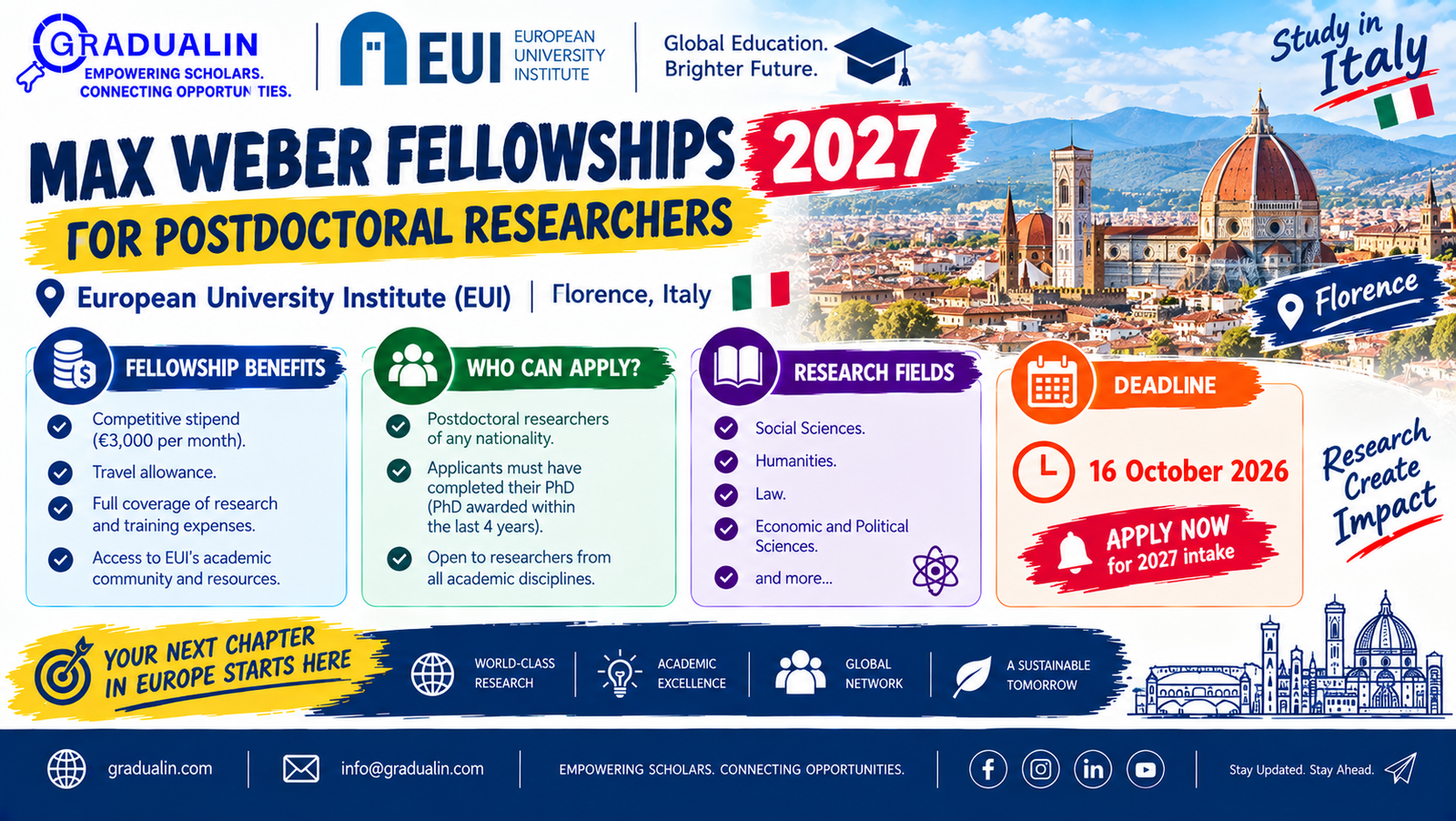
The Max Weber Fellowships 2027 pay early-career researchers €2,500 a month, plus health insurance and a research fund, to spend one or two years at the European University Institute (EUI) in Florence. It is one of the best-known postdoctoral programmes in the social sciences and humanities in Europe, and it is open to applicants of any nationality, including Pakistani and South Asian PhD holders.
It is also extremely selective. This guide covers what the fellowship pays, who is eligible, what the 2-page proposal needs to show, how to manage your referees with only a few days left, and an honest view of whether it’s worth your time compared with other postdoc options.
| University/Organization | European University Institute (EUI), Max Weber Programme |
| Country | Italy (Florence) |
| Degree/Level | Postdoctoral (PhD within the last 5 years) |
| Funding Type | €2,500/month grant + health insurance + €1,500 research fund |
| Deadline | 16 October 2026, 14:00 CEST |
| Open To | International Students Worldwide |
| Pakistani Students Eligible | Yes (no nationality restriction) |
| Official Link | Apply Here |
🎓 About the Max Weber Fellowships 2027
The European University Institute is an international postgraduate and research institution set up by EU member states, based in the hills of Fiesole above Florence. Its Max Weber Programme (MWP) is one of the largest postdoctoral programmes in the social sciences and humanities in the world. Each year it hosts a cohort of around 65 fellows in Economics, History, Law, Political and Social Sciences, the Robert Schuman Centre and the Florence School of Transnational Governance.
What makes the programme different is that it isn’t only a research grant. Fellows also take part in Academic Practice activities: training in teaching, presenting, publishing, and preparing for the academic job market. In other words, it is designed to turn a new PhD into a competitive candidate for faculty jobs.
How does it compare? The EU’s Marie Skłodowska-Curie (MSCA) Postdoctoral Fellowships generally pay more, but they require you to find a host supervisor and write a much longer proposal. The Humboldt Research Fellowship in Germany accepts applications year-round but also needs a host. The Max Weber application is shorter by comparison: a 2-page proposal and a 1-page statement, with no host to arrange. The trade-off is very tough competition, with a reported acceptance rate of under 2%.
💰 Benefits and Funding
- 💶 Monthly grant: €2,500, plus family allowances where applicable
- 🏥 Health insurance for the length of the fellowship
- ✈️ Personal mission and research fund: €1,500 for conferences, archives and fieldwork
- 👩🏫 Second-year option: a part-time assistant-professor contract worth about €850 net on top, in departments that offer 2-year fellowships
- 👶 Parental leave policy for fellows
- 📆 Duration: 1 or 2 years depending on the department; a 3rd year only in exceptional cases
- 🎓 Academic Practice training: teaching, publishing and job-market preparation
Is €2,500 enough to live on in Florence? For a single researcher, yes, comfortably. A room in a shared flat often costs about €600–900 a month, and a small studio more (approximate; verify current rents). With a family to support, the family allowance becomes important, so check the exact amounts in the fellowship rules.
For Pakistani readers, €2,500 a month is roughly PKR 750,000–800,000 at current exchange rates. That is far above typical postdoc pay in Pakistan, but Florence costs are in euros too, so compare it with local expenses rather than with home salaries (verify current exchange rate).
✅ Eligibility Criteria
- Nationality: open to applicants from anywhere in the world
- PhD timing: your PhD must have been awarded within the last 5 years, OR you must have official approval to defend by 1 September 2027, with the defence held no later than 31 December 2027
- Extensions to the 5-year rule are possible for maternity or paternity leave, illness or mandatory military service. Explain this in the “Additional Notes” field
- Fields: Economics, History, Law, Political and Social Sciences, plus the Robert Schuman Centre and the School of Transnational Governance
- English: the programme expects C1-level English (CEFR). No specific test is named, so check whether you need to provide a certificate (verify on official website)
- Residence: fellows must live in the Florence area during the fellowship
- Preference goes to candidates who have just finished their PhD, haven’t held a postdoc before, and/or are on the academic job market
Pakistani students: eligible. There is no nationality restriction, and a PhD from a Pakistani university (HEC-recognised or otherwise) is not excluded. Pakistan isn’t on the EUI’s “Widening countries” list, which receives extra encouragement, and there’s no special national grant for Pakistan as there is for Finland, Germany, Greece, Poland and Japan.
✅ Strong Candidates
- Recent PhDs (or near-final candidates) in economics, law, history, political science or sociology
- Researchers with at least one paper in, or under review at, a respected international journal
- Applicants with a clear 12–24 month research plan that has a European or comparative angle
- Pakistani and South Asian scholars working on governance, migration, trade, constitutional law or South Asian history, which are areas with strong EUI interest
❌ Not the Right Fit If
- Your PhD is in the natural sciences, engineering, medicine or computer science
- You finished your PhD more than 5 years ago and don’t qualify for an extension
- You can’t relocate to Florence for the full fellowship
- Your referees can’t upload letters by 16 October
On competitiveness: South Asian applicants are usually up against PhDs from leading European and American universities. What makes the difference isn’t your university’s name. It’s a sharp, realistic proposal and evidence that you are already publishing. A well-placed article from a Pakistani PhD will count for more than a vague proposal from a famous university.
📚 Departments and Research Areas
Fellows are hosted by one of the EUI’s academic units, and the unit decides whether the fellowship lasts 1 or 2 years:
- Department of Economics: macro, micro, econometrics and applied economics
- Department of History: European, global and transnational history
- Department of Law: EU, international, comparative and constitutional law
- Department of Political and Social Sciences: political science, sociology and international relations
- Robert Schuman Centre for Advanced Studies: policy-oriented interdisciplinary research
- Florence School of Transnational Governance: global governance and policy
Before writing your proposal, read the profiles of faculty in your chosen unit. Mentioning one or two named faculty members whose work connects with yours shows you’ve chosen the EUI deliberately and not as part of a mass application (verify current faculty on official website).
📄 Required Documents
- CV with a full list of publications (PDF)
- Academic career statement (1 page): why the Max Weber Programme and its Academic Practice activities would help you, your research and teaching interests, and your career plans
- Research proposal (2 pages): clearly structured with realistic goals. For a 24-month fellowship, split your plan into months 1–12 and months 13–24. It must also include a reflection on how gender and diversity relate to your research, which many applicants forget
- 2–3 academic referees: they submit online by the deadline. Letters from current EUI professors are not accepted
- PhD proof: your degree certificate, or official confirmation of your defence date if you haven’t defended yet (verify on official website)
A common misunderstanding for Pakistani applicants: HEC attestation is not part of the EUI application. You may need attested documents later for your Italian visa, so start that process early if you are shortlisted.
🧭 Step-by-Step Application Process
- Today: confirm 2–3 referees. Email them your CV, a draft proposal and the deadline: 16 October 2026, 14:00 CEST (17:00 Pakistan time).
- Create your account on the EUI application portal and enter your referees’ details early, because the system sends them the upload request.
- Choose your host unit and check whether it offers 1- or 2-year fellowships.
- Write the 2-page proposal: the research question, why it matters, your method and sources, realistic outputs (for example, two papers or a book proposal), a timeline, and the gender/diversity reflection.
- Write the 1-page career statement, linking your plans to the Academic Practice activities.
- Upload your CV and documents, then submit at least a day early.
- Check that every reference has arrived, and remind referees 48 hours before the deadline.
Practical tip: successful proposals usually name concrete outputs, such as “submit paper X to journal Y by month 10”, rather than broad goals like “deepen my research”. Selection committees fund a plan they believe you can deliver within the fellowship, not a lifetime research agenda.
📅 Important Dates
| Milestone | Date |
|---|---|
| Application deadline | 16 October 2026, 14:00 CEST |
| Reference letters due | 16 October 2026, 14:00 CEST |
| Selection results | Early 2027 (verify on official website) |
| Defence approval needed by | 1 September 2027 |
| Fellowship starts | 1 September 2027 |
| Latest PhD defence date | 31 December 2027 |
📌 Bookmark this page. We update deadlines as soon as changes are announced.
🌟 Why Apply
A Max Weber Fellowship is a recognised signal on an academic CV. Many former fellows go on to faculty jobs across Europe and beyond, and the programme’s job-market training is aimed directly at that next step. You also gain a network of around 65 peers from dozens of countries, plus some of Europe’s leading faculty in your field.
The application itself is a lot less work than MSCA or ERC-style proposals, so even with an acceptance rate under 2%, the effort-to-reward ratio is reasonable if you meet the profile. For more European options, see our Study in Italy guide and our list of funded PhD positions in Switzerland. You can also browse all Scholarships, research and academic roles in Jobs & Internships, proposal and CV guides in Guidelines & Resources, and call-for-papers listings in Events & Conferences.
❓ Frequently Asked Questions
These questions are based on what students most commonly search about this program.
Q: Can Pakistani PhD holders apply for the Max Weber Fellowship?
Yes. The fellowship is open to all nationalities, and a PhD from a Pakistani university is not excluded. You must have finished your PhD within the last 5 years, or be scheduled to defend by 31 December 2027 with approval by 1 September 2027.
Q: How much does the Max Weber Fellowship pay?
€2,500 per month, plus family allowances where applicable, health insurance and a €1,500 research and mission fund. Fellows on a 2-year fellowship can take a part-time assistant-professor contract in the second year, worth about €850 net extra.
Q: Can I apply before my PhD defence?
Yes, if you have official approval to defend by 1 September 2027 and the defence takes place no later than 31 December 2027.
Q: Do I need IELTS for the Max Weber Fellowship?
The programme expects C1-level English (CEFR) but doesn’t name a specific test. Check the current call for whether you need to show proof, such as an English-medium PhD (verify on official website).
Q: How many reference letters do I need, and when are they due?
2 to 3 academic referees, who submit online by the same deadline: 16 October 2026, 14:00 CEST. References from current EUI professors are not accepted.
Q: Is the Max Weber Fellowship open to science or engineering PhDs?
No. It is limited to economics, history, law, political and social sciences, and related interdisciplinary units at the EUI.
🔗 Official Source
📊 Summary Table
| Detail | Information |
|---|---|
| Institution | European University Institute, Florence, Italy |
| Programme | Max Weber Fellowships 2027–2028 |
| Level | Postdoctoral (PhD within 5 years) |
| Funding | €2,500/month + health insurance + €1,500 research fund |
| Duration | 1 or 2 years (by department) |
| Cohort Size | About 65 fellows; acceptance rate under 2% |
| Fields | Economics, History, Law, Political & Social Sciences, RSC, STG |
| Deadline | 16 October 2026, 14:00 CEST |
| Start Date | 1 September 2027 |
| Pakistani Students Eligible | Yes |
| Official Link | eui.eu: Max Weber Fellowships |
Stay updated with the latest scholarships, jobs, and opportunities at Gradualin.com — your trusted guide to studying abroad for free.


One Response