

📅 Last Updated: October 2026
OIST PhD Admissions 2027 — Fully Funded PhD in Japan
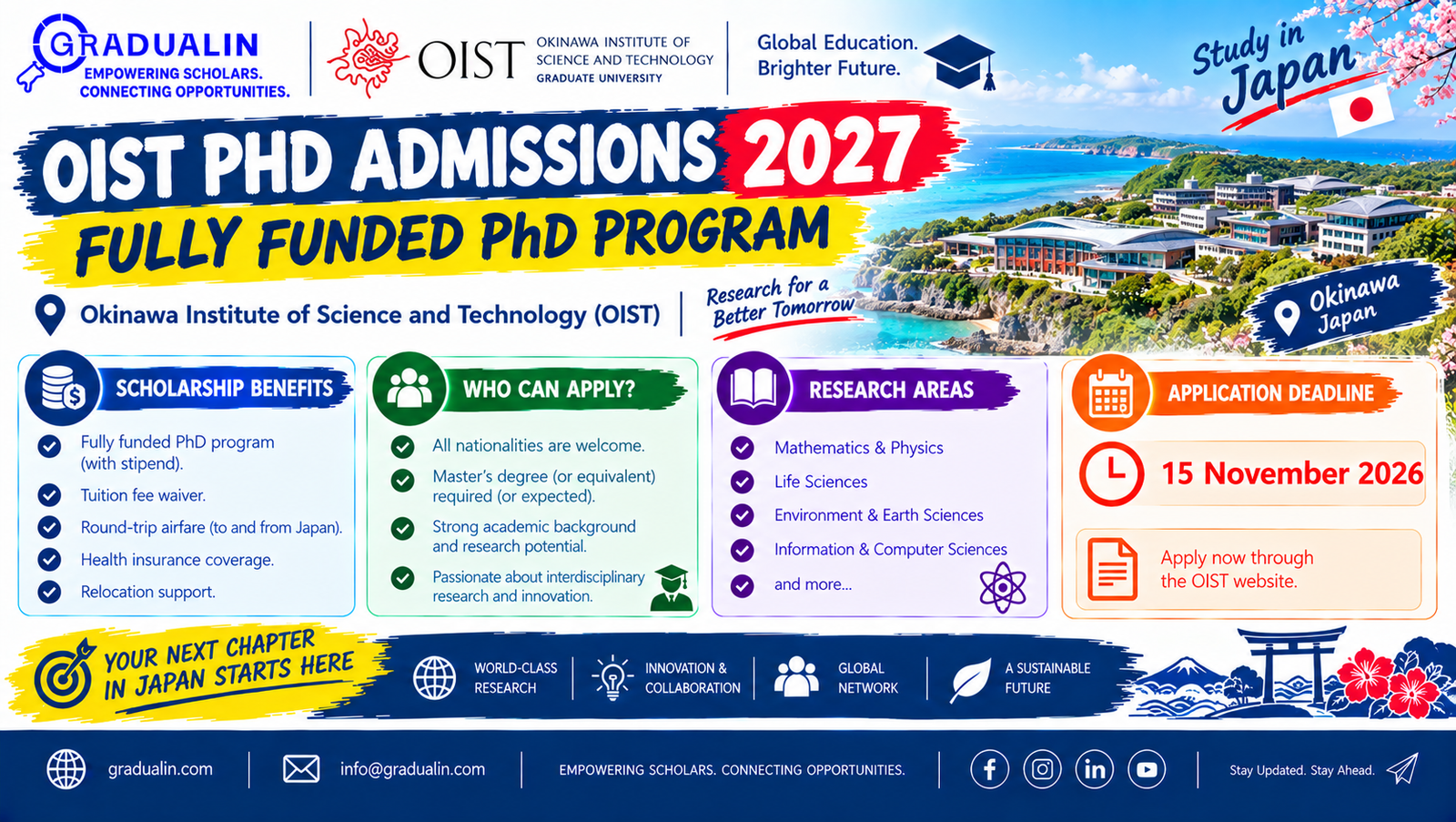
The Okinawa Institute of Science and Technology (OIST) offers a fully funded five-year PhD, taught entirely in English. Financial support starts at about ¥2.6 million a year and rises to about ¥3.6 million, with subsidised campus housing on top. Unusually, you can apply with only a bachelor’s degree.
Applications for the 2027 intake close on 15 November 2026. OIST recruits worldwide, and Pakistani and South Asian science graduates can apply on equal terms. This guide explains what the funding is worth in practice, how the selection process and Admissions Workshop work, and how to make your 800-word statement count.
| University/Organization | Okinawa Institute of Science and Technology Graduate University (OIST) |
| Country | Japan (Onna, Okinawa) |
| Degree/Level | PhD (5 years), open to bachelor’s or master’s holders |
| Funding Type | Fully Funded: about ¥2.6M/year rising to about ¥3.6M + subsidised housing |
| Deadline | 15 November 2026, 23:59 JST |
| Open To | International Students Worldwide |
| Pakistani Students Eligible | Yes |
| Official Link | Apply Here |
🎓 About the OIST PhD Programme 2027
OIST is a young, research-intensive graduate university on Okinawa’s west coast, founded with support from the Japanese government. It has no traditional departments. Faculty in physics, chemistry, biology, neuroscience, marine science, mathematics and computational science share facilities and work across fields, and English is the official language on campus.
The PhD is a single interdisciplinary programme. Students begin with lab rotations in different research units before choosing a thesis lab, then follow an individually tailored curriculum. Because rotations come first, you don’t have to commit to a supervisor before you arrive. That is very different from most PhD systems.
How it compares with MEXT: Japan’s government MEXT scholarship is the usual route for Pakistani students, but it requires an embassy or university nomination and a supervisor in advance. OIST’s support is higher than a typical MEXT doctoral stipend, you apply directly to the university, and rotations let you choose your lab after arriving. The trade-off is that OIST is highly selective and focused on the natural sciences.
💰 Benefits and Funding
- 💴 Financial support: about ¥2.6 million a year (taxable) in year 1, rising with progress to about ¥3.6 million
- 🎓 Tuition: covered within the support package, either as an amount equal to tuition or as a tuition waiver (verify current arrangement)
- 🏠 Subsidised housing in the Campus Village: about ¥21,600 a month for a furnished single apartment, or ¥18,000 a month per person in a shared two-room apartment
- ✈️ Conference and research travel budgeted separately
- 🛡️ Personal accident and liability insurance for students
- 👶 On-campus Child Development Center for students with families
- 📆 Duration: 5 years
What it’s worth: ¥2.6 million a year is about ¥216,000 a month before tax. That’s roughly PKR 380,000–420,000 a month (approximate; check today’s rate). Because the support is taxable and Japan has social-insurance contributions, your take-home pay will be lower than the gross figure (verify current deductions with OIST).
Campus rent of around ¥21,600 a month is very low for Japan, so even after deductions most single students live comfortably and can save.
✅ Eligibility Criteria
- Degree: a bachelor’s or master’s degree, or expected completion before your enrolment date
- Nationality: open to applicants from any country
- English: if your previous degree was not taught or examined in English, you need a TOEFL iBT or IELTS score from the last two years
- Recommendations: 2 to 5 letters in English from faculty-level recommenders
- Field: a background in the natural sciences, mathematics, engineering or computational science, in line with OIST’s research areas
English test status: OIST says a TOEFL or IELTS score is needed only if your previous degree wasn’t taught or examined in English. Pakistani BS or MS graduates from English-medium programmes may be exempt. Prepare a letter from your university confirming the medium of instruction and examination.
Pakistani students: eligible. There are no nationality restrictions.
✅ Strong Candidates
- BS or MS graduates in physics, chemistry, biology, neuroscience, mathematics, marine science or computer science with real research experience
- Applicants with a thesis, a publication, or a strong research internship (for example, through the OIST Research Internship)
- Pakistani graduates of English-medium programmes with strong recommendation letters from active researchers
- Curious, interdisciplinary students who would value lab rotations
❌ Not the Right Fit If
- Your field is in the humanities, business or the social sciences
- You want a master’s degree, because OIST offers only the PhD
- You can’t commit to five years in Okinawa
- You can’t get at least two faculty-level recommendation letters
On competitiveness: OIST attracts applicants from top universities worldwide, so the bar is high. Pakistani applicants succeed with evidence of independent research (a thesis, a paper or an internship) and recommenders who can describe their research ability in detail. Grades alone rarely carry an OIST application.
📚 Research Areas
OIST’s research units cover a broad range of science, including:
- Physics: quantum, condensed matter and fluid physics
- Chemistry and materials science
- Neuroscience: one of OIST’s best-known strengths
- Molecular, cell and developmental biology
- Marine science and ecology, helped by Okinawa’s coral reefs
- Mathematics and computational science, including AI and machine learning
- Environmental and Earth sciences
Browse the faculty and research units on OIST’s website before applying, and name two or three whose work interests you in your Statement of Purpose. You aren’t required to secure a supervisor, but showing that you know who works on what makes a strong impression.
📄 Required Documents
- Transcripts and diploma from your previous degrees. Provisional documents are acceptable if you are still studying
- Statement of Purpose (maximum 800 words)
- Curriculum vitae
- 2–5 recommendation letters in English from faculty-level recommenders
- TOEFL iBT or IELTS score, if your degree wasn’t taught or examined in English
- Passport information and scan
- Recent ID photo
- Application fee: ¥5,000 (non-refundable)
Note for Pakistani applicants: HEC attestation isn’t listed for the OIST application. Your university’s own transcripts and degree are what OIST asks for at this stage. Attested copies may be needed later for your Japanese visa or enrolment (verify with OIST after admission).
🧭 Step-by-Step Application Process
- Explore OIST’s research units and shortlist the faculty whose work fits your interests.
- Ask 2–5 recommenders early. They will submit their letters through the online system.
- Write your Statement of Purpose (max 800 words), covering your research experience, motivation and fit with OIST’s interdisciplinary model.
- Apply online through the OIST Graduate School application portal and pay the ¥5,000 fee.
- Submit by 15 November 2026, 23:59 JST (19:59 Pakistan time).
- If shortlisted, take part in the Admissions Workshop (18 January – 7 February 2027), which includes interviews and meetings with faculty (verify the format with OIST).
- Receive your result in mid-February 2027 and choose a start date: 1 May 2027, 1 September 2027 or 1 January 2028.
Practical tip: make your Statement of Purpose specific. Describe one research project you did, what you contributed, what went wrong and how you solved it, and why OIST’s rotations suit your next step. Reviewers read hundreds of generic “passionate about science” statements, and specific detail is what stands out.
📅 Important Dates
| Milestone | Date |
|---|---|
| Application window opened | 31 July 2026 |
| Application deadline | 15 November 2026, 23:59 JST |
| Admissions Workshop (shortlisted applicants) | 18 January – 7 February 2027 |
| Final results | Mid-February 2027 |
| Enrolment options | 1 May 2027 · 1 September 2027 · 1 January 2028 |
📌 Bookmark this page. We update deadlines as soon as changes are announced.
🌟 Why Apply
Few PhD programmes in Asia combine full funding at this level, an all-English campus, direct entry after a bachelor’s degree and lab rotations before you commit to a supervisor. Add OIST’s shared research facilities and international faculty, and it gives the kind of training normally associated with top US programmes, in a quieter coastal setting.
If you want to try OIST first, its Research Internship is a well-known route into the PhD, and established researchers can look at the OIST Visiting Scholar Program. For other funded options in Japan, see our KUT SSP PhD Scholarship guide. You can also browse all Scholarships, research roles in Jobs & Internships, SOP-writing help in Guidelines & Resources, and science conferences in Events & Conferences.
❓ Frequently Asked Questions
These questions are based on what students most commonly search about this program.
Q: Can Pakistani students apply for the OIST PhD?
Yes. OIST accepts applicants of any nationality with a bachelor’s or master’s degree. Pakistani applicants from English-medium programmes may not need IELTS or TOEFL. Provide proof that your degree was taught and examined in English.
Q: Can I apply to OIST with only a bachelor’s degree?
Yes. OIST’s five-year PhD accepts bachelor’s degree holders, and those expecting to graduate before enrolment.
Q: How much does an OIST PhD student receive?
About ¥2.6 million a year (taxable) in the first year, rising to about ¥3.6 million with progress, plus subsidised campus housing at about ¥18,000–21,600 a month.
Q: Do I need IELTS or TOEFL for OIST?
Only if your previous degree was not taught or examined in English. In that case, submit a TOEFL iBT or IELTS score from the last two years.
Q: Do I need a supervisor before applying?
No. OIST students start with lab rotations and choose a thesis lab after arriving. Mentioning faculty you’d like to work with in your statement still helps.
Q: What is the OIST Admissions Workshop?
It is the final selection stage for shortlisted applicants, held between 18 January and 7 February 2027, and includes interviews and meetings with faculty. Final results are released in mid-February.
🔗 Official Source
📊 Summary Table
| Detail | Information |
|---|---|
| University | Okinawa Institute of Science and Technology (OIST), Japan |
| Programme | Interdisciplinary PhD, 5 years, in English |
| Funding | About ¥2.6M/year rising to about ¥3.6M (taxable); tuition covered (verify arrangement) |
| Housing | Campus Village: about ¥18,000–21,600/month |
| Eligibility | Bachelor’s or master’s holders, any nationality |
| English | TOEFL iBT or IELTS only if your degree wasn’t taught or examined in English |
| Documents | Transcripts, 800-word SOP, CV, 2–5 recommendations, passport, photo |
| Application Fee | ¥5,000 |
| Deadline | 15 November 2026, 23:59 JST |
| Admissions Workshop | 18 January – 7 February 2027 |
| Start Options | May 2027 · September 2027 · January 2028 |
| Pakistani Students Eligible | Yes |
| Official Link | oist.jp |
Stay updated with the latest scholarships, jobs, and opportunities at Gradualin.com — your trusted guide to studying abroad for free.


One Response