
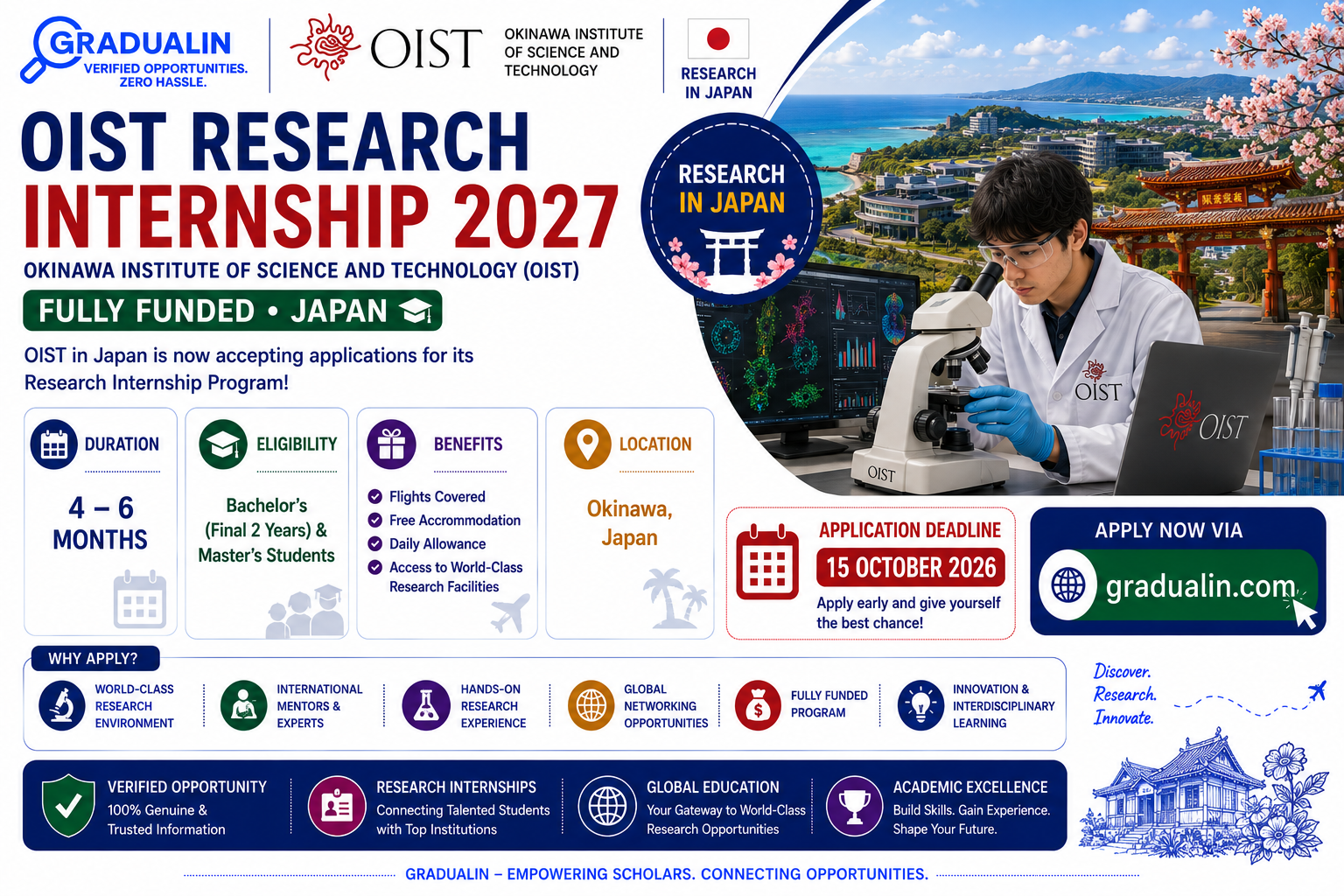
OIST Research Internship 2027 — Paid Program in Japan, No IELTS Required
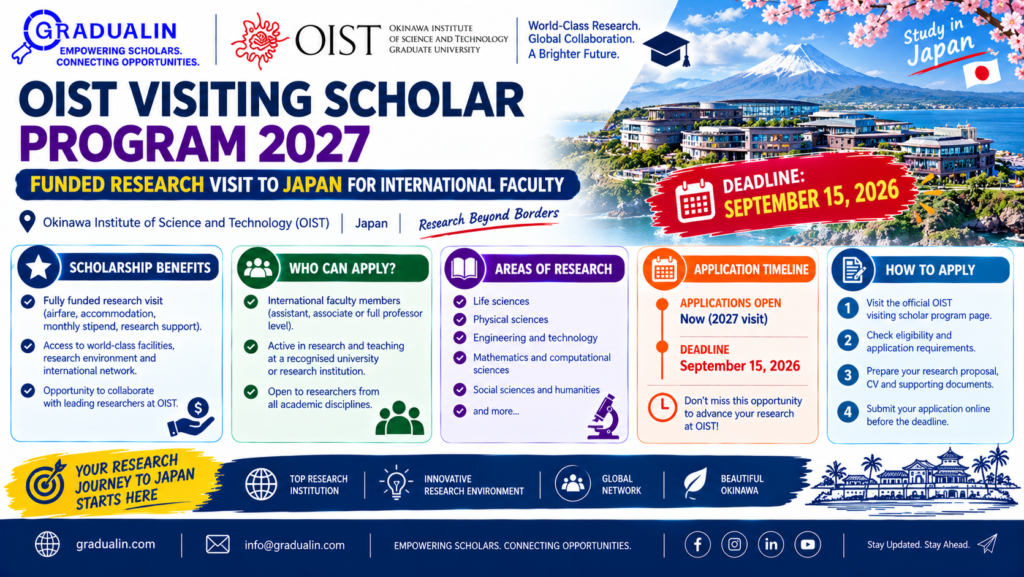
One of the most distinctive paid research internships available to international science students, the OIST Research Internship places you inside an active laboratory at the Okinawa Institute of Science and Technology — a privately funded, globally ranked university situated on a cliff above the East China Sea in Japan. The Spring 2027 round is opening around the end of July 2026, making this an immediate opportunity to act on.
This article covers everything you need to know before applying: what the program actually pays, who genuinely qualifies, how the application is evaluated, and whether it is the right move for your specific stage of research. The information here goes beyond what the official page tells you.
| Detail | Information |
| Institution | Okinawa Institute of Science and Technology (OIST) |
| Country | Japan (Okinawa) |
| Level | Bachelor’s (final 2 years), Master’s, or recent graduate |
| Funding Type | Partial support — stipend, accommodation, flights, shuttle pass |
| Spring 2027 Deadline | October 15, 2026, 23:59 JST |
| Open To | International students worldwide |
| English Test | Not required (optional) |
| Application Fee | 5,000 JPY (non-refundable) |
| Official Link | Apply Here |
🎓 About the OIST Research Internship
OIST is not a conventional Japanese university. It operates in English, recruits almost entirely from outside Japan, and receives the majority of its funding directly from the Japanese Cabinet Office rather than through the standard national university system. That structure gives it unusual freedom — no rigid departmental silos, no pressure to keep research within traditional boundaries.
The Research Internship places students for 4 to 6 months inside one of OIST’s research units, working directly under a faculty supervisor on a live project. Fields covered include physics, chemistry, mathematical and computational sciences, marine sciences, neuroscience, molecular and cellular biology, environmental and ecological science, and quantum science.
Unlike most university internship programs, this one has a concrete pathway dimension: interns who later apply to the OIST PhD Program within one year may count their internship as one of the three required lab rotations. That is a meaningful structural advantage that programs like the RIKEN internship or university-specific exchange programs generally do not offer.
The campus hosts over 1,100 staff and students from more than 70 countries. For students seeking international lab exposure early in their research career, the environment is genuinely cosmopolitan — not performatively so.
🎓 Benefits and Support Package
The OIST Research Internship is partially funded — it is not a scholarship and does not cover all costs. What OIST confirms:
- Internship allowance of 2,400 JPY per working day (approximately 48,000–52,800 JPY per month depending on working days — verify current rate on the official site)
- One direct round-trip air ticket for travel closest to the internship term dates
- Furnished accommodation on or off campus, funded by OIST or the hosting research unit
- OIST Shuttle Bus Pass for daily transport around the campus and surrounding area
- Administrative support for visa processing, including Certificate of Eligibility (CoE) acquisition and registration procedures
What this does not cover: the application fee of 5,000 JPY (non-refundable under all circumstances), dependents or family members, and any personal costs beyond the daily allowance. Students from Japanese universities must also arrange their own accident and liability insurance (Gakkensai/Gakkenbai or equivalent) before arrival.
The daily allowance is modest by Japanese cost-of-living standards. Okinawa is less expensive than Tokyo or Osaka, but students should budget carefully for food and local transport not covered by the shuttle pass.
🎓 Eligibility Criteria
- Currently enrolled in the final two years of a bachelor’s degree, or in any year of a master’s degree, at a university, college, junior college, or vocational school — in Japan or overseas
- Recent graduates with a BSc or MSc are also eligible
- If you will be in your final two years of a bachelor’s by the start of the internship, you qualify to apply now
- Home institution approval is required for currently enrolled students
- Academic background must be appropriate for the research unit you are applying to
- Current or graduated PhD students are not eligible
- Those wishing to collaborate rather than learn should explore OIST Workshops or Careers instead
- English test score is NOT required — IELTS or TOEFL may be uploaded optionally if you feel it strengthens your file
- No nationality restrictions are stated; OIST explicitly encourages applications from women and underrepresented groups
🎓 Who Should Apply — and Who Probably Shouldn’t
✅ Strong fit:
- Final-year bachelor’s or current master’s students in STEM who want hands-on laboratory experience at a world-class facility
- Students seriously considering applying to OIST’s PhD program and wanting to test whether the environment suits them before committing
- Researchers who want to pick up a specific technique or methodology not available at their home institution
- Applicants who thrive in interdisciplinary, English-language environments with international colleagues
- Students whose home institutions do not offer access to specialist equipment (electron microscopy, marine research stations, quantum computing infrastructure)
❌ Probably not the right fit:
- PhD students — you are explicitly ineligible
- Students who need the placement to be cost-neutral; the daily allowance covers basics but not comfortably
- Applicants who cannot obtain home institution approval for a 4–6 month absence
- Those looking for a short-term programme — the minimum commitment is 4 months (120 days); there is no shorter version
- Students hoping for a remote or hybrid arrangement — this is an in-person, on-campus laboratory placement in Okinawa, Japan
🎓 Available Research Fields
OIST’s research spans multiple STEM disciplines under a deliberately non-departmental structure. The fields available to interns include:
- Physics (including quantum science and quantum computing)
- Chemistry
- Mathematical and Computational Sciences
- Marine Sciences (with access to the OIST Marine Science Station)
- Neuroscience
- Molecular, Cellular, and Developmental Biology
- Environmental and Ecological Science
The research unit you apply to is central to your application — OIST places you based on fit with a specific lab, not a general field category. Before applying, check the RI Faculty and Project Availability page to confirm which units are currently accepting interns. Not all units recruit every round.
This is a critical step that many applicants skip. Applying to units with no available capacity wastes your recommenders’ time and your application fee.
🎓 Required Documents
- Academic transcripts — current transcript plus any prior degree transcripts, in PDF; unofficial copies accepted; non-English transcripts must include an English explanation
- Diploma or certificate of enrollment — completed degree diplomas if applicable, or a certificate of enrollment showing expected graduation date if still enrolled
- Statement of Purpose — maximum 400 words (2,500 characters); must address fit with your chosen research unit(s), what you aim to accomplish, and how the internship connects to your career plans; if applying to multiple units, address each within the single statement
- CV — any standard academic format; include academic background, research experience, skills, and accomplishments
- Recommendation letters — 1 to 3 letters from professorial-level faculty only; letters from lab members, postdocs, or industry supervisors are not accepted; at least one letter must be received in the system before your application can be submitted
- Passport — passport number and scanned photo page required; government-issued ID accepted if you do not yet have a passport
- ID photo — recent (within 3 months), front-facing, passport-style
- English proficiency score — optional, not required
🎓 Step-by-Step Application Process
- Check unit availability — visit the RI Faculty and Project Availability page before anything else; confirm your target unit(s) are open for the Spring 2027 round
- Create your account on the OIST application portal — you can save and return, but do not leave registration to the last week
- Contact your recommenders early — at least one letter must arrive in the system before your application can be submitted; give recommenders a minimum of 4–6 weeks, and confirm they are professorial-level; a letter from a postdoc will disqualify that reference
- Draft your Statement of Purpose — 400 words is tight; use it to make a direct argument for why your existing skills are relevant to the specific research unit, not a general statement of ambition. The most common weakness in STEM internship SOPs is describing what you want rather than demonstrating what you can contribute
- Compile and upload documents — prepare everything in English, convert to PDF, and upload through the portal; a desktop computer is recommended over mobile
- Pay the 5,000 JPY application fee — non-refundable under any circumstance; students from sanctioned countries facing payment difficulties should contact OIST via the Contact Us page before the deadline
- Submit before October 15, 2026, 23:59 JST — note the time zone; 23:59 JST is earlier in the day for most international applicants
For the Jobs & Internships category, the OIST Research Internship stands apart because it combines genuine research involvement with a clearly structured pathway to PhD consideration — which is rare for a non-degree placement.
🎓 Important Dates
| Round | Application Deadline | Results | Internship Period |
| Fall 2026 | April 15, 2026, 23:59 JST | Mid-June 2026 | Oct 1, 2026 – Mar 31, 2027 |
| Spring 2027 | October 15, 2026, 23:59 JST | Mid-December 2026 | Apr 1 – Sep 30, 2027 |
The Fall 2026 deadline has already passed. The Spring 2027 round is the active window, with applications opening around the end of July 2026.
Schedule is tentative and subject to change. Bookmark this page and check back for updates.
🎓 Why Apply — Why OIST and Okinawa
OIST consistently ranks among the top research institutions in the world by citation impact per paper — a measure of research quality that rewards depth over volume. For a postgraduate student or final-year bachelor’s student, working in that environment for 4–6 months produces the kind of observable research output (lab techniques, co-authored reports, conference exposure) that strengthens a PhD application considerably.
Okinawa itself adds a dimension most laboratory-focused programmes miss. The island sits at the intersection of subtropical marine ecosystems and advanced STEM infrastructure — OIST’s Marine Science Station gives interns in relevant fields direct ocean access that no landlocked campus can replicate. The pace of life is slower than Tokyo, costs are lower, and the cultural environment is a genuine blend of Japanese, Ryukyuan, and international influences.
For students interested in Asia-based Scholarships or research programmes, this is also one of the few Japan-based opportunities with an almost entirely English-language working environment — no Japanese language ability is expected or required.
You may also want to explore the Top 10 Fully Funded Scholarships in Asia 2027 for a broader view of funded research and study opportunities across the region.
Gradualin Editor’s Note: The OIST Research Internship is a strong choice for students who are already doing research and want to upgrade their environment, not for students looking for their first research exposure. The 400-word SOP requirement and the need for professorial recommendations make this more competitive than a typical internship application — expect to spend real time on it. The lab-rotation equivalency for future PhD applicants is genuinely valuable and not widely advertised; if you are considering OIST’s PhD programme, this path is significantly more strategic than a cold application.
🎓 Frequently Asked Questions
These questions are based on what students most commonly search about this program.
Can I apply without IELTS or TOEFL? Yes. The OIST Research Internship does not require an English proficiency test. You may upload a score voluntarily if you believe it helps your case, but it will not compensate for weaknesses elsewhere in your file. The interview and SOP are the primary language indicators used in evaluation.
Is the OIST internship fully funded? No — it is partially funded. OIST provides a daily allowance (2,400 JPY per working day), one round-trip air ticket, furnished accommodation, and a shuttle bus pass. It does not cover the 5,000 JPY application fee, personal expenses, or dependent family members. Students should plan for a modest out-of-pocket cost.
What happens if I want to apply to the OIST PhD after the internship? Interns who apply to the OIST PhD Program within one year of completing the internship may request that their placement count as one of the three required lab rotations. This requires that you declare the intent at the start of the internship and meet the assessment criteria. It is one in-field rotation — two additional rotations (including one out of field) are still required in the PhD programme itself.
Can I apply to more than one research unit? Yes, and you are encouraged to. Multiple units can be listed in a single Statement of Purpose — address your fit and interest for each unit briefly within the 400-word limit. However, always check availability for each unit on the RI Faculty and Project Availability page before naming them.
I am from a country under international sanctions and cannot pay the fee online. What should I do? Contact OIST directly through the Contact Us page and describe your situation before the deadline. Use “Research Internship” as your reason to contact. OIST acknowledges this situation explicitly on its application page and has a process for handling it.
What is the minimum duration and can I do it remotely? The minimum duration is 4 months (120 days) and the maximum is 6 months within a single internship period. The placement is entirely in-person at the OIST campus in Okinawa, Japan. There is no remote or hybrid option.
🎓 Official Source
- Application portal: Apply to OIST Research Internship
- Program description: OIST Research Internship Program Description
- Application guide: Apply to Research Internship
- Faculty availability: RI Faculty and Project Availability
- FAQ: OIST Admissions FAQ
- Contact: OIST Admissions Contact Page
- Address: Okinawa Institute of Science and Technology, 1919-1 Tancha, Onna-son, Kunigami-gun, Okinawa, Japan 904-0495
For broader research and study opportunities, browse the Guidelines & Resources and Events & Conferences sections on Gradualin.
🎓 Summary Table
| Detail | Information |
| Institution | Okinawa Institute of Science and Technology (OIST) |
| Country | Japan (Okinawa) |
| Level | Final 2 years of bachelor’s, any year of master’s, or recent BSc/MSc graduate |
| Funding Type | Partial — stipend, flights, accommodation, shuttle pass |
| Daily Allowance | 2,400 JPY per working day |
| Duration | 4–6 months (minimum 120 days) |
| Spring 2027 Deadline | October 15, 2026, 23:59 JST |
| Results Announced | Mid-December 2026 |
| Internship Period | April 1 – September 30, 2027 |
| Open To | International students worldwide |
| English Test | Not required (optional) |
| Application Fee | 5,000 JPY (non-refundable) |
| PhD Pathway | Internship may count as one lab rotation if PhD application made within 1 year |
| Official Link | Apply Here |
Related reading:
- Top 10 Fully Funded Scholarships in Asia 2027
- Fully Funded PhD Scholarships in the UK 2026
- Fully Funded PhD Positions in Switzerland 2026
Stay updated with the latest scholarships, jobs, and opportunities at Gradualin.com — your trusted guide to studying abroad for free.
Author: Faseeh Sultan — MSIT, PhD Scholar | 7 Years in Education