
📅 Last Updated: 1 November 2026
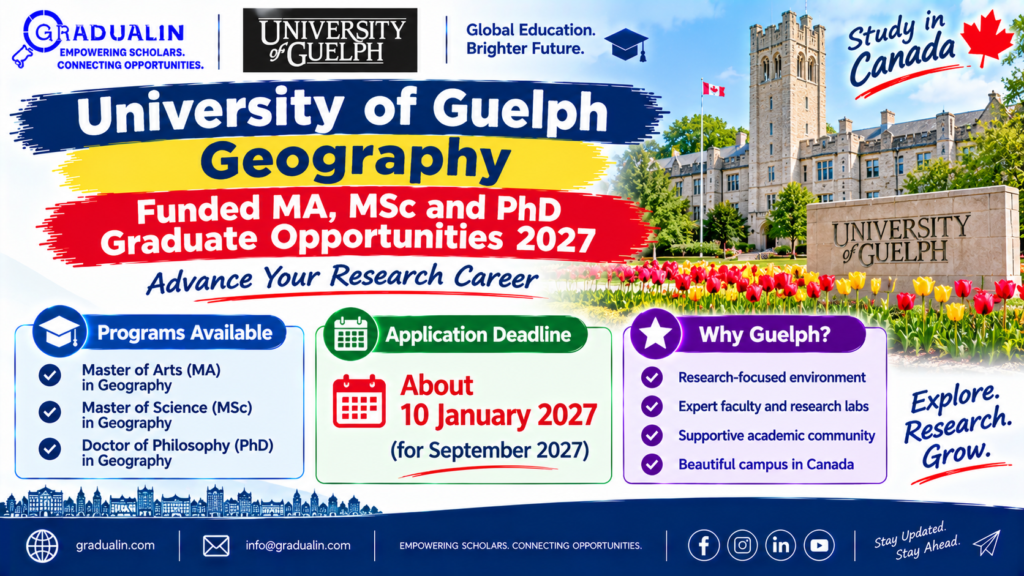
Guelph Geography Grad Positions 2027 — Funded MA, MSc & PhD
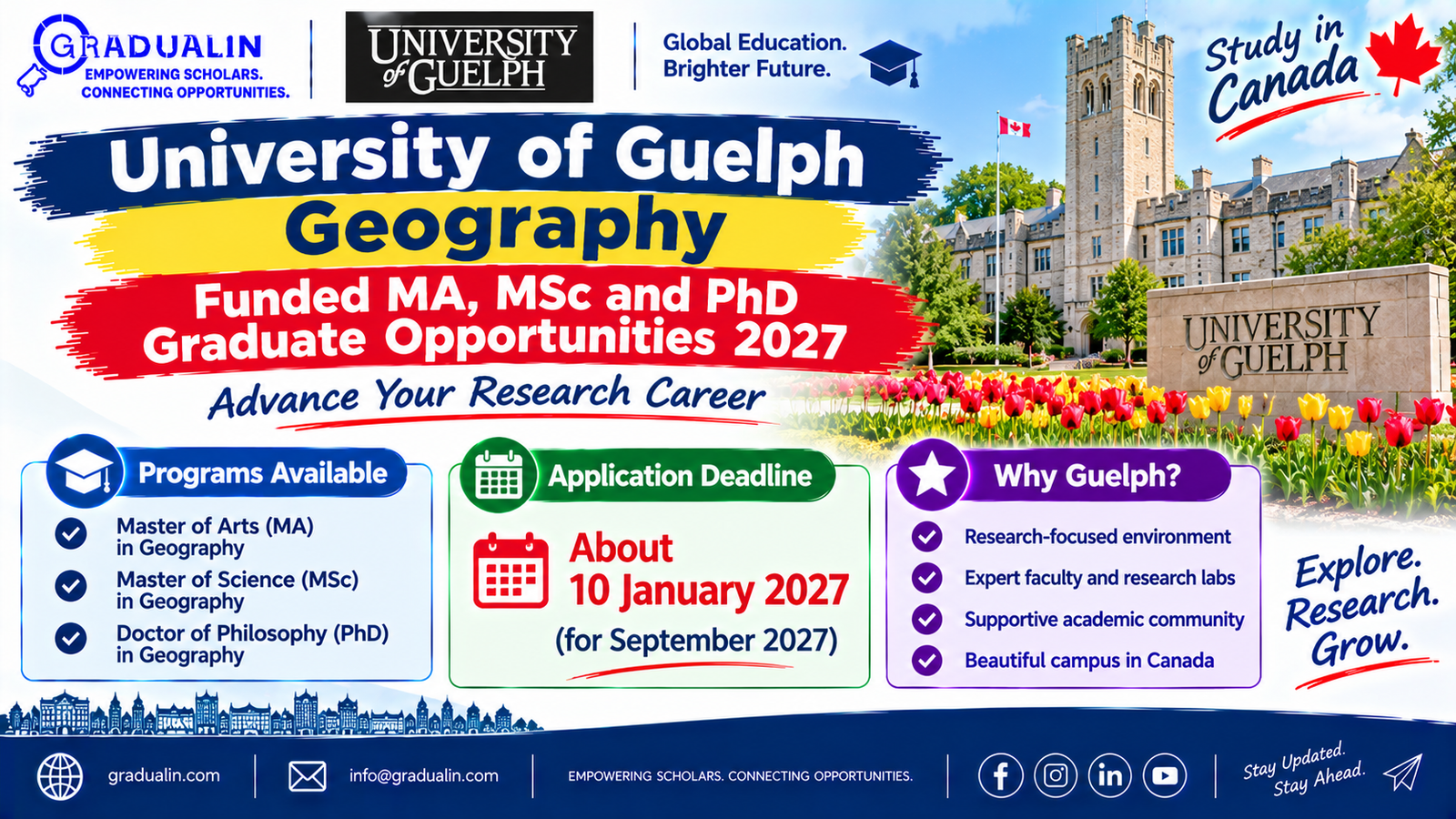
The University of Guelph’s Department of Geography, Environment and Geomatics in Ontario, Canada, publishes a list of supervisors looking for graduate students, and many of the current listings are for Fall 2027. Across 18 faculty members, topics range from satellite remote sensing and hydrology to climate-adaptive farming, food security, conservation, Indigenous partnerships and AI in environmental governance. Full-time students get guaranteed minimum funding: C$20,000 a year for four years at PhD level and C$18,500 for the first three semesters at master’s level. The department’s stated deadline is 10 January each year for September entry, but the first step is finding a supervisor: without one, you won’t receive an offer. This guide organises the supervisors by theme and explains the funding, including what international students need to check.
| 🏛️ University | University of Guelph, Ontario, Canada |
| 🏫 Department | Geography, Environment and Geomatics |
| 🎓 Degrees | MA, MSc, PhD |
| 👩🏫 Supervisors Listed | 18 (not all are recruiting at every level) |
| 💰 PhD Funding | Guaranteed minimum C$20,000/year for 4 years (recent average about C$24,000/year) |
| 💰 Master’s Funding | Guaranteed minimum C$18,500 for semesters 1–3; C$12,000 for semesters 4–5 (recent average about C$36,600 over the programme) |
| ⚠️ International Fees | Extra funding to cover higher fees isn’t guaranteed (2013 policy; confirm with the department) |
| 🎓 Grades | Master’s: at least a B average · PhD: A- average + a recognised master’s |
| 🗣️ English | University of Guelph requirements apply (verify on official website) |
| 📅 Deadline | 10 January for September entry (10 January 2027 for Fall 2027; confirm with the programme office) |
| 🇵🇰 Pakistani Students Eligible | Yes. No nationality limit is listed (except one French-only position), but check the fee gap |
| 🔗 Official Page | Guelph Graduate Research Opportunities |
About the Department and How Funding Works
Guelph’s Department of Geography, Environment and Geomatics brings together physical geographers, GIS and remote sensing specialists, and social scientists who work on environmental governance. Its graduate programmes are research-based, so you join a supervisor’s project or develop your own idea within their field.
The department says it guarantees funding for full-time students, and that actual packages are usually higher than the minimum. Supervisors normally pay part of each package from their research grants. That’s why the department says that if no faculty member has agreed to give your application serious consideration, you won’t receive an offer.
How it compares: this isn’t a single scholarship competition like Guelph’s undergraduate scholarships or a national doctoral award. It’s a supervisor-led route: you’re funded through a mix of assistantships, research grants and awards. A strong match with a professor matters far more than a separate scholarship essay.
👩🏫 Supervisors and Research Areas
| Theme | Supervisor | What They’re Looking For |
|---|---|---|
| Remote sensing, GIS and water | Aaron Berg | PhD or MSc in terrestrial hydrology and remote sensing (soil moisture, freeze-thaw, agricultural land). Several funded positions are typically available |
| Ben DeVries (GEOLab) | PhD: remote sensing of agricultural flooding and precision conservation; PhD: species assembly in dry tropical forests (Summer/Fall 2027) | |
| Wanhong Yang | One PhD and/or one MSc: cost-effectiveness of agricultural conservation programmes, using GIS and watershed modelling | |
| Forests, conservation and ecology | Ze’ev Gedalof | Forest ecology, climate change and wildfire |
| Faisal Moola | MSc and PhD: conservation policy, forest management, plant ecology and ethnobotany with Indigenous partners (field work expected) | |
| Travis Steffens | PhD: lemur species richness and dry forest dynamics in Madagascar | |
| Food, farming and communities | Karina Benessaiah | Master’s (Fall 2027): SMEs and biodiversity; climate-adaptive farming; food waste governance in Montreal (French needed for some projects) |
| Sara Edge | 1–2 master’s and possibly one PhD (Fall 2027): food system resilience and immigrant and racialised inclusion in food security | |
| Kate Parizeau | MA only: social dimensions of waste | |
| Environmental governance and society | Ben Bradshaw | MA or PhD: mining governance, Indigenous communities and energy transitions, agri-environmental stewardship |
| Eric Nost | MA: AI and data technologies in environmental governance | |
| Noella Gray | MA or PhD: marine conservation governance, blue economy, island futures | |
| Jennifer Silver | MA or PhD: ocean and fisheries governance, digital technology in environmental change | |
| Robin Roth | MA or PhD: decolonial alternatives in conservation (strong community ties expected) | |
| Health, equity and feminist geography | Diana Lewis | RAs and postdocs: Indigenous value-based environmental health risk assessment |
| Roberta Hawkins | One master’s student: feminist theory, methods and geographies |
Also listed: Jaclyn Cockburn has no current openings but is open to conversations. John Lindsay’s listing (geomorphometry, LiDAR and hydrology, “fully funded” master’s) still says “Fall 2020”, so ask him directly whether it’s current. Contact emails and full descriptions are on the official page.
💰 Funding in Detail
- ✅ PhD guarantee: at least C$20,000 a year for 4 years
- ✅ PhD average (last 3 years, all sources): about C$24,000 a year
- ✅ Master’s guarantee: at least C$18,500 for the first 3 semesters and C$12,000 for semesters 4–5
- ✅ Master’s average (all sources): about C$36,600 over the programme
- ✅ Some projects add fieldwork and conference funding, depending on need
⚠️ The fee question: these figures are a funding total, not a tuition waiver. A department policy document (December 2013) says it doesn’t guarantee international students extra money to offset higher fees, and applicants may need to show they can cover their studies. That document is old, so ask the supervisor and graduate office what your net income would be after international tuition (see the fee schedule in the graduate calendar). In PKR: C$20,000 is roughly PKR 40 lakh a year (check the current rate).
📋 Eligibility
- Master’s (MA or MSc): a recognised 4-year honours degree with at least a B average over your last two years of full-time study
- PhD: a recognised master’s degree with an A- average
- A faculty supervisor willing to consider your application is essential
- Full-time study for the department’s funding guarantee to apply
- English: meet the University of Guelph’s requirements if your earlier degree wasn’t in English (verify on official website)
- Project requirements vary. Some need French, field work or community experience
🇵🇰 Pakistani students: eligible, as no nationality limit is listed for these positions (only the CARE programme is limited to French nationals). Good fits include graduates in geography, environmental science, GIS and remote sensing, water resources, agriculture, forestry, civil engineering and development studies from PMAS Arid, UAF, NUST (IGIS), Punjab University, Peshawar University and QAU. Remote sensing and hydrology (Berg, DeVries, Yang) and food security (Edge) are especially relevant to Pakistan’s floods, water and agriculture. Pakistan’s 16-year BS generally fits the master’s route, but Guelph decides equivalence (verify on official website).
✅ Apply if you…
- Have research interests that match a listed supervisor
- Have GIS, remote sensing, modelling or fieldwork experience
- Meet the B (master’s) or A- (PhD) average requirement
- Can have an honest conversation about funding and fees
- Can start contacting supervisors now, well before January
❌ Skip it if you…
- Need a guaranteed full fee waiver and can’t cover any gap
- Haven’t got, and don’t want to find, a supervisor match
- Only have a 14-year BA/BSc
- Need a part-time programme (the guarantee is for full-time students)
- Have no background related to geography or the environment
📄 What You’ll Need
- For your first email: a CV, a statement of interests, an unofficial transcript and (for some supervisors) a writing or research sample
- For the formal application: transcripts, reference letters, a statement of interest and English test results if required (see the department’s graduate pages)
HEC note for Pakistani applicants: prepare HEC-attested degrees and transcripts, with your university’s grading scale, for the formal stage and for your Canadian study permit.
🪜 Step-by-Step: How to Apply
- Pick 2–3 supervisors from the table, and read their recent papers.
- Email each supervisor in November with what they ask for (CV, statement of interests, transcript, writing sample). Refer to their project and say why you fit. See our supervisor guide.
- Ask about money early: “What would the funding package be for an international student, and how would it cover tuition?”
- If a supervisor is supportive, prepare your formal application through the University of Guelph’s graduate admissions system.
- Submit by 10 January 2027 (confirm the date with the programme office). A second round in spring is possible.
- Offers follow; then apply for your Canadian study permit. Start in September 2027.
📅 Important Dates
| Milestone | Date |
|---|---|
| Contact supervisors | Now – December 2026 |
| Application deadline | 10 January 2027 (confirm with the programme office) |
| Possible second round | Spring 2027 (depends on first-round offers) |
| Programme start | September 2027 (some projects Summer 2027) |
🌍 Why Apply
Guelph is one of Canada’s strongest universities for agriculture and the environment, so its geography projects are often tied to real farms, watersheds, forests and communities. Skills in remote sensing, GIS and watershed modelling are in demand worldwide, including for climate adaptation and water management in Pakistan. A Canadian graduate degree can also open up post-graduation work options (verify current rules with IRCC).
❓ Frequently Asked Questions
Can Pakistani students apply to Guelph Geography’s graduate positions?
Yes. No nationality limit is listed (except one French-only programme). You must meet the academic requirements and find a supervisor. Ask about international tuition, because extra funding for higher fees isn’t guaranteed.
Is it fully funded?
Not necessarily for international students. The department guarantees minimum funding (PhD C$20,000 a year; master’s C$18,500 for three semesters, then C$12,000), but a 2013 policy says it doesn’t guarantee extra money for higher international fees. Confirm your net package with your supervisor.
Do I need a supervisor before applying?
Effectively, yes. The department says that if no faculty member has indicated they’ll give your application serious consideration, you won’t receive an offer.
What is the deadline?
The department’s FAQ gives 10 January each year for entry that September, with a possible second round in spring. The graduate calendar advises confirming deadlines with the programme office.
What grades do I need?
For a master’s, a recognised 4-year honours degree with at least a B average in your last two years. For a PhD, a recognised master’s with an A- average.
Which supervisors have funded positions now?
Aaron Berg says several funded positions are typically available, Ben DeVries lists two PhD projects, and Sara Edge and Karina Benessaiah list Fall 2027 positions. Others invite enquiries. Check the official page, and email to confirm.
🔗 Official Sources
📊 Summary Table
| Detail | Information |
|---|---|
| Department | Geography, Environment and Geomatics, University of Guelph |
| Degrees | MA, MSc, PhD |
| PhD Funding | Minimum C$20,000/year for 4 years |
| Master’s Funding | Minimum C$18,500 (semesters 1–3), C$12,000 (semesters 4–5) |
| International Fees | Extra funding not guaranteed; ask first |
| Key Step | Find a supervisor first |
| Deadline | 10 January 2027 (confirm) |
| Pakistani Students | Eligible (check the fee gap) |
Explore more on Gradualin: Scholarships, Jobs & Internships, Events & Conferences, and Guidelines & Resources.
Stay updated with the latest scholarships, jobs, and opportunities at Gradualin.com — your trusted guide to studying abroad for free.