
📅 Last Updated: 18 October 2026
Van der Schaar Lab PhD 2027 — Fully Funded AI at Cambridge
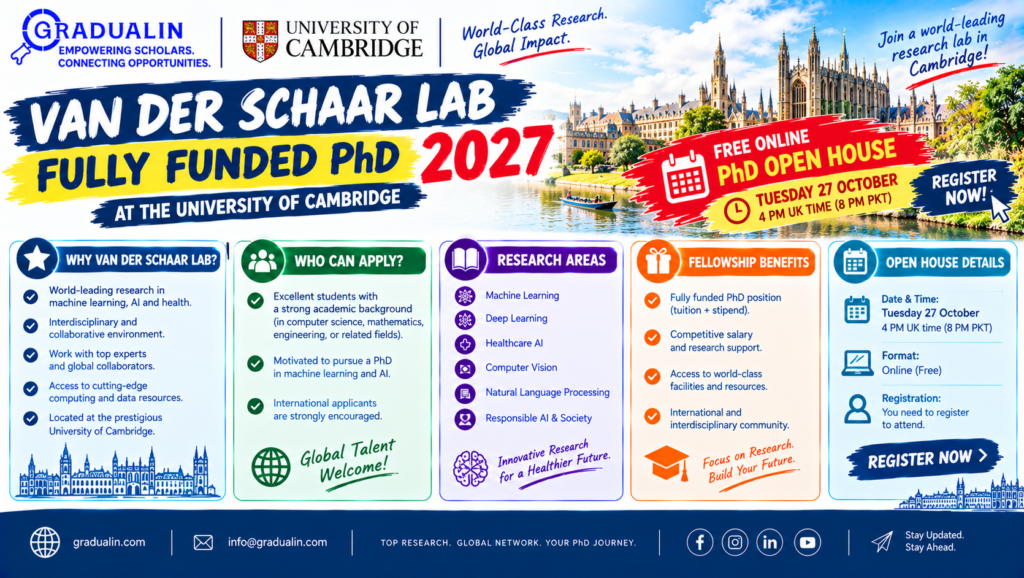
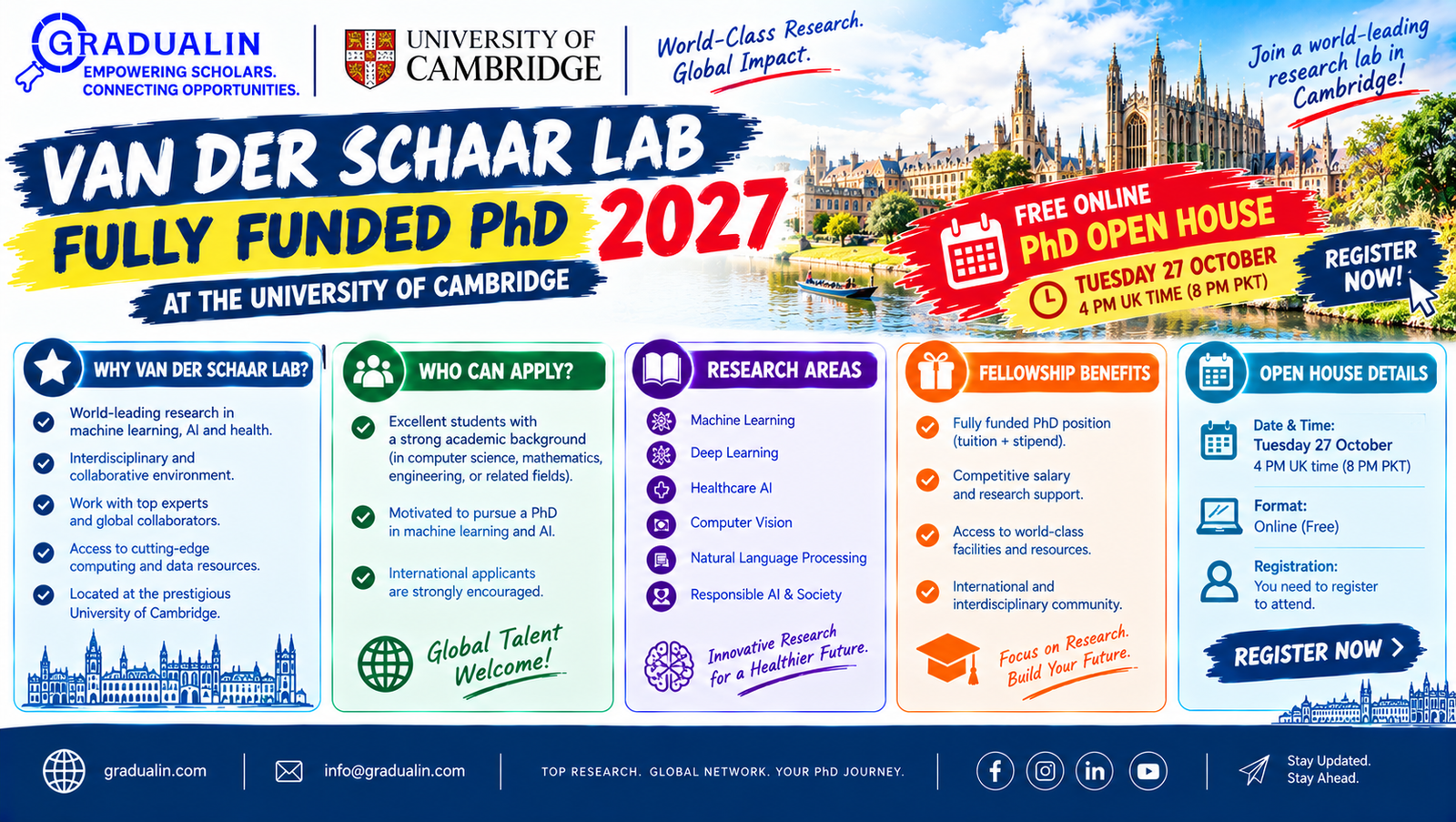
If you want a PhD in machine learning at one of the world’s most productive AI labs, this is a rare open door. The van der Schaar Lab at the University of Cambridge, led by Prof. Mihaela van der Schaar, is recruiting PhD students for a 2027 start. The lab says all positions come with full funding. Applications are assessed on a rolling basis through the lab’s own online form, and you don’t need any background in medicine or biology. What you do need is an excellent mathematical foundation, ideally with machine learning experience. This guide explains who the lab is looking for, how the rolling process works, how strong a Pakistani profile needs to be, and how to make your short application stand out.
| 🏛️ University | University of Cambridge, UK |
| 🔬 Lab | van der Schaar Lab (Prof. Mihaela van der Schaar) |
| 🎓 Level | PhD (start 2027) |
| 💰 Funding | “All positions come with full funding” (stipend amount not published; verify on official website) |
| 🔄 Application Type | Rolling, with no fixed deadline. Apply early |
| 📚 Field | Machine learning and AI: AI for science, medicine, causal ML, time series, synthetic data and more |
| 🧮 Key Requirement | Excellent mathematics; ML experience preferred |
| 🩺 Medical Background | Not required |
| 🗣️ English Test | Not stated by the lab; Cambridge’s standard requirements apply at formal admission (verify on official website) |
| 🗓️ Open House | 27 October 2026, 16:00 UK time (online, registration needed) |
| 🇵🇰 Pakistani Students Eligible | Yes. The lab welcomes applicants “from around the world” |
| 🔗 Apply | Lab application form |
About the van der Schaar Lab
Prof. Mihaela van der Schaar is one of the most cited researchers in machine learning for healthcare. Her group at Cambridge builds new ML methods and applies them to real problems, including cancer screening and treatment, organ transplant matching, cystic fibrosis, COVID-19 forecasting and, more recently, AI agents for scientific discovery and labour-market research. In 2026 she was also appointed Chief AI Scientist at the Francis Crick Institute, one of the lab’s collaborators along with Addenbrooke’s Hospital.
The lab’s research covers a wide range of areas: AI4Science, AutoML, causal deep learning, causal effect inference, clustering, data-centric AI, digital twins, interpretable ML, next-generation clinical trials, quantitative epistemology, self-/semi-supervised and multi-view learning, survival analysis, synthetic data, time series and uncertainty quantification. It also maintains well-known open-source tools such as SynthCity, AutoPrognosis 2.0 and TemporAI.
How it compares: most UK PhD routes ask you to apply to a university programme first and find a supervisor later. Funding then often depends on a separate scholarship competition, such as Gates Cambridge. Here you start with the lab. You fill in a short form, and the lab contacts you if it wants to take you forward. You only apply through the University of Cambridge’s formal system if the lab invites you to. It is a lab-first, rolling process, more like US-style faculty recruiting than a typical UK scholarship round.
💰 What You Get
- ✅ Full funding: the lab states that all PhD positions are fully funded. The exact stipend and fee coverage aren’t published (verify on official website)
- ✅ A high-output research environment: the lab says its students publish around 15 papers on average during their PhD, mainly at NeurIPS, ICML, ICLR and AISTATS
- ✅ Real-world impact: collaborations with clinicians and institutions such as the Francis Crick Institute and Addenbrooke’s Hospital
- ✅ A Cambridge PhD, a degree that opens doors in academia, AI industry labs and health-tech
- ✅ Open-source and software experience on widely used ML libraries
- ✅ A diverse, international team. The lab explicitly welcomes different nationalities, specialisations and professional backgrounds
Context for Pakistani students: Cambridge PhD studentships typically cover tuition fees and a tax-free living stipend set near the UKRI minimum, which is currently over £20,000 a year. A lab’s exact package can differ, so confirm the details if you’re invited to interview (verify on official website).
📋 Eligibility
- An excellent mathematical background, ideally with prior machine learning experience
- An undergraduate degree with top grades from a world-leading institution, equivalent to a UK first-class honours (or predicted to be)
- A degree with a strong quantitative component, such as engineering, computer science, mathematics or economics
- A master’s degree (or equivalent research or work experience) is preferred, not mandatory
- No medicine or biology knowledge required
- English test: the lab page does not mention one. If you are invited to apply formally, Cambridge’s standard English requirements (usually IELTS or an equivalent) will apply (verify on official website)
🇵🇰 Pakistani students: eligible. There is no nationality restriction. Realistically, the lab is looking for a top-of-class profile: a CGPA of about 3.7/4.0 or higher from NUST, LUMS, FAST, GIKI, PIEAS, IST, QAU or a similar university, strong maths courses (linear algebra, probability, optimisation), and visible ML work such as papers, a solid GitHub or Kaggle results. A UK first-class equivalence for Pakistani CGPAs isn’t fixed, so treat 3.7+ as a guide only (verify on official website).
✅ Apply if you…
- Have top grades in CS, maths, EE, statistics or quantitative economics
- Are comfortable with the theory behind ML: probability, linear algebra and optimisation
- Have research output: a thesis, an arXiv paper, a workshop paper or a strong open-source repo
- Are interested in causal ML, time series, uncertainty or AI for science and medicine
- Want an ambitious, publication-heavy PhD
❌ Skip it if you…
- Have average grades and no maths-heavy coursework
- Want a purely applied software or web-development PhD
- Are looking for a biology or medicine wet-lab PhD (this is ML research)
- Need a guaranteed reply. The lab only contacts applicants it plans to follow up
- Want a part-time or remote PhD (verify on official website)
📚 Research Areas You Can Work On
- AI4Science and AI agents: automating parts of scientific discovery
- Causal deep learning and causal effect inference: estimating which treatment works, and for whom
- Digital twins and next-generation clinical trials
- Synthetic data and data-centric AI: privacy-preserving data generation and data quality
- Time series and survival analysis: forecasting patient trajectories
- Uncertainty quantification and interpretable ML
- AutoML, clustering, and self-/semi-supervised and multi-view learning
- Quantitative epistemology and the future of work
Ideas with a Pakistani angle (our suggestions, not the lab’s): ML for hepatitis C or TB risk prediction from low-resource health records, synthetic data for privacy-safe health datasets in South Asia, or causal analysis of public-health interventions. Frame any idea around the lab’s methods, not just the application.
📄 What You Need
- CV / resume / portfolio: up to 3 files, PDF only. If you don’t upload a file, paste CV links in the message box
- Academic history: institutions, courses and grades for your bachelor’s (and master’s, if you have one)
- A short motivation statement on why you want a PhD in this group
- Links to your work: publications, reports, theses, GitHub or code
- An organisational email address (a university or work email is preferred)
HEC note for Pakistani applicants: you don’t need HEC attestation for the lab’s first-stage form. Have HEC-attested degrees and transcripts ready anyway, because they’ll be needed if you’re invited to Cambridge’s formal application. Also keep an official grading-scale letter from your university so your CGPA can be read correctly.
🪜 Step-by-Step: How to Apply
- Register for the Open House (27 October 2026, 16:00 UK time) using the registration link on the lab’s page. It’s the best way to hear what the lab looks for.
- Read 2–3 recent lab papers in the area that interests you. Mention them precisely in your statement.
- Polish your CV as a PDF: put your grades, maths courses, ML projects and papers near the top.
- Fill in the online form: your name, an organisational email, your institutions, a study and work summary, why this group, and links.
- Upload up to 3 PDFs and click Send. A confirmation email should arrive within about 10 minutes. If it doesn’t, use the backup Google Form linked on the lab’s page.
- Wait. The lab replies only if it wants to follow up, for example to ask for more information or invite you to interview. It warns that this may take time because of the volume of applications.
- If invited, you’ll then apply formally through the University of Cambridge. Prepare English test scores and attested documents for that stage.
Tip: write your “why this group” answer in 150–250 words. Name one method (for example causal inference or synthetic data), one lab paper, and one concrete question you want to work on. Generic praise of Cambridge won’t stand out.
📅 Important Dates
| Milestone | Date |
|---|---|
| Applications open | Now (rolling) |
| Online PhD Open House | Tuesday 27 October 2026, 16:00 UK / 20:00 PKT |
| Application deadline | None fixed; assessed on a rolling basis (apply early) |
| Interviews | By invitation, on a rolling basis (verify on official website) |
| PhD start | 2027 (exact term: verify on official website) |
🌍 Why Apply
Few PhD routes combine Cambridge, full funding, top-venue publishing and real-world clinical impact. Because the process is lab-first and rolling, a strong but unconventional applicant, such as someone with excellent maths and a good GitHub but no famous university name, gets read on substance. For Pakistani students, the open international policy and the absence of a medicine requirement make this unusually accessible for such a high-profile lab.
❓ Frequently Asked Questions
Can Pakistani students apply for a PhD in the van der Schaar Lab?
Yes. The lab welcomes applicants from around the world, and there’s no nationality restriction. You need top grades (around UK first-class equivalent), an excellent maths background and ideally ML experience. Have HEC-attested documents ready in case you’re invited to apply formally.
Is the PhD really fully funded?
The lab states that all its PhD positions come with full funding. It does not publish the stipend amount or exactly which costs are covered, so confirm the details if you’re invited to interview (verify on official website).
Do I need IELTS?
The lab’s first-stage form doesn’t ask for an English test. If you’re invited to apply formally to the University of Cambridge, its standard English requirements will apply, usually IELTS or an equivalent (verify on official website).
Do I need a master’s degree?
No, but it’s preferred. Equivalent research or work experience can count instead. Strong bachelor’s graduates with research output can apply.
I submitted the form but heard nothing. What does that mean?
The lab contacts only applicants it plans to follow up, and warns that reviews can take time because of the volume of applications. Check that you received the confirmation email within about 10 minutes. If you didn’t, resubmit through the backup Google Form linked on the lab’s page.
Do I need a medical or biology background?
No. The lab says explicitly that no knowledge of medicine or biology is required. It’s an ML research lab, so maths and ML skills matter most.
🔗 Official Sources
📊 Summary Table
| Detail | Information |
|---|---|
| Opportunity | Fully funded PhD, van der Schaar Lab |
| University | University of Cambridge, UK |
| Field | Machine learning / AI (science, medicine, causal ML and more) |
| Funding | Full funding (amount: verify on official website) |
| Deadline | Rolling, so apply early |
| Open House | 27 October 2026, 16:00 UK time |
| Start | 2027 |
| Key Requirement | First-class-equivalent grades + excellent maths |
| Pakistani Students | Eligible |
Explore more on Gradualin: Scholarships, Jobs & Internships, Events & Conferences, and Guidelines & Resources.
Stay updated with the latest scholarships, jobs, and opportunities at Gradualin.com — your trusted guide to studying abroad for free.