
📅 Last Updated: 5 November 2026
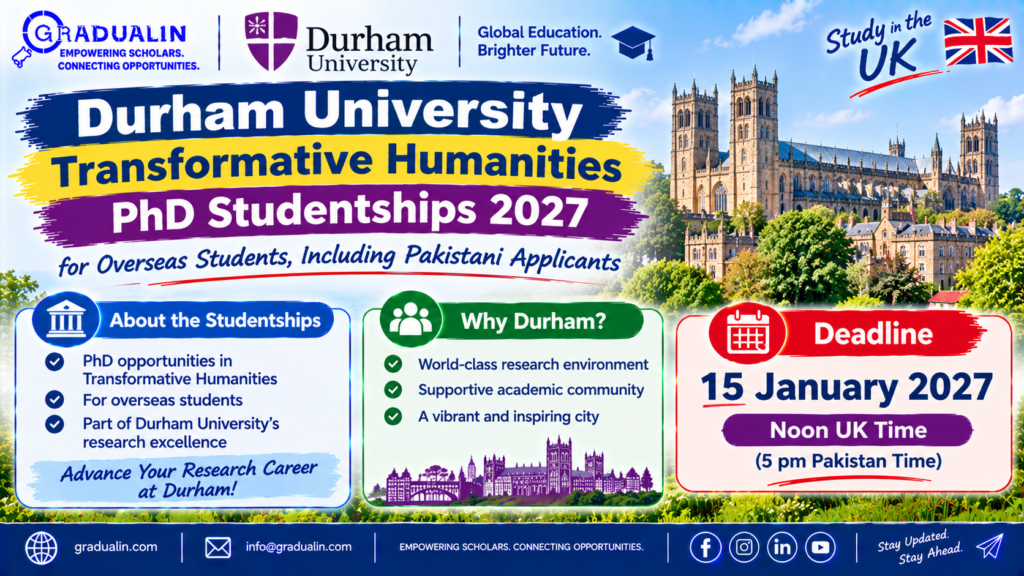
Durham Transformative Humanities PhD Studentships 2027
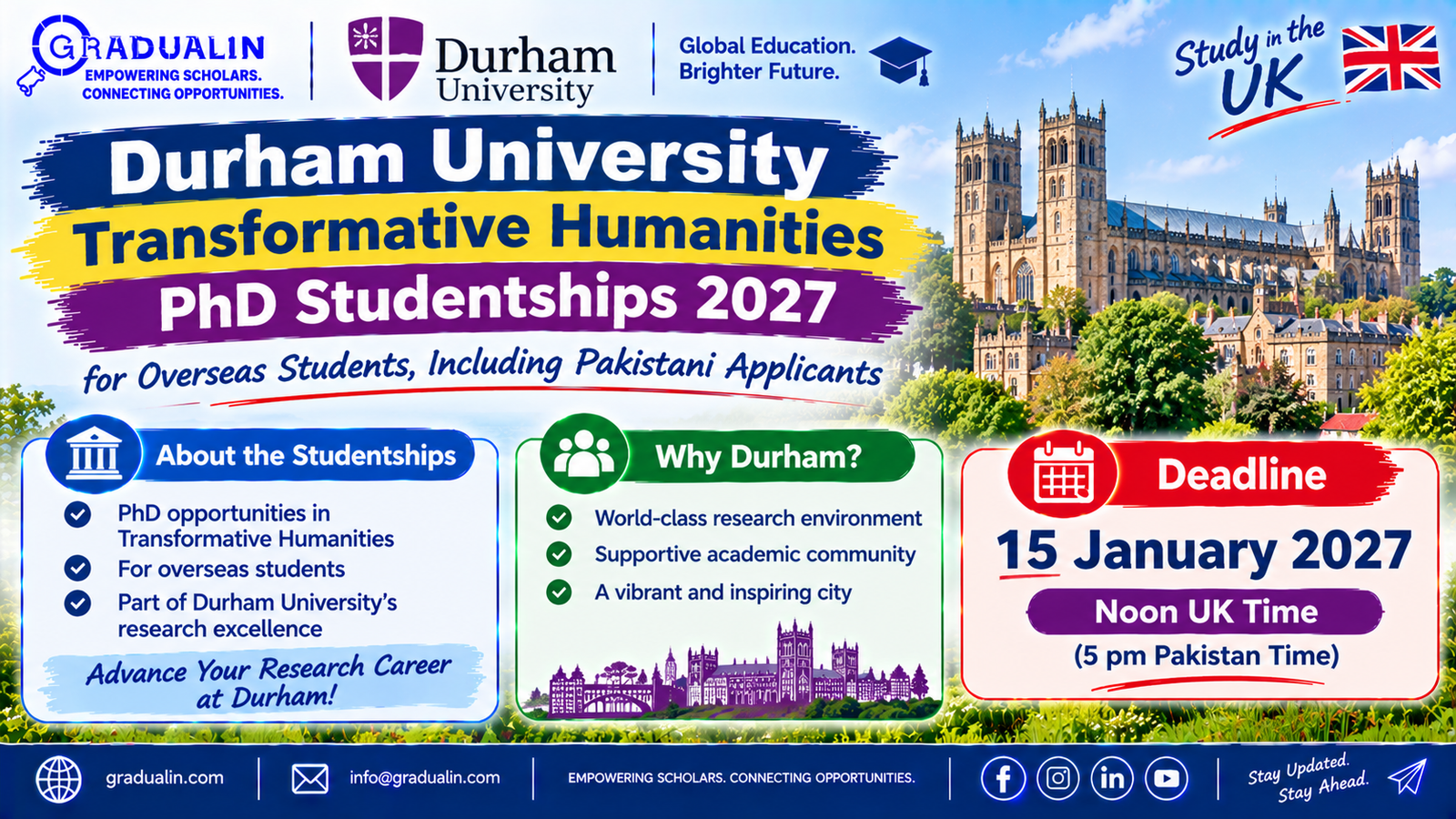
Durham University in the UK has opened its competition for up to eleven PhD Studentships in Transformative Humanities, for students starting in October 2027. Each award includes a tuition fee waiver, a tax-free stipend at the UKRI rate (currently £21,805 a year) for 3.5 years full time or 7 years part time, plus access to extra funding and training. The scheme is open to both home and overseas students, but the split matters: up to nine awards are for home students and up to two are for overseas students. This guide explains what the award pays and doesn’t pay, the two-department supervision rule that catches many applicants out, the six research themes, how to write the 1,000-word proposal and how to apply, with notes for Pakistani applicants.
| 🏛️ University | Durham University, UK |
| 🎓 Award | PhD Studentships in Transformative Humanities |
| 🏦 Supported By | AHRC Doctoral Landscape Award and Durham’s Faculties of Arts & Humanities and Social Sciences |
| 🔢 Number of Awards | Up to 11: up to 9 home, up to 2 overseas |
| 💰 Stipend | £21,805/year, tax free (2026/27 UKRI rate; can change each year) |
| 📚 Tuition | Waived at home or overseas level, matching your award |
| ⏳ Duration | 3.5 years full time · 7 years part time |
| 👥 Supervision | Must involve at least two Durham departments |
| 📄 Proposal | Maximum 1,000 words |
| 📅 Deadline | 15 January 2027, noon UK time (5 pm Pakistan time) |
| 🚀 PhD Start | October 2027 |
| 🇵🇰 Pakistani Students | Can apply through the overseas category, which has very few places |
| 🔗 Official Page | Durham: Transformative Humanities Studentships |
About the Studentships
The scheme is built around Durham’s Transformative Humanities framework. Durham describes this as research that enriches, shapes and transforms lives, nurtures thoughtful and engaged citizens, is inherently interdisciplinary and uses more than one kind of method.
In practice, this isn’t a general humanities scholarship. A good project in a single discipline may not be enough, because Durham judges how well your project fits this framework as well as how good it is. Durham says plainly that an excellent project alone isn’t sufficient.
Up to six award holders will also be selected for association with the AHRC Northern Hub.
💰 What the Award Covers
- ✅ Tuition fee waiver at the overseas level for overseas awards, or the home level for home awards
- ✅ Tax-free stipend at the UKRI rate: £21,805 a year for 2026/27
- ✅ 3.5 years of funding full time, or 7 years part time at a pro-rata stipend
- ✅ Research and training funding that award holders are eligible to apply for
- ✅ Community-building resources and placement opportunities
- ✅ Academic training, which may include archival, digital, GIS and coding, language and public engagement skills, depending on your project
What this is worth: at the current rate, the stipend adds up to about £76,300 over 3.5 years (our calculation), not counting the fee waiver. The £21,805 figure is the 2026/27 rate and your PhD starts in October 2027, so the actual amount may differ. UKRI reviews its rates each year.
⚠️ What You’ll Have to Pay Yourself
Many posts call this “fully funded”, and the fees and stipend are covered. But Durham’s FAQ is clear that overseas award holders must pay for these themselves:
- Visa fees
- The NHS surcharge (Immigration Health Surcharge)
- Relocation costs, including flights and moving to Durham
Durham doesn’t give amounts for these, so check current visa and surcharge costs on GOV.UK’s Student visa page. Some of these costs come before your first stipend payment, so plan for them early. If you’re bringing family, your costs will be higher (verify on official website).
📋 Eligibility
To be considered, you must:
- Apply for admission to an eligible PhD programme at Durham University
- Have a supervisory team led by the Faculty of Arts & Humanities or the Faculty of Social Sciences
- Propose a project that fits the Transformative Humanities framework
- Meet the admission requirements of the department you apply to
- Have supervision involving at least two departments
- Not have started doctoral study already
Master’s degree: many successful applicants hold or are completing one, but eligibility depends on each department’s admission rules, and equivalent qualifications or experience may be considered. Check your department’s page. You can apply while finishing your current degree if you’ll meet the requirements before registering.
Employment: students in full-time employment can’t hold a UKRI award. A student in part-time employment may be eligible for a part-time award of at least 50% of the full-time equivalent.
Where you live: you’re expected to live within reasonable travel distance of Durham and attend regularly. You can’t live abroad during the award unless you’re on fieldwork. So this can’t be held from Pakistan, apart from approved research travel or fieldwork.
🇵🇰 For Pakistani students: Durham’s pages don’t list requirements by country. Check your department’s entry rules and Durham’s English language requirements, which are linked from the FAQ page, to see how your degree and English qualifications are treated (verify on official website).
🌍 Home or Overseas? Why Fee Status Matters
Your fee status decides which pool you compete in, and you can’t choose it. Durham assesses it under UK Government rules, looking at factors such as nationality, immigration status, ordinary residence, length of UK residence and educational history.
- Applying from Pakistan on a Pakistani passport? Expect to be treated as overseas, though the university makes the final decision.
- Dual national or UK citizen living abroad? You won’t automatically count as home. Nationality alone doesn’t decide it.
- Settled status or indefinite leave to remain? You may be assessed as home, depending on the other criteria.
Don’t wait for a fee decision before applying. Submit before the deadline and answer any fee status questionnaire as soon as it’s requested, because delays can hold up your funding review.
🔬 The Six Research Themes
Your project should fit one or more of these themes. Name your main theme clearly, along with any links to others:
- Creativity, Culture and Heritage
- Digital Humanities
- Environmental Humanities
- Medical Humanities
- Science-Humanities
- Social Justice, Communities and Policy
You don’t have to stay inside one theme. Durham says projects may engage with several where there’s a clear reason.
🏫 Eligible Departments
Apply to the PhD programme of your lead supervisor’s department:
👥 The Two-Department Rule and Finding Supervisors
This is the requirement to plan around first. Your supervision must include collaboration across at least two Durham departments, and panels will look for real interdisciplinary work. According to Durham, simply naming several disciplines is unlikely to be enough. They want to see that:
- Different disciplines are genuinely combined in the project
- Your supervisors’ expertise spans more than one department
- Your research questions actually benefit from crossing those boundaries
For example, a project on how flood-affected communities remember disasters could plausibly connect Geography and History. That’s only our illustration, so check that real supervisors at Durham would support your idea.
How to approach them: Durham recommends contacting supervisors as soon as possible, while your proposal is still developing. The Faculty’s PGR team can’t suggest or secure supervisors for you. Your first email should include:
- A draft project summary and preliminary research questions
- Your academic background
- Why you believe they’re a suitable supervisor
Expect honest feedback on feasibility and be ready to change your project. Our guide to finding a PhD supervisor covers how to write these emails.
✍️ Writing the 1,000-Word Proposal
The limit is 1,000 words including footnotes, but excluding any bibliography. Your proposal should clearly cover:
- Research questions and context: what you’re asking and why it matters now
- Approach and methods: how you’ll answer it, including the data or source materials you’ll use
- Relevance to Transformative Humanities: name your theme and show how the project contributes
- Fit with Durham: relevant expertise, centres and institutes, research groups, facilities, archives, collections and training
How panels judge it: Durham says they assess academic quality, relevance to Transformative Humanities, whether the project can be finished in 3.5 years full time (or 7 part time), and whether Durham has the expertise and resources to support it.
Your CV (two pages maximum): highlight master’s-level research, subject expertise, publications, blogs or podcasts, professional experience and technical skills. Durham asks you to clearly explain what you already bring to the project.
✅ Apply if you…
- Have a project that truly needs two or more disciplines
- Can link it clearly to one of the six themes
- Can find supervisors from two Durham departments
- Can explain why Durham specifically suits your work
- Can pay visa, NHS surcharge and relocation costs
❌ Rethink if you…
- Have a single-discipline project with no real crossover
- Work in a field outside Arts & Humanities or Social Sciences leadership
- Have already started a doctorate
- Plan to stay in full-time employment or live abroad
- Have no time to develop your project with supervisors before January
🪜 Step-by-Step: How to Apply
- Read the official pages, including the FAQ and its checklist.
- Join the information and Q&A session on 10 November 2026 at 11 am UK time (4 pm in Pakistan). Durham says the recording will stay available on its page.
- Contact supervisors from at least two departments with a draft summary.
- Write your proposal and prepare your two-page CV.
- Confirm two referees early. The online application explains how their letters are submitted, so check those instructions and give them plenty of notice.
- Complete the equal opportunities monitoring form, linked from the scheme page. You’ll receive a code after submitting, so keep it as proof.
- Apply online to the PhD programme of your lead supervisor’s department.
- Name the scheme in your application. Under Programme Related Information, you’ll be asked whether you’ve applied or intend to apply for a scholarship or studentship. Enter the scheme name there, and list any other funding schemes you want to be considered for.
- Submit by noon UK time on 15 January 2027, which is 5 pm in Pakistan. Aim to finish a few days earlier.
HEC note for Pakistani applicants: Durham doesn’t list HEC attestation as a requirement for this application. Still, have your degrees and transcripts ready early, and check what your department and the visa process ask for (verify on official website).
📅 Important Dates
| Milestone | Date |
|---|---|
| Information and Q&A session (online) | 10 November 2026, 11 am UK / 4 pm Pakistan |
| Application deadline | 15 January 2027, noon UK / 5 pm Pakistan |
| Successful applicants notified | March 2027 |
| PhD starts | October 2027 |
🌟 Why Apply, and an Honest Look at the Odds
Funded PhD places in the humanities are hard to find, especially in the UK and especially for overseas students. This award offers a fee waiver at the overseas level, a UKRI-rate stipend, and training and placement opportunities. It also lets you apply for other Durham funding at the same time, as long as you list those schemes in your application and meet their rules.
But with up to two overseas places across fifteen departments, the competition will be tough. “Up to” also means Durham isn’t promising to award all of them. Treat this as one strong application in a wider plan.
❓ Frequently Asked Questions
Can Pakistani students apply for the Durham Transformative Humanities Studentships?
Yes, the scheme is open to overseas students, but only up to two of the eleven awards are for this group. Durham assesses your fee status during the application process.
How much is the stipend?
£21,805 a year, tax free, at the 2026/27 UKRI rate. The rate can change each year, so the amount for October 2027 may differ.
Does it cover visa and travel costs?
No. Overseas award holders pay their own visa fees, NHS surcharge and relocation costs.
Do I need a master’s degree?
Many successful applicants have one or are completing one, but it depends on the department’s admission rules. Equivalent qualifications or experience may be considered.
Do I need a supervisor before applying?
Durham recommends contacting potential supervisors before applying, and your supervision must span at least two departments. So you should speak to them early rather than wait until your proposal is finished.
Can I study from Pakistan?
No. You must live within reasonable travel distance of Durham and attend regularly. You can only be abroad for approved reasons such as fieldwork.
Can I study part time?
The award can be held part time over 7 years with a pro-rata stipend, subject to approval. International applicants should check whether part-time study fits their visa conditions.
Can I apply for other Durham funding as well?
Often, yes, although each scheme has its own rules. List any other schemes in the funding section of your PhD application.
Who can I contact with questions?
Speak to your potential supervisor first. For general advice, email the Arts & Humanities PGR Team at artsandhumanities.pgrteam@durham.ac.uk.
🔗 Official Sources
📊 Summary Table
| Detail | Information |
|---|---|
| Award | PhD Studentships in Transformative Humanities, Durham University |
| Places | Up to 11 (up to 9 home, up to 2 overseas) |
| Stipend | £21,805/year, tax free (2026/27 rate) |
| Tuition | Fee waiver at home or overseas level |
| Duration | 3.5 years full time · 7 years part time |
| Not Covered | Visa fees, NHS surcharge, relocation |
| Supervision | At least two Durham departments |
| Documents | Proposal (1,000 words), CV (2 pages), monitoring form, two referees |
| Deadline | 15 January 2027, noon UK time |
| Results | March 2027 |
| Start | October 2027 |
Explore more on Gradualin: Scholarships, Jobs & Internships, Events & Conferences, and Guidelines & Resources.
Stay updated with the latest scholarships, jobs, and opportunities at Gradualin.com — your trusted guide to studying abroad for free.