
Commonwealth PhD Scholarship 2027 at Sussex — Fully Funded UK Guide for International Students
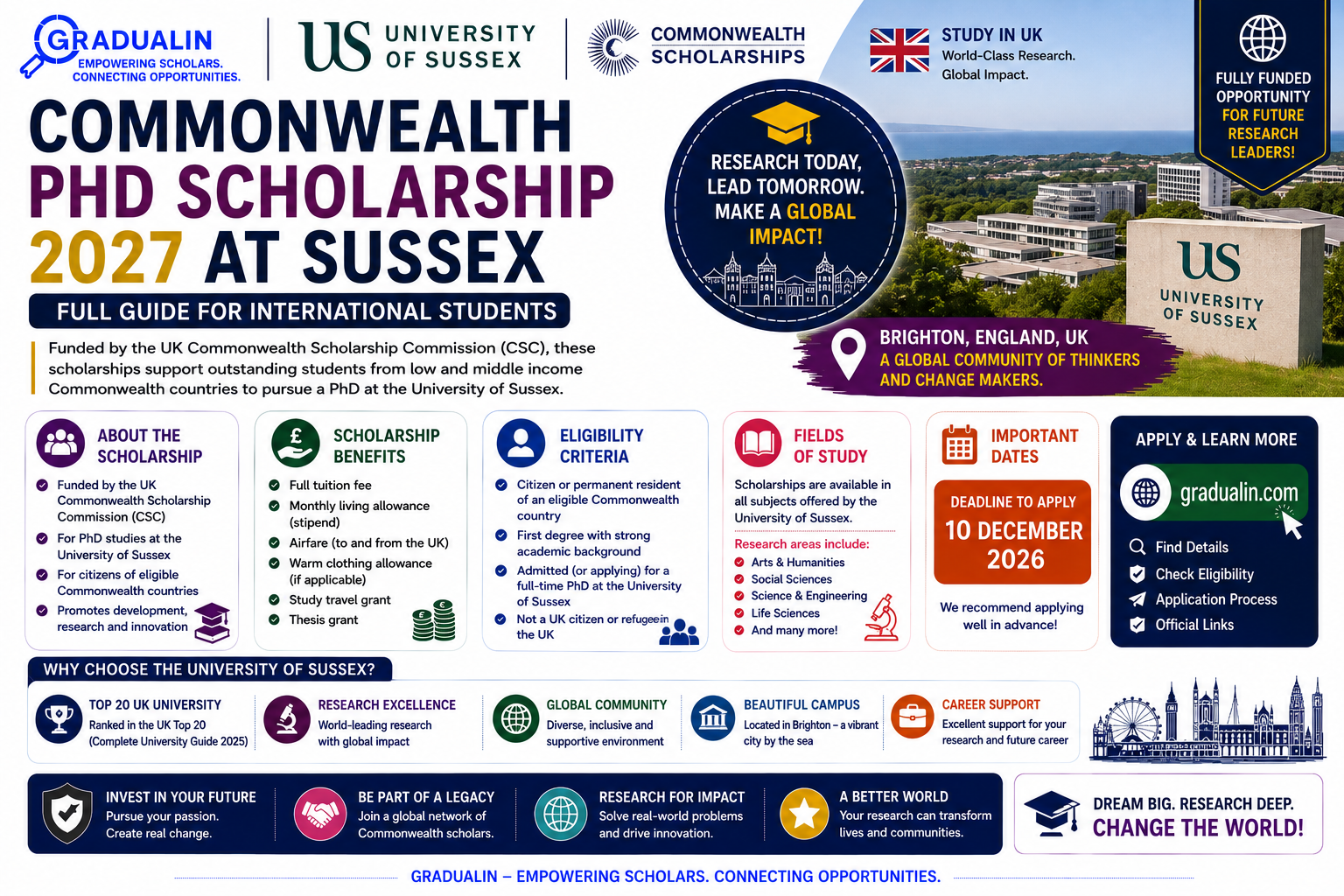
Only 17 nationalities worldwide are eligible for the Commonwealth PhD Scholarship 2027 — a fully funded doctoral award covering tuition, a monthly stipend, return airfare, and research fieldwork costs — and the University of Sussex is now accepting applications for September 2027 entry, with the final deadline of 20 October 2026 at 16:00 GMT. If you’re from Bangladesh, Nigeria, Pakistan, Tanzania, Uganda, or one of the other listed countries, and cost has been the only barrier between you and a UK doctorate, this scholarship was designed for exactly that situation. But here’s the part most articles skip: the application is actually three separate processes running in parallel — Sussex, the Commonwealth Scholarship Commission, and your national nominating agency — and most strong candidates lose not because of their academic record, but because they misunderstand the structure. This guide fixes that.
| Detail | Information |
| University/Organization | University of Sussex (funded by UK FCDO via Commonwealth Scholarship Commission) |
| Country | United Kingdom |
| Degree/Level | PhD — full-time, 36 months |
| Funding Type | Fully Funded |
| Deadline | 20 October 2026, 16:00 GMT |
| Open To | Citizens of 17 eligible least-developed/fragile Commonwealth countries |
| Pakistani Students Eligible | Yes |
| Official Link | Apply Here |
About This Opportunity
The Commonwealth PhD Scholarship is funded by the UK’s Foreign, Commonwealth and Development Office (FCDO) and administered by the Commonwealth Scholarship Commission (CSC) — one of the oldest international scholarship programmes in the world, running since 1959. Sussex is one of approximately 50 UK universities holding a CSC part-funding agreement, which allows it to host a small number of scholars each academic year.
The crucial distinction worth understanding from the outset: Sussex assesses your academic fit and your supervisor relationship, while the CSC is the body that actually funds the award. Getting into Sussex without CSC funding means you’re paying international fees yourself. Getting CSC funding without a Sussex supervisor means you have no placement. You need both, and you need your national nominating agency to forward your application to the CSC before December 2026. All three processes must run simultaneously, not sequentially.
Sussex and its partner, the Institute of Development Studies (IDS), have been ranked first in the world for Development Studies in the QS World University Rankings by Subject for ten consecutive years — sitting above Harvard and Oxford in the latest 2026 rankings. That’s not incidental to this scholarship. The CSC themes — health systems, governance, resilience, global prosperity — map almost exactly onto what IDS and Sussex’s Global Studies faculty actually research. If your doctoral project touches any of those areas, you’re applying to the world’s leading institution in that precise domain.
Unlike the Chevening Scholarship (which covers Master’s degrees only, not doctoral research) or standard university PhD studentships (open to any nationality but rarely covering full living costs for dependents), the Commonwealth PhD Scholarship is deliberately restricted to citizens of low-income and fragile Commonwealth states, and it is built on a single organising idea: your research should help solve a specific development problem in your home country, and you should be planning to return and apply that knowledge. That framing matters at every stage of the application, from the Development Impact Statement to the final panel interview.
Benefits and Funding
The full package covers:
- Full overseas PhD tuition fees — paid directly through the CSC–Sussex agreement; you are not liable for any portion
- Monthly stipend — reported at approximately £1,712 per month at current rates, rising to £2,000 per month for scholars based at universities in the London metropolitan area, noting Sussex is in Brighton, not inner London; verify exact current rates on the official CSC website as these are revised annually
- Return economy airfare from your home country to the UK at the start and end of your award
- Research Training Support Grant (RTSG) — covers costs associated with your research, including fieldwork expenses and conference travel
- Provision towards fieldwork abroad — one economy-class return airfare to your fieldwork location, where approved by the CSC
- Paid mid-term visit to your home country (unless you claim family allowances or have already received a return fieldwork airfare)
- Family allowances — spouse allowance of approximately £313 per month for a maximum of nine months if living with you in the UK; child allowances also available for the first three children under 16, subject to conditions
For applicants contextualising these figures: the monthly stipend outside London converts to roughly PKR 585,000–650,000, or roughly NGN 2.7–3.0 million, or BDT 215,000–240,000 at approximate exchange rates — enough to cover UK living costs comfortably, though applicants planning to bring dependents should read the CSC’s family allowance conditions carefully rather than assuming full household coverage. Always verify amounts on the Commonwealth Scholarship Commission website since rates are reviewed each cycle.
Eligibility Criteria
Who can apply:
The 17 eligible countries are: Bangladesh, Cameroon, The Gambia, Kenya, Kiribati, Lesotho, Malawi, Mozambique, Nigeria, Pakistan, Rwanda, Sierra Leone, Solomon Islands, Tanzania, Tuvalu, Uganda, Vanuatu, and Zambia. Note that India is explicitly excluded from the PhD scheme, even though Indian students are eligible for other Commonwealth Scholarship types.
All applicants must:
- Be a citizen of, or hold refugee status in, one of the 17 eligible countries, and be permanently resident there
- Be available to start UK study in September/October 2027
- Hold at least an upper second class (2:1) honours degree by October 2027, or a second-class degree plus a relevant postgraduate qualification (typically a Master’s)
- Not already be registered for a PhD or MPhil-to-PhD at any UK university before September/October 2027
- Genuinely be unable to afford UK doctoral study without this scholarship — this is a means-tested condition, not just a formality
- Submit a valid IELTS certificate as part of the Sussex application — no exemptions are mentioned for any nationality on the official page
Pakistani students: eligible. Pakistan appears explicitly on both Sussex’s country list and the OECD DAC classification underpinning the scheme. No additional citizenship verification is required beyond standard documentation.
The Six Research Themes — Choosing Yours Strategically
The CSC funds doctoral research under six defined themes. Understanding these isn’t optional — your Development Impact Statement, supervisor choice, and research proposal all need to align with one of them:
1. Science and Technology for Development — applying scientific or technological innovation to solve practical development challenges
2. Strengthening Health Systems and Capacity — improving health infrastructure, access, service delivery, or health outcomes in developing nations
3. Promoting Global Prosperity — economic growth, trade, financial inclusion, and reducing poverty
4. Strengthening Global Peace, Security and Governance — institutions, rule of law, conflict prevention, and democratic governance
5. Strengthening Resilience and Response to Crises — climate adaptation, disaster risk, food security, and humanitarian response
6. Access, Inclusion and Opportunity — education, gender equity, disability, social inclusion, and reducing inequality
The most important thing to understand about these themes: they are not just boxes to tick. Stronger applicants connect one specific development problem, one research response, and one measurable post-PhD impact path across their entire application. Applicants who pick a theme and then write a purely academic research proposal — without ever explaining how the findings return value to their home country — consistently underperform applicants with a clear development narrative, even where the academic credentials are similar.
Who Should Apply — and Who Probably Shouldn’t
✅ You hold at least a 2:1-equivalent degree from an accredited university in one of the 17 eligible countries, and financial need is genuine
✅ Your research idea maps clearly and specifically onto one of the six CSC themes — not vaguely, but with a concrete problem and measurable outcome
✅ You can articulate, in writing, exactly how your PhD will benefit your home country after you return — the “development impact” framing is the primary lens for CSC panel assessment
✅ You’ve already identified, or can realistically contact, a Sussex academic whose existing research overlaps with your proposed topic
✅ You have, or can obtain before applying, a valid IELTS score meeting Sussex’s doctoral entry requirements
✅ Your academic record places you in roughly the top 10–15% of your graduating class — this is where the competitive bar realistically sits for Commonwealth PhD Scholarships globally
❌ You’re looking for a scholarship you can apply to cold, without prior supervisor contact — the CSC application requires a supervisor statement signed on institutional letterhead, uploaded in PDF; this cannot be improvised at the last minute
❌ Your research topic is purely theoretical, with no clear pathway to development outcomes — panels weight development impact as heavily as academic merit
❌ You need funding before September 2027 — there is no accelerated track in this cycle
❌ You’re already registered in a UK PhD or MPhil-to-PhD program before September 2027 — this disqualifies you entirely
❌ You haven’t started building your Development Impact Statement — it’s the most demanding part of the application and the piece most applicants underestimate
Available Fields and Programs at Sussex
Because Sussex holds a CSC part-funding agreement across multiple schools — including Global Studies, Life Sciences, Engineering, Media Arts and Humanities, and the Institute of Development Studies — doctoral projects in nearly any discipline can be hosted here, provided a suitable supervisor exists and the research topic connects to a CSC theme.
At IDS specifically, PhD researchers join a community with more than 70 research staff and 50 postgraduate researchers, with access to seminars by leading development professionals and practitioners. Graduates of the IDS PhD programme have gone on to become ministers in national governments, civil servants, senior figures in international agencies, and leading academics — making it a genuinely career-defining placement for development-focused research.
To shortlist supervisors, use the Sussex PhD course finder and the IDS researcher directory. Match your proposed topic to someone already actively publishing in that space — a supervisor who already works on health systems in sub-Saharan Africa, for example, is a far stronger fit for a governance-and-health-access proposal than a supervisor who researches adjacent topics.
Required Documents
- CV — academic and professional history; be comprehensive, not selective
- Degree transcripts and certificates — certified and in English; if your originals are not in English, notarised translations are needed; applicants from countries with national attestation bodies (HEC in Pakistan, for example) should note that HEC degree attestation is not required at application stage but is frequently required for UK visa purposes — begin that process early to avoid delays after an offer is made
- Statement of interest — must clearly state your proposed project title and the name of your proposed Sussex supervisor
- Names of two academic referees — both should know your academic work well enough to speak to your research capability specifically, not just your character
- Valid IELTS certificate — meeting Sussex’s PhD entry language requirements; check the exact band score requirement on the Sussex international student pages
- Development Impact Statement — required separately for the CSC application (not for Sussex); this four-part statement covers your research’s connection to global and national development issues, its link to the chosen CSC theme, and how you will apply your new skills after the scholarship ends; the CSC application form also asks for academic history, employment, up to ten publications and prizes, referees, study plan, personal statement, leadership experience, and career plans alongside this statement
- Supervisor support statement — a signed PDF on Sussex institutional letterhead from your confirmed Sussex supervisor; without this, your CSC application cannot be completed
Step-by-Step Application Process
The application runs across three separate systems simultaneously. Treat them as parallel tracks, not sequential steps.
Step 1: Contact a Sussex supervisor — do this first, before anything else. Search the Sussex PhD directory and the IDS researcher pages for academics whose published work overlaps your proposed topic. Email them a concise research outline — two paragraphs is enough — and ask whether they’d be willing to supervise. You need a written commitment and their willingness to provide a signed statement before you can complete the CSC application. Give yourself at least four to six weeks for this, as supervisors are busy and may not respond immediately.
Step 2: Apply for a PhD place at Sussex. Submit your formal PhD application through the Sussex online application system, including your CV, degree transcripts and certificates, statement of interest naming your project and supervisor, two academic referee names, and IELTS certificate. Sussex does not publish a fixed deadline for PhD applications, but you should submit well before October 20 to give your supervisor and academic school time to review your application and issue the supervisor statement.
Step 3: Apply to the CSC through its central online system. The CSC application requires your full academic history, publications, personal statement, study plan, leadership record, career plans, referees, the Development Impact Statement, and the uploaded supervisor statement from Sussex. All of this must be submitted by 16:00 GMT on 20 October 2026. The CSC does not accept late submissions under any circumstances, and you cannot edit your application after submitting.
Step 4: Apply to your national nominating agency. In most cases, this is a government body in your home country designated by the CSC. Some NGOs and universities also act as nominators. Nominating agencies set their own internal deadlines — which are often weeks before the CSC’s October deadline — and they forward only their highest-ranked candidates to the CSC. For Pakistani applicants, confirm your nominating agency’s identity and deadline directly at cscuk.fcdo.gov.uk/national-nominating-agencies as soon as possible; do not assume you have until October.
Step 5: Track your supervisor statement upload. The supervisor statement must be in PDF format, signed, and on institutional letterhead. It must be uploaded through the CSC Central portal — not emailed. Build at least two weeks of buffer time between requesting it from your supervisor and the CSC deadline.
A practical tip worth taking seriously: state your development impact with specificity — panels dismiss generic answers about “contributing to national development” and respond to concrete, evidence-based plans. The difference between a passed-over application and a nominated one usually isn’t academic qualifications. It’s the Development Impact Statement.
Important Dates
| Stage | Date |
| Applications open (CSC portal) | 8 September 2026 |
| Sussex PhD application | No fixed deadline — submit as early as possible |
| Nominating agency deadline | Varies by country — confirm directly with your nominator immediately |
| CSC application deadline | 20 October 2026, 16:00 GMT |
| Nominating bodies submit to CSC | December 2026 |
| Final outcomes announced | By July 2027 |
| Study begins | September/October 2027 |
Bookmark this page — we update deadlines as soon as changes are announced.
Why Apply at Sussex — and Why It Matters for Your Career
Brighton is a compact, well-connected city about an hour from London by train — lower cost of living than the capital, easier to navigate as a new arrival, and with strong transport links for fieldwork or conference travel. Sussex’s campus is purpose-built, with everything from the library to the student union within walking distance — a genuine advantage if you’re arriving in a new country for the first time.
But the real argument for Sussex as your CSC host isn’t the campus or the city. Sussex and IDS have been ranked first in the world for Development Studies for ten consecutive years in the QS World University Rankings, consistently placing above Harvard and Oxford. For applicants whose research falls within any of the six CSC themes — and especially for those working on health, governance, resilience, or inclusion — there is genuinely no stronger institutional home in the world for that work.
PhD graduates from the IDS programme go on to work as ministers in national governments, senior civil servants, high-level officials in international agencies, and leading academics. The institutional network you build during a Sussex/IDS PhD is not abstract — it is a direct career asset in exactly the sectors where development-focused researchers from eligible Commonwealth countries tend to work after returning home.
Gradualin Editor’s Note: This scholarship is among the most legitimate fully funded doctoral routes available to applicants from the 17 eligible countries — it’s been running since 1959, it’s government-funded, and the outcome (a UK PhD from one of the world’s top development studies institutions) is career-defining. But it is not a prize for academic performance alone. If your research proposal and Development Impact Statement don’t make a compelling, specific case for why your home country needs this work done, a strong transcript won’t save you. Applicants with a clear development angle, a confirmed Sussex supervisor, and a well-structured nominating agency application are realistically competitive. Applicants approaching this without supervisor contact yet should prioritise that above everything else, starting today.
FAQ
These questions are based on what students most commonly search about this program.
Which countries are eligible for the Commonwealth PhD Scholarship 2027? Bangladesh, Cameroon, The Gambia, Kenya, Kiribati, Lesotho, Malawi, Mozambique, Nigeria, Pakistan, Rwanda, Sierra Leone, Solomon Islands, Tanzania, Tuvalu, Uganda, Vanuatu, and Zambia. India is specifically excluded from this scheme.
Can Pakistani students apply for this scholarship? Yes. Pakistan appears explicitly on both the Sussex and the CSC eligibility lists. No citizenship-specific restrictions apply beyond the general requirement to be a citizen and permanent resident of an eligible country.
Is IELTS required for all applicants? Yes. Sussex lists a valid IELTS certificate as a required application document for all nationalities. The official page does not mention an exemption for any country.
What is the Development Impact Statement and why does it matter? It is the centrepiece of your CSC application — a four-part written statement explaining how your research connects to development issues at global and national level, which CSC theme it addresses, and how you will apply your new skills after the scholarship. The CSC selection panel assesses candidate merit, research proposal quality, and home-country development impact — the Development Impact Statement is where development impact is actually argued and evidenced.
What’s the difference between applying to Sussex and applying to the CSC? They are entirely separate processes on separate systems. Sussex evaluates your candidacy as a PhD student and facilitates the supervisor statement. The CSC evaluates your scholarship eligibility and funds the award. You also need a nominating agency application in your home country. All three must be completed, and none substitutes for the others.
Is India eligible for this scholarship? No. The Sussex official page explicitly notes that India is excluded from the Commonwealth PhD scheme for least developed countries and fragile states.
What happens after the CSC deadline? Nominating agencies forward their shortlisted candidates to the CSC in December 2026. The CSC conducts final assessment through spring 2027. Successful candidates are typically notified by July 2027 for September 2027 study start.
Official Source
- Apply via Sussex
- Commonwealth Scholarship Commission — PhD Scholarships
- National Nominating Agencies
- Sussex contact: pgr-scholarships@sussex.ac.uk
Summary Table
| Detail | Information |
| University/Organization | University of Sussex |
| Country | United Kingdom |
| Degree/Level | PhD (Full-time, 36 months) |
| Funding Type | Fully Funded |
| Deadline | 20 October 2026, 16:00 GMT |
| Pakistani Students Eligible | Yes |
| Official Link | Apply Here |
Explore more opportunities:
Scholarships | Jobs & Internships | Events & Conferences | Guidelines & Resources
Further reading: Fully Funded PhD Scholarships in the UK 2026 | Top Fully Funded Scholarships in Asia 2027 | Study in Germany 2026 — Guide for International Students | Study in Netherlands 2026 — Guide for International Students
Stay updated with the latest scholarships, jobs, and opportunities at Gradualin.com — your trusted guide to studying abroad for free.
Author: Faseeh Sultan — PhD Scholar & MSIT | 7 Years in Education