

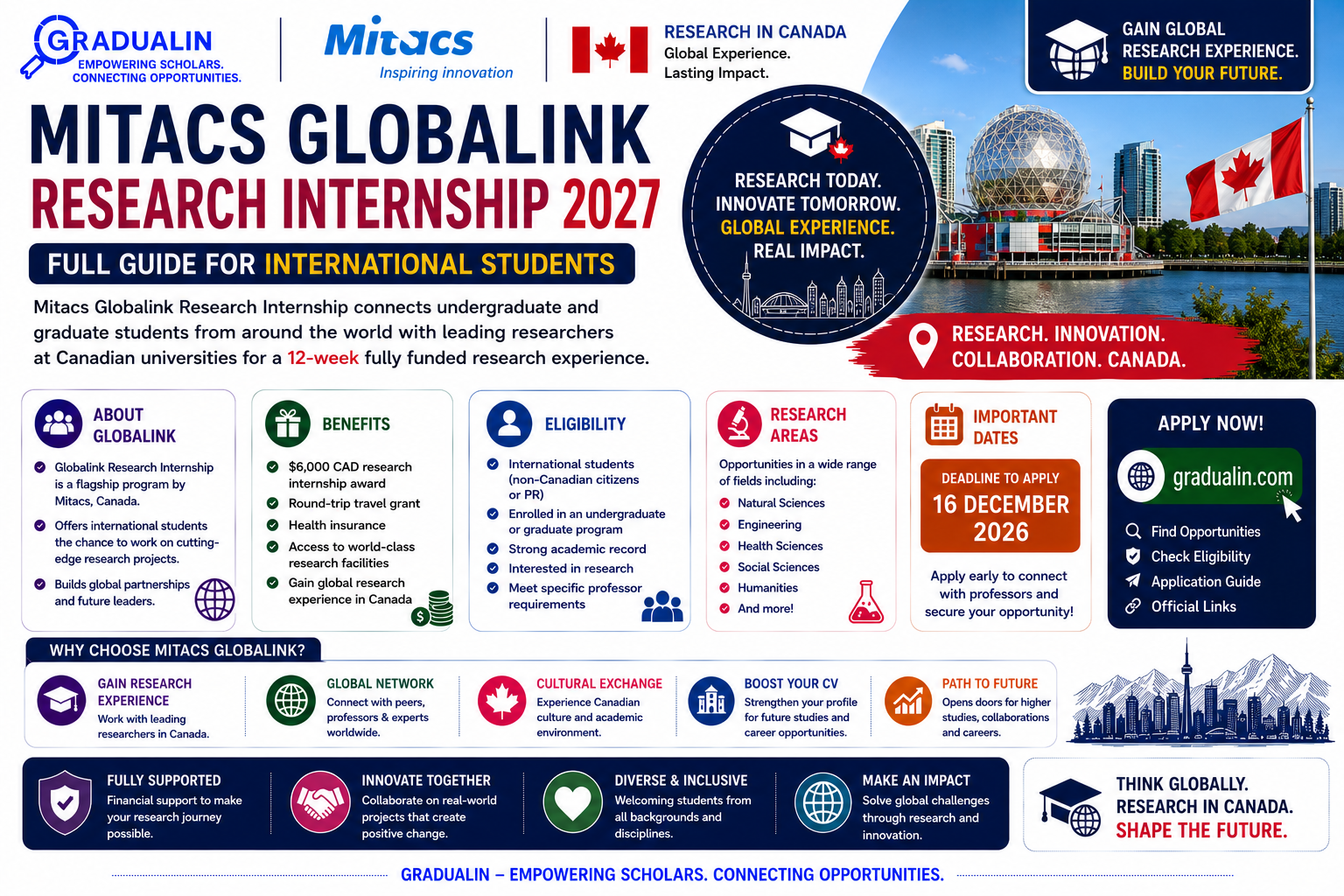
Mitacs Globalink Research Internship 2027 — Complete Guide for International Students
International undergraduates from 22 partner countries and regions — including Pakistan, India, China, Germany, France, Brazil, and Nigeria — can apply for a fully funded 12-week research placement at one of more than 70 Canadian universities through the Mitacs Globalink Research Internship 2027, with applications open now and closing Wednesday, September 16, 2026, at 1:00 p.m. Pacific time. This is not a generic study-abroad semester. You’ll be working full-time in a research lab or social science project under a Canadian faculty supervisor — alongside graduate students and research associates — for three months, fully funded. But here’s what most guides about this program get wrong: the eligibility rules, GPA requirements, citizenship conditions, and language test requirements are entirely different depending on which country you’re applying from. Understanding your country’s specific rulebook — before you open the application — is the difference between a complete application and a wasted afternoon.
| Detail | Information |
| University/Organization | Mitacs (hosted by 70+ Canadian academic institutions) |
| Country | Canada |
| Degree/Level | Undergraduate (and combined undergrad/Master’s) — research internship |
| Funding Type | Fully Funded |
| Deadline | Wednesday, 16 September 2026, 1:00 p.m. Pacific time |
| Open To | Undergraduates from 22 eligible partner countries/regions |
| Pakistani Students Eligible | Yes |
| Official Link | Apply Here |
About This Opportunity
Mitacs is a Canadian non-profit organisation that funds research partnerships between academic institutions and industry, and it is the only body in Canada running a program of this scale for international undergraduates. The Globalink Research Internship (GRI) was built to bring talented undergraduates into Canadian research environments and create lasting research relationships between Canada and partner countries. It has been running for over a decade and now partners with national governments, funding bodies, and universities across six continents.
What makes GRI meaningfully different from comparable programs is how it handles academic disciplines. Unlike Germany’s DAAD RISE program, which is restricted to students in biology, chemistry, physics, earth sciences, computer science, and engineering, the Globalink Research Internship covers the full range — science, engineering, mathematics, humanities, and social sciences — making it one of the only competitive international research internships where a political science student and a biochemistry student can both apply and be genuinely competitive. The exception is Germany itself: German applicants through the DAAD partnership are limited to the sciences.
There is also a Globalink Graduate Fellowship pathway for students who complete the GRI and are later accepted into eligible graduate programs in Canada — a meaningful downstream benefit that most applicants don’t know about and most competitor articles don’t mention. For students who are considering Canadian graduate school after their undergraduate degree, the GRI is not just a summer placement; it can be the foundation of an ongoing relationship with a Canadian institution and supervisor.
Benefits and Funding
The Globalink Research Internship award covers:
- Round-trip airfare contribution to Canada — the exact amount varies by country of origin; the US Fulbright-Mitacs track quotes up to CAD $5,000 from Mitacs covering housing, transport, permit fees, student fees, and insurance, giving a rough benchmark for total funding value, though exact amounts for other countries vary
- Transportation from the Canadian airport to your accommodation
- Housing stipend — varies by country of origin and host institution
- Enrollment fee stipend — varies by host institution
- Food and incidentals stipend — varies by country of origin
- Emergency health insurance for the full 12-week internship, plus two days before the start and two days after the end date
- Access to professional development workshops, industry events, and government events during your time in Canada
- On-campus student mentor support
Mitacs does not publish one universal stipend figure — the value and payment arrangement vary according to the student’s country of origin, host institution, and applicable partner funding. Mitacs funds are generally released to the selected intern after the internship begins, requiring physical presence in Canada before any payment is issued. In some cases, part or all of the funding is provided through the international partner rather than Mitacs directly.
The practical implication: applicants should plan financially for the pre-departure period — visa fees, the flight to Canada, and initial accommodation costs may need to be covered personally before reimbursement or disbursement begins. The final award letter will specify amounts, payment methods, and actions required.
Eligibility Criteria
General requirements applying to all countries:
- At least 18 years of age at application
- Enrolled full-time in an undergraduate or combined undergraduate/Master’s program at an eligible institution (Master’s-only students are not eligible)
- Completed at least two years of undergraduate study, or currently enrolled in second year
- 1–3 semesters remaining as of fall 2027 (with country-specific variation)
- Meet your country’s specific GPA threshold
- Apply to a minimum of 3 and a maximum of 10 projects, from at least 3 different Canadian provinces
- Sufficient English or French proficiency to carry out research activities — note that Mitacs itself does not universally require a test score, but some country partners do
- Available for 12 full, consecutive weeks between May 1 and October 31, 2027, starting between May 1 and July 31
- Have not previously received a Globalink Research Internship award
- Not currently affiliated with any institution on Canada’s Named Research Organizations (NRO) list where the project touches Sensitive Technology Research Areas
Country-by-country key differences — the details most guides skip:
The 22 eligible countries/regions are: Austria, Brazil, Chile, China, Colombia, Finland, France, Germany, Hong Kong, India, Ireland, Jordan, Mexico, Pakistan, Peru, Singapore, South Korea, Taiwan, Thailand, Tunisia, Ukraine, United Kingdom, and United States.
Several countries require citizenship, not just enrollment, in that country: Brazil (citizenship required), China (Chinese citizenship), Colombia (Colombian citizenship), Jordan (Jordanian citizenship), Mexico (Mexican citizenship), Singapore (Singaporean citizenship), South Korea (Republic of Korea citizenship), Taiwan (ROC citizenship), Tunisia (Tunisian citizenship), and USA (US citizenship through Fulbright).
Countries with no citizenship requirement — meaning any full-time student enrolled at an eligible institution in that country can apply regardless of their nationality: Austria, Chile, Finland, France, Germany, Hong Kong, Ireland, Pakistan, Thailand, Ukraine, and United Kingdom.
GPA thresholds by selected country (minimum cumulative, verify on official page):
- Pakistan: 80%
- India: 70%
- China: 85%
- Germany: 65% (2.9/6 or lower in German grading)
- France (most institutions): 60%
- United Kingdom: 60–65% depending on widening participation status
- Mexico (most institutions): 80%
- Brazil (Fundação Araucária): 80%
Pakistani students: eligible. All Pakistani universities can participate (no restricted list — though check the drop-down; if your institution isn’t there, email Mitacs to add it). All disciplines are eligible. Minimum cumulative GPA: 80%. No language proficiency test required. No citizenship requirement.
Who Should Apply — and Who Probably Shouldn’t
✅ You’re a full-time undergraduate in one of the 22 partner countries with 1–3 semesters remaining as of fall 2027, meeting your country’s GPA threshold
✅ You have a professor willing to write you a reference letter — not just a teacher who knows your face, but someone who actually supervised your work and can speak to your research capability
✅ You’re applying broadly: across disciplines, across provinces, to projects where your background is genuinely relevant even if the discipline label doesn’t match exactly
✅ You can commit to 12 unbroken weeks in Canada — no exceptions, no early departures, no extensions for most country partners
✅ You’re interested in research as a career path, or in strengthening a graduate school application — GRI is most valuable for students in these two situations
❌ You’re a graduate student or postdoc — the program is explicitly undergraduate-only; no exceptions
❌ You’ve received a Globalink Research Internship in any previous cycle — one award per person, ever
❌ Your reference letter would come from a teaching assistant, a staff member, or a professor who has never actually seen your research work — these letters are explicitly disqualified and make an application ineligible
❌ You can only apply to one or two projects in one province — the minimum is three projects in three provinces; narrower applications are both ineligible and strategically weaker
❌ You’re from a citizenship-required country but don’t hold that citizenship — enrollment at a university there is not sufficient
For Pakistani applicants specifically: the combination of no citizenship requirement, no language test, 80% GPA threshold, and all disciplines eligible makes Pakistan one of the more open eligibility environments in the program. Applicants with strong academic records and a genuine research reference are realistically competitive.
Available Fields and Host Institutions
Projects span the full range of academic disciplines: science, engineering, mathematics, computer science, health sciences, humanities, and social sciences — and many projects are deliberately interdisciplinary. A computer science student can apply to a health data project; an economics student can apply to a sustainability research project. Mitacs encourages broad searches rather than narrow discipline-matching.
Mitacs Globalink Research Internships are currently available at over 70 academic institutions across Canada, ranging from major research-intensive universities — such as the University of Toronto, University of British Columbia, McGill, University of Alberta, and University of Waterloo — to smaller institutions where competition for individual projects may be less intense. Spreading your applications across a range of institution sizes and provinces is a genuine strategic advantage.
Browse and apply to specific projects through the Globalink open projects database before applying through the Globalink Student Platform.
Required Documents
- Reference letter — from a professor who directly supervised your research, coursework, or lab work; must be on institutional letterhead; must follow Mitacs’ specific formatting and content guidelines (download from the How to Apply section); letters from academic staff who are not professors, or from professors who only know you as a course student and never supervised research, are disqualified
- Academic transcripts — official, in English or French; if your institution cannot provide them in either language, you are responsible for translation and notarisation; the transcript language must match the language of the projects you apply to
- CV/résumé — Mitacs provides a template; your own format is accepted; focus on research experience, technical skills, and academic achievements relevant to your target projects
- Passport — valid until at least January 2028 for a 2027 internship; you may apply without a passport but must provide details if selected, so begin this process now if yours is expired or absent
- Language proficiency test scores, where required by your country partner — not required for Pakistani applicants as a Mitacs submission, though Mitacs expects sufficient working proficiency in the project language; country partners in China, Taiwan, South Korea (some), Jordan, and others have their own test requirements submitted directly to those bodies
A practical note on transcripts for students from Pakistan, India, Bangladesh, and other countries where institutions issue transcripts in English: you still need to ensure these are official university-issued copies, not student portal screenshots. When in doubt, request a signed, stamped copy from your registrar’s office.
Step-by-Step Application Process
Step 1: Check your country’s specific eligibility rules before anything else. GPA threshold, citizenship requirement, language test, eligible disciplines, and eligible institutions all vary by country. Reading the general eligibility section is not enough — find your country’s specific block on the official page and confirm every condition applies to your situation.
Step 2: Secure a reference letter from a supervising professor. This is the most common bottleneck. Professors receive multiple requests in September; contacting them early, providing your CV, a brief description of your research interests, and the Mitacs reference letter guidelines document in the same email dramatically increases your chances of a timely, high-quality letter. Download the guidelines from the Mitacs application page.
Step 3: Collect and prepare your transcripts and CV. If your transcripts aren’t in English or French, begin translation and notarisation immediately — this takes longer than most students expect. Make sure the language of your transcripts matches the language of the projects you’re targeting.
Step 4: Search the project database strategically. Use the open projects database and run multiple searches — your exact discipline, related disciplines, keywords from your skills and interests, and general thematic areas. Students must apply to a minimum of three and a maximum of ten projects from at least three different Canadian provinces. Spreading applications across institution sizes and provinces improves matching odds meaningfully. Don’t fixate on the most prestigious labs — a match with a strong supervisor at a mid-sized university is more valuable than a rejected application to a flagship one.
Step 5: Create one account on the Globalink Student Platform and build your application. Go to globalink.mitacs.ca. Create a single account — never create multiple profiles, as this can cause incorrect processing. You can save your work and return. Upload your documents, complete all mandatory fields, and select your projects.
Step 6: Ensure your application reads “Complete” before the deadline. There is no “Submit” button. Applications lock automatically at 1:00 p.m. Pacific on September 16, 2026. Your application status must read “Complete” by that time. Check this status before the deadline day — the system does not send a confirmation that you are “done,” and technical issues in the final hours cannot be resolved in time.
A genuinely useful tip from how the program actually works: applications are assessed on CGPA, quality of the statement of interest, quality of the reference letter, and how well research interests and experience match the project. The statement of interest is often under-invested — it is your direct pitch to the professor whose project you’re applying to, and it should demonstrate that you’ve actually read their project description, understand what they’re researching, and can explain specifically why your background and interests align with that work. Generic statements that could apply to any project are filtered out early.
Important Dates
| Stage | Date |
| Applications open | Now open for 2027 cohort |
| Application deadline | 16 September 2026, 1:00 p.m. Pacific time |
| Matching period | September–December 2026 |
| Intern notification | Mid-December 2026 to mid-February 2027 |
| Pre-internship preparation | January–February 2027 |
| Internship window | May 1 – October 31, 2027 (start between May 1 and July 31) |
| Duration | 12 consecutive weeks, 40 hours/week |
Bookmark this page — we update deadlines as soon as changes are announced.
Why Canada — and Why This Program Specifically
Canada is one of a very small number of countries where a government-backed research exchange program actively recruits international undergraduates rather than treating them as a secondary cohort. The GRI is not a side programme bolted onto a university’s existing activity — it is the primary vehicle through which Canadian universities access international undergraduate research talent, and Canadian faculty take it seriously for exactly that reason.
Beyond the research itself, Globalink participants develop critical thinking, cultural awareness, and a global outlook; take part in professional training in teamwork, project management, problem solving, communication, and entrepreneurship; and join an international alumni community that makes them eligible for the Mitacs Globalink Graduate Fellowship — a pathway toward fully supported Canadian graduate study for standout performers.
Canada also has a large, established Pakistani diaspora community, with Pakistani student communities at most major research universities — making the social transition significantly easier than comparable programs in countries with less established South Asian networks.
Gradualin Editor’s Note: The Mitacs GRI is one of the best-structured undergraduate research programs available to international students anywhere — genuinely funded, genuinely supervised, and with a clear downstream pathway toward graduate school or a research career. The program is competitive, but not so selective that only students with published papers can get in. What it rewards is preparation: a strong reference letter from the right person, a project search broad enough to find real matches, and a statement of interest that shows you’ve actually read the project description. The students who don’t get in usually got one of those three things wrong, not their GPA. If you’re eligible, apply now — the September 16 deadline does not extend.
FAQ
These questions are based on what students most commonly search about this program.
Can Pakistani students apply for the Mitacs Globalink Research Internship 2027? Yes. Pakistan has no citizenship requirement, no language test requirement, all disciplines are eligible, and all Pakistani universities are eligible (email Mitacs if yours isn’t in the drop-down). The minimum cumulative GPA is 80%.
Is IELTS or TOEFL required for Pakistani applicants? No — Mitacs does not require a language proficiency test from Pakistani applicants. However, you must have sufficient working proficiency in the project’s language (English or French) to actually carry out the research.
Is this program available to graduate students or Master’s-only students? No. GRI is explicitly for full-time undergraduates and combined undergraduate/Master’s students. Students enrolled in a Master’s-only program are not eligible.
How many projects should I apply to? A minimum of 3 and a maximum of 10, spanning at least 3 different Canadian provinces. Applying broadly — including to projects outside your exact discipline where your skills are relevant — significantly improves matching odds.
There’s no “Submit” button — how do I know my application is submitted? Your application submits automatically at the deadline. Make sure your application status reads “Complete” in the Globalink Student Platform before 1:00 p.m. Pacific on September 16, 2026. Do not wait until the final day to confirm this.
When will I hear back if I’m accepted? Mitacs notifies successful applicants by email between mid-December 2026 and mid-February 2027. Eligibility confirmation or interview invitations in earlier stages do not guarantee an internship offer.
Do US students apply through the Mitacs portal? No. American students must apply through Fulbright Canada’s separate website — not the Mitacs portal. Applying through the wrong system will result in an ineligible application.
What happens after the internship? Students who complete a Globalink Research Internship and are later accepted into eligible Canadian graduate programs may become eligible for the Globalink Graduate Fellowship, a grant supporting continued graduate study in Canada. Beyond that, GRI alumni report significantly stronger graduate school applications and employer interest as a direct outcome of the international research credential.
Official Source
- Apply via Globalink Student Platform
- Official Program Page
- Open Projects Database
- Eligible Institutions List
- Contact: globalinkinterns@mitacs.ca
Summary Table
| Detail | Information |
| University/Organization | Mitacs (70+ Canadian host institutions) |
| Country | Canada |
| Degree/Level | Undergraduate research internship (12 weeks) |
| Funding Type | Fully Funded |
| Deadline | 16 September 2026, 1:00 p.m. Pacific time |
| Pakistani Students Eligible | Yes |
| Official Link | Apply Here |
Explore more opportunities:
Scholarships | Jobs & Internships | Events & Conferences | Guidelines & Resources
Further reading: Fully Funded Scholarships in the USA 2026 | Top Fully Funded Scholarships in Asia 2027 | Study in Canada 2026 — Guide for International Students | Finland Scholarships 2026 — Tuition Waivers for International Students
Stay updated with the latest scholarships, jobs, and opportunities at Gradualin.com — your trusted guide to studying abroad for free.
Author: Faseeh Sultan — PhD Scholar & MSIT | 7 Years in Education

2 Responses
Rất cảm ơn những chia sẻ này. Nếu cần tư vấn du học Hàn Quốc, hãy tìm đến Letco — kinh nghiệm nhiều năm, dịch vụ uy tín. Chi tiết tại letco.vn.