
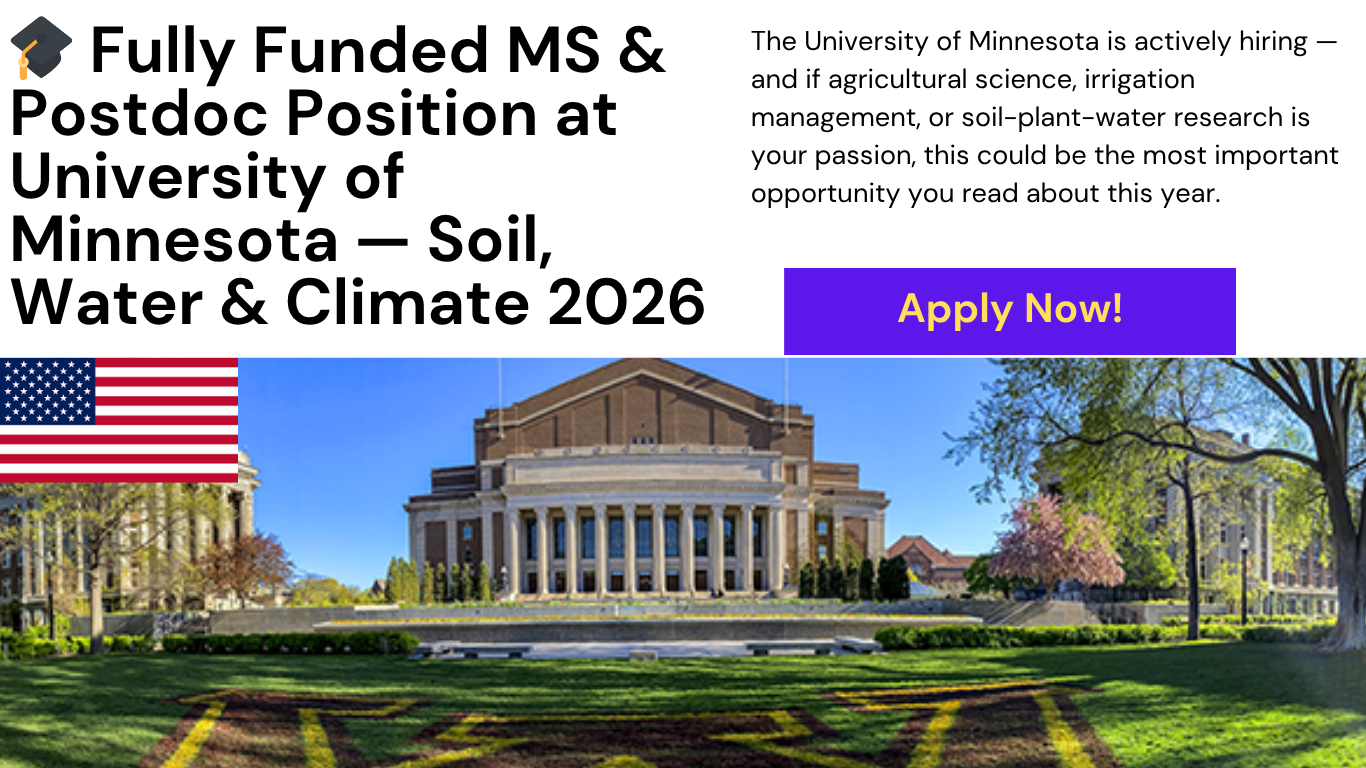
The University of Minnesota is actively hiring — and if agricultural science, irrigation management, or soil-plant-water research is your passion, this could be the most important opportunity you read about this year. The Department of Soil, Water, and Climate at UMN Twin Cities has two open funded positions starting June 1, 2026: a fully funded Master of Science (M.S.) Graduate Research Assistantship and a Postdoctoral Researcher role. Both positions are connected to real-world field research in Minnesota, mentored by expert faculty, and designed for candidates who want to make a genuine difference in sustainable agriculture. This guide covers everything — what you will do, what you will earn, how to qualify, and exactly how to apply.
📋 Quick Summary Table
| Detail | Information |
| University | University of Minnesota Twin Cities |
| Department | Soil, Water, and Climate — College of Agricultural, Food & Environmental Sciences (CFANS) |
| Country | United States 🇺🇸 |
| City | St. Paul, Minnesota |
| Positions Available | 1 × M.S. Graduate Research Assistantship + 1 × Postdoctoral Researcher |
| Programme (MS) | Land and Atmospheric Science (LAAS) |
| Research Focus | Irrigation management in potato production, Minnesota |
| Funding Type | Fully Funded (Research Assistantship) |
| Start Date | June 1, 2026 |
| Major Advisor (MS) | Dr. Vasudha Sharma |
| Co-PIs | Dr. Carl Rosen & Dr. Yuxin Miao |
| Contact | vasudha@umn.edu |
| Official Link | UMN Fellowships & Assistantships |
🎓 Department and University Overview
The University of Minnesota Twin Cities is one of America’s most respected public research universities and a member of the prestigious Association of American Universities (AAU) — an elite group of just 71 leading research institutions across North America. Located across the Minneapolis and St. Paul campuses, UMN consistently ranks among the top 15 public universities in the US.
The Department of Soil, Water, and Climate (SWAC) sits within the College of Agricultural, Food, and Environmental Sciences (CFANS) — one of the leading agricultural colleges in the entire United States. The department is headquartered at 439 Borlaug Hall, 1991 Upper Buford Circle, St. Paul, MN 55108, and its faculty are internationally recognised for field-based, applied research that directly informs farming practice, water management policy, and environmental sustainability.
What makes these two openings especially exciting is that they are tied to a field-based research project with real-world grower impact. This is not a desk job — you will be doing hands-on science in actual Minnesota farm environments, directly contributing to water management strategies that affect potato producers across the state and beyond.
Both positions are supervised by Dr. Vasudha Sharma (Assistant Professor and Major Advisor), with co-supervision from Dr. Carl Rosen and Dr. Yuxin Miao — three of UMN’s leading agricultural science researchers.
🎓 Position 1 — M.S. Graduate Research Assistantship
What Is This Position?
The Department of Soil, Water, and Climate is seeking an M.S. student to enrol in the Land and Atmospheric Science (LAAS) programme. This is a fully funded research assistantship focused on irrigation management in potato production in Minnesota.
You will join a faculty-led research team conducting applied field research, collecting and analysing agricultural data, and producing actionable water management recommendations for farmers. This is exactly the kind of position that bridges academic science and real-world agricultural practice.
What You Will Do
Your day-to-day responsibilities will be diverse and genuinely hands-on:
- 🌱 Field experiments — evaluating irrigation treatments, soil moisture dynamics, crop response, and agronomic measurements
- 📋 Field plot setup and maintenance — including soil moisture and crop data collection
- 🌾 Harvest support — actively participating in seasonal field research activities
- 💻 Data entry and analysis — processing agricultural datasets to support research conclusions
- 📝 Reports, presentations, and manuscripts — contributing to academic publications and grower communications
- 🚗 Regular travel to field sites across Minnesota throughout the growing season
Here is something important to know: this position requires active field participation during growing season. If you love working outdoors, getting your hands dirty with real science, and seeing your research translate directly into farm recommendations — this role is genuinely exciting.
Eligibility Requirements
To be considered for the M.S. assistantship, you need to meet the following:
- 📌 Undergraduate degree in soil science, agronomy, agricultural engineering, environmental science, plant science, or a closely related field
- 📌 Experience in applied field research, agricultural data collection, and basic data analysis (preferred — not strictly required)
- 📌 Valid driver’s licence — travel to field sites is a core part of the role
- 📌 Ability to work independently, manage field tasks carefully, and collaborate effectively within a research team
- 📌 Strong work ethic and genuine interest in irrigation management, crop production, and applied agricultural research under Minnesota conditions
💡 Good news for international students: The position is listed as open, and UMN actively recruits internationally. You will need to meet English language proficiency requirements for graduate admission. Check UMN’s international admissions page for current TOEFL/IELTS thresholds.
🎓 Position 2 — Postdoctoral Researcher
What Is This Position?
Alongside the MS opening, the department is also recruiting a Postdoctoral Researcher to contribute to ongoing and future projects on:
- Irrigation management
- Soil-plant-water interactions
- Data-driven decision support for sustainable crop production
This is a research-intensive role for someone who already holds a PhD and wants to advance their academic career in agricultural and environmental science in a world-class US research environment.
Key Responsibilities
- 🔬 Design and lead field and lysimeter experiments on irrigation treatments and water use efficiency
- 📊 Analyse soil moisture dynamics, crop response, and environmental data
- 🤖 Develop models and decision-support tools for irrigation management
- 📄 Publish research findings in peer-reviewed international journals and present at conferences
- 🤝 Collaborate with graduate students, researchers, and industry partners
- 💡 Contribute to grant writing and project development
What makes this postdoctoral role stand out is the modelling and decision-support component. You won’t just be collecting data — you’ll be building the computational tools that allow farmers and policymakers to act on it. This is genuinely cutting-edge, applied environmental science.
Qualifications for the Postdoc Role
- 📌 PhD in Soil Science, Agronomy, Agricultural Engineering, Hydrology, or a closely related field
- 📌 Strong background in irrigation management, soil-plant-water relations, and statistical/data analysis
- 📌 Experience with field experiments, sensors, and modelling approaches
- 📌 Excellent publication and communication skills
- 📌 Ability to work independently and lead research activities
🎓 Who Should Apply (And Who Should Not)
✅ Apply for the MS position if you…
- Have a Bachelor’s degree in soil science, agronomy, agricultural or environmental engineering, or plant science
- Enjoy hands-on field research and don’t mind physical outdoor work during the growing season
- Have a valid driver’s licence and are comfortable with regular travel across Minnesota
- Are passionate about water management and sustainable agriculture
- Want a fully funded Master’s degree at one of the USA’s top agricultural universities
✅ Apply for the Postdoc position if you…
- Hold a completed PhD in soil science, agronomy, hydrology, or related field
- Have published peer-reviewed research and have strong analytical/modelling skills
- Want to build a track record in grant writing and independent research leadership
- Are ready to work in a collaborative, multi-PI research environment at a top US university
❌ Don’t apply if you…
- Have no background in agricultural, environmental, or soil science disciplines
- Are unwilling to conduct regular field work and travel within Minnesota
- Cannot obtain or do not hold a valid driver’s licence (required for MS role)
- Are looking for a purely computational/desktop role with no field component (for MS specifically)
🎓 Research Focus — Why This Project Matters
The research sits at the intersection of three urgent global challenges:
1. Food Security Potato is one of the world’s most important food crops. In Minnesota specifically, it is a major commercial crop. Improving irrigation management in potato production directly translates into better yields, reduced input costs, and more reliable food production for farmers and consumers.
2. Water Resource Management Agricultural irrigation is one of the largest consumers of freshwater in the United States. Developing smarter, data-driven irrigation strategies means less water wasted — a critical priority as climate variability puts increasing pressure on water supplies across the Midwest.
3. Data-Driven Agriculture Both positions contribute to building and validating models and decision-support tools that allow growers to make better irrigation decisions without guessing. This is where agricultural science meets modern data science — a field that is growing rapidly in both academic and industry demand.
This is the kind of research that gets published in top journals, attracts follow-on funding, and builds a career. Whether you are an MS student at the start of your journey or a postdoc building toward a faculty position, this project gives you all three ingredients: great data, great mentors, and real-world impact.
🎓 Required Documents
To apply for either position, prepare the following materials:
For the MS Assistantship:
- CV / Résumé — highlighting academic background, research experience, and any field work
- Statement of interest — explaining why you are interested in this specific project and how your background fits
- Academic transcripts from all universities attended
- Contact details for two or three references (academic or research supervisors preferred)
- Proof of driver’s licence (or ability to obtain one before start date)
- English language proficiency scores (TOEFL/IELTS) for international applicants
For the Postdoctoral Researcher:
- Full CV — including full publication list
- Cover letter / research statement — outlining relevant experience in irrigation management, soil-plant-water science, and modelling
- Names and contact details of three professional references
- Representative publications (2–3 recent papers, if available)
🎓 Step-by-Step Application Process
Here is exactly how to apply:
- Email Dr. Vasudha Sharma directly at vasudha@umn.edu — introduce yourself, attach your CV, and briefly explain your interest in the position
- Mention which role you are applying for — MS assistantship or postdoctoral researcher (or both, if applicable)
- Prepare your supporting documents (CV, transcripts, statement of interest, references)
- Complete the formal UMN graduate admissions application at grad.umn.edu/admissions for the MS role, selecting the Land and Atmospheric Science (LAAS) programme
- For the postdoc role, the formal application process will be confirmed by Dr. Sharma — begin with an email introduction
- Arrange reference letters in advance — give your referees plenty of notice
- For international applicants: ensure your English proficiency scores are ready and your visa documentation is in order
💡 Pro Tip: Email Dr. Sharma as soon as possible — even if your documents are not yet complete. Faculty supervisors for funded positions often conduct informal interviews and make selections well before the official start date. Your first email is your first impression.
🎓 Important Dates and Deadlines
| Milestone | Date |
| Position Start Date | June 1, 2026 |
| Recommended Contact Deadline | As soon as possible — positions fill quickly |
| UMN Graduate Admissions (general) | Varies by programme — check LAAS programme page |
⚠️ These positions have a fixed start date of June 1, 2026. Do not delay — reach out to Dr. Sharma and begin your formal application immediately. Funded positions at top US universities fill fast.
📌 Bookmark this page and check back for updates.
🎓 Why Apply — Why UMN, Why Minnesota
Let’s talk about why this opportunity is genuinely special beyond just the funding.
The University of Minnesota is home to the Nobel Prize-winning Norman Borlaug legacy — the father of the Green Revolution studied and taught at institutions deeply connected to UMN’s agricultural tradition. The CFANS college is one of the most respected agricultural research colleges in the world, and the Department of Soil, Water, and Climate has a long record of producing graduates who lead in academia, government, and the private sector.
St. Paul, Minnesota is an exceptional place to live and work. The Twin Cities metro area is consistently ranked among the most liveable in the United States — with affordable housing, world-class healthcare, excellent public transport, and a thriving cultural scene. Your stipend stretches considerably further here than it would in New York, Boston, or San Francisco.
And the research itself? Irrigation management and sustainable agriculture are among the fastest-growing areas of investment in both public funding and private industry. A funded MS or postdoc in this field from a top US university positions you exceptionally well — for a faculty career, an industry role in precision agriculture or agtech, or a policy position in water and food systems.
This is one of those rare opportunities where the science, the mentorship, the location, and the funding all align.
🎓 Frequently Asked Questions (FAQ)
Q: Is this position open to international students? A: Yes. The University of Minnesota welcomes international applicants for both the MS assistantship and the postdoctoral researcher position. International MS students will need to meet UMN’s English language requirements (TOEFL/IELTS) and complete the international student admissions process. Contact Dr. Sharma and the LAAS programme office for specific details.
Q: Is the MS position fully funded? A: Yes. This is a Graduate Research Assistantship — meaning your tuition is covered and you receive a monthly stipend for the duration of your assistantship appointment. Health insurance benefits are typically included for graduate assistantship holders at UMN (verify current benefits with the department).
Q: When does the position start? A: Both positions have a start date of June 1, 2026. You should reach out as soon as possible to express your interest and begin the application process.
Q: Do I need field experience to apply for the MS role? A: Preference is given to candidates with experience in applied field research and agricultural data collection — but it is listed as a preference, not a strict requirement. If you have strong academic preparation and genuine motivation, your application can still be competitive. Be clear and specific in your statement of interest.
Q: How do I apply for the postdoctoral position specifically? A: Begin by emailing Dr. Vasudha Sharma at vasudha@umn.edu with your CV and a brief cover note. She will direct you through the formal application process for the postdoc role.
Q: Can I apply for both positions? A: If you are currently a PhD student nearing completion or recently graduated, you may wish to enquire about the postdoc role. If you are finishing an undergraduate or Master’s degree, the MS assistantship is the appropriate fit. If you are genuinely eligible for both, you can mention this in your email to Dr. Sharma — but be clear and specific about your current qualification level.
🎓 Official Source and Contact Information
- Application Contact: Dr. Vasudha Sharma, Assistant Professor — vasudha@umn.edu
- Department: Soil, Water, and Climate, College of Agricultural, Food & Environmental Sciences
- Address: 439 Borlaug Hall, 1991 Upper Buford Circle, St. Paul, MN 55108
- Phone: 612-625-1244 | Fax: 612-625-2208
- Department Website: www.swac.umn.edu
- UMN Fellowships & Assistantships: onestop.umn.edu/finances/types-financial-aid/fellowships-and-assistantships
- UMN Diversity Statement: diversity.umn.edu
🎓 Complete Summary Table
| Detail | Information |
| University | University of Minnesota Twin Cities |
| Department | Soil, Water, and Climate (SWAC) — CFANS |
| Country | United States 🇺🇸 |
| City | St. Paul, Minnesota |
| MS Programme | Land and Atmospheric Science (LAAS) |
| Positions | 1 × MS Research Assistantship + 1 × Postdoctoral Researcher |
| Research Focus | Irrigation management, soil-plant-water interactions, decision-support tools |
| Funding | Fully Funded (tuition waiver + stipend + health insurance) |
| Start Date | June 1, 2026 |
| Major Advisor | Dr. Vasudha Sharma (vasudha@umn.edu) |
| Co-PIs | Dr. Carl Rosen & Dr. Yuxin Miao |
| MS Requirements | BSc in soil/agronomy/ag engineering/env science + driver’s licence |
| Postdoc Requirements | PhD in soil science, agronomy, hydrology, or related field |
| Open To | Domestic & International Applicants |
| Apply | Email vasudha@umn.edu + UMN Graduate Admissions Portal |
🔗 Explore More Opportunities on Gradualin
Browse by Category:
Related Articles You’ll Love:
- 🎓 Fully Funded Scholarships in the USA 2026 for International Students
- 🎓 Fully Funded PhD Scholarships in the UK 2026 for International Students
- 🎓 Fully Funded Scholarships in Australia 2026 for International Students
- 📚 Study in Italy 2026 — Complete Guide for International Students
Stay updated with the latest scholarships, jobs, and opportunities at Gradualin.com — your trusted guide to studying abroad for free.