
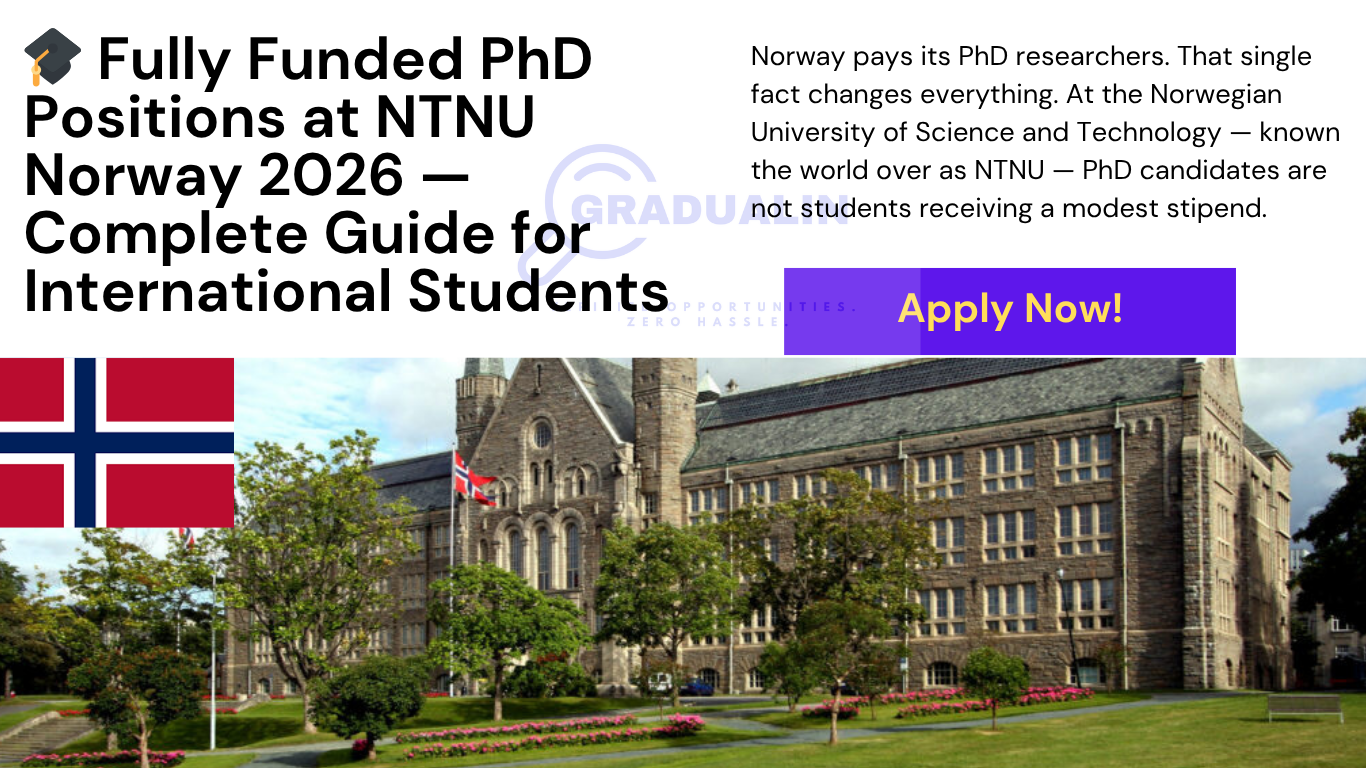
Norway pays its PhD researchers. That single fact changes everything. At the Norwegian University of Science and Technology — known the world over as NTNU — PhD candidates are not students receiving a modest stipend. They are fully employed researchers earning a competitive government salary, with access to Norway’s world-class public healthcare system, paid annual leave, pension contributions, and one of the highest qualities of life on the planet. If you hold a Master’s degree and are ready to dedicate yourself to cutting-edge research, NTNU’s continuously open PhD vacancies in 2026 could be your most life-changing opportunity yet.
At Gradualin, we bring you complete, honest guides to the world’s best PhD opportunities — and this one is among the finest in Europe. Read on for everything you need to know about finding, applying for, and securing a fully funded PhD position at NTNU.
📋 Quick Summary
| Detail | Information |
| University | Norwegian University of Science and Technology (NTNU) |
| Country | Norway 🇳🇴 |
| Campuses | Trondheim (main), Gjøvik, Ålesund |
| Degree Level | PhD (Doctorate) |
| Fields Available | Engineering, Sciences, Medicine, ICT, Humanities, Social Sciences & more |
| Funding Type | Fully Funded — Salaried Employment |
| Annual Gross Salary | NOK 501,200–550,800 (~USD 46,000–51,000) |
| PhD Duration | 3 Years (sometimes 4 with teaching duties) |
| Open To | International Students — All Nationalities |
| IELTS Required | Not always — English proficiency required (confirm per vacancy) |
| Official Vacancies Portal | ntnu.edu/vacancies |
| PhD Info Page | ntnu.edu/phd |
🎓 About NTNU — Norway’s Largest and Most Innovative University
The Norwegian University of Science and Technology (NTNU) is Norway’s largest single university and one of Europe’s most dynamic research institutions. Founded through a landmark 2016 merger that united several universities into one powerhouse, NTNU today enrolls over 43,000 students — including more than 4,000 international students — and employs approximately 8,000 staff members across three campuses.
NTNU has its roots stretching back to 1760, with the founding of Det Trondhiemske Selskab (Trondheim Academy). Today, it is headquartered in Trondheim — a medieval city on Norway’s western coast that has become one of Scandinavia’s leading technology and research hubs — with additional campuses in Gjøvik and Ålesund.
What makes NTNU truly distinctive in the global PhD landscape is its primary focus on science and technology, combined with significant breadth across humanities, social sciences, medicine, architecture, and the arts. NTNU is home to 398 study programmes, world-class research centres, and strong partnerships with Norwegian industry giants like Equinor, Aker BP, and the Norwegian Research Council.
NTNU is part of the Nordic Five Tech (N5T) alliance — alongside Chalmers University (Sweden), Aalto University (Finland), KTH Royal Institute of Technology (Sweden), and Technical University of Denmark — a collaboration that gives NTNU PhD candidates access to courses and research facilities at four other elite Nordic technical universities, with no participation fees.
The university has also been delivering impactful research that makes global headlines — from infant brain development studies to deep-sea carbon monitoring, autonomous ship safety, and quantum physics. A NTNU PhD degree opens doors not just in academia but increasingly in leading private sector positions worldwide.
🎓 Benefits and Funding — What You Actually Receive
Here is the single most important thing to understand about PhD positions in Norway, including at NTNU:
PhD candidates are employees — not students.
This changes everything. Here is what being a salaried PhD researcher at NTNU means in practice:
- ✅ Full annual gross salary of NOK 501,200–550,800 (~USD 46,000–51,000 / ~EUR 43,000–48,000) depending on experience and seniority (verify exact figure per vacancy — a recent mathematical sciences posting listed NOK 550,800 gross)
- ✅ 2% statutory contribution to Norway’s State Pension Fund — deducted from salary but building your retirement security
- ✅ Access to Norway’s public healthcare system — one of the world’s best, covering GPs, specialists, and hospitals at minimal cost
- ✅ Paid annual leave — Norwegian law guarantees all employees generous annual leave entitlements
- ✅ Parental leave rights — as a salaried employee, you are entitled to Norwegian parental leave provisions
- ✅ Research funding — conference travel, materials, and equipment covered by the project budget
- ✅ Nordic Five Tech mobility — take PhD-level courses at partner universities (Chalmers, KTH, Aalto, DTU) at no cost
- ✅ International research stays — many positions include funded stays at international partner institutions
- ✅ NTNU International Researcher Support (NIRS) — dedicated counselling and relocation support for international researchers arriving in Norway
Here is the perspective: A gross salary of NOK 530,000/year in Norway — after tax, social contributions, and with free healthcare — is a genuinely comfortable living wage in Trondheim, a city that costs significantly less than Oslo but offers world-class quality of life. You are not surviving on a grant. You are building a career, a life, and a pension — all while doing your PhD.
🎓 Eligibility Criteria
Requirements vary by individual vacancy, but the standard academic conditions for admission to an NTNU PhD programme are:
- ✅ Completed at least 5 years of higher education — including a Master’s degree or equivalent
- ✅ Strong academic record — a weighted average equivalent to a B or higher (in NTNU’s grading scale) for the last two years of your Master’s degree
- ✅ Confirmed financing — funding is an absolute requirement for admission. For advertised positions, this is covered by the employing department or research project
- ✅ Confirmed supervisor — a main NTNU supervisor must be in place before admission
- ✅ Good written and oral English language skills — required for all positions. Formal English test scores are not always explicitly required, but strong proficiency must be demonstrated (confirm per vacancy)
- ✅ Open to all nationalities worldwide — NTNU actively welcomes international researchers
- ⚠️ For some EU Horizon Europe / COFUND positions: candidates must not have resided in Norway for more than 12 months in the 3 years prior to the application deadline (EU mobility rule — check per vacancy)
- ✅ Master’s students in their final year may apply — employment begins upon completion of the degree
Recognition of foreign degrees: If your Master’s degree is from outside Norway, you can have it assessed and recognized through NOKUT (the Norwegian Agency for Quality Assurance in Education), or the Faculty may complete a similar assessment as part of your application review.
🎓 Who Should Apply — And Who Should Not
✅ Apply if you:
- Hold (or are close to completing) a Master’s degree in a relevant field
- Have a strong academic record — solid grades and ideally some research experience
- Are genuinely passionate about independent research and can work with intellectual discipline over 3–4 years
- Want to live in one of the world’s most admired countries, with an excellent quality of life and safety record
- Are comfortable working in an English-language research environment
- Want real employment — a salary, pension, and full social rights — not just a scholarship grant
- Are interested in technology, engineering, or science (NTNU’s core strengths) or any of its broader disciplines
❌ Do not apply if you:
- Do not have a completed or nearly completed Master’s degree
- Have a GPA below the minimum threshold (B average or equivalent in your Master’s final two years)
- Cannot commit to full-time, on-site research for the full contract period
- Are looking for a part-time, remote, or online PhD arrangement
- Have not identified a research area and potential supervisor before applying
🎓 Available Research Fields and Faculties
NTNU covers an extraordinary breadth of disciplines across its 9 faculties. Recent and active PhD vacancy postings have spanned:
Engineering and Technology:
- Mechanical and Industrial Engineering
- Electronic Systems and ICT
- Energy and Process Engineering
- Aerospace Engineering
- Computer Science and Telecommunications
- Civil and Environmental Engineering
- Nanotechnology and Materials Science
Natural Sciences:
- Physics (including Quantum Mechanics and Condensed Matter)
- Mathematics and Statistics
- Chemistry
- Biology and Biotechnology
- Geosciences and Earth Science
- Environmental Science
Medicine and Health:
- Clinical and Molecular Medicine
- Neuroscience
- Public Health and Nursing
- Medical Technology
Social Sciences, Humanities and Architecture:
- Architecture and Planning
- Psychology and Education
- Economics and Business
- Law
- Linguistics and Literature
- History and Philosophy
Interdisciplinary and Industry-Linked:
- Cybersecurity and Information Security (NORCICS Centre)
- Geophysical Forecasting (CGF Centre)
- Sustainable Energy (HYDROGENi)
- Marine Technology and Ocean Engineering
The variety is remarkable — and new positions across all these areas are posted every single week throughout the year on NTNU’s official vacancies portal.
🎓 Required Documents
While exact requirements vary per position, a typical NTNU PhD application includes:
- Application form — completed electronically via the NTNU or Jobbnorge portal linked in the vacancy
- CV / Curriculum Vitae — full academic and professional history, including publications if any
- Motivation letter — tailored specifically to the research project and department
- Official Master’s degree diploma and transcripts — with certified English translation if not in English or Norwegian
- Documentation of funding — for advertised positions, this is covered by the position; state this clearly
- Project description — either a full or preliminary version (some positions require this, others do not)
- Reference letters — typically 2 academic references (varies by position)
- NOKUT recognition letter (if applicable — for non-Norwegian degrees that require formal recognition)
- Proof of English proficiency (if explicitly required by the specific vacancy)
Important: For positions with specific ethical or legal dimensions (e.g. involving human data, animal research, or biosafety), documentation of relevant approvals or a plan to obtain them should be included.
🎓 Step-by-Step Application Process
Follow these steps carefully to maximise your chances of success:
Step 1: Visit the official NTNU Vacancies Portal and also check Jobbnorge — both list NTNU PhD positions. Set up job alerts for your field so you never miss a new posting.
Step 2: Read each vacancy carefully and in full. Pay special attention to the specific eligibility requirements, application deadline, required documents, and the contact details of the named supervisor.
Step 3: Contact the supervisor early. Before formally applying, send a brief, professional email introducing yourself, explaining your research background, and expressing your interest in the specific project. Attach your CV. This is standard practice in Norwegian academia and significantly improves your chances.
Step 4: Prepare your full application package. Tailor your motivation letter directly to the research described in the vacancy — generic letters are not competitive at NTNU.
Step 5: Submit your application electronically through the portal linked in the vacancy (NTNU’s own system or Jobbnorge). Ensure all documents are in English or Norwegian.
Step 6: Shortlisted candidates are invited for interview — typically online, sometimes in person in Trondheim. Prepare to discuss your research background, your understanding of the project, and your ability to work independently.
Step 7: Successful candidates receive an employment contract and begin the official admission process to an NTNU PhD programme. Your supervisor will guide you through the formal enrolment paperwork with your faculty.
Gradualin Pro Tip: Do not apply to just one position. NTNU posts new PhD vacancies continuously. Browse regularly, apply to several well-matched positions, and treat each application as tailored, not templated.
🎓 Important Dates and Deadlines
| Vacancy Type | Deadline |
| Standard open PhD positions | Rolling — new postings weekly, individual deadlines |
| HYDROGENi Energy PhD positions | Check ntnu.edu/vacancies |
| Horizon Europe / COFUND positions | Varies by project — check per posting |
| Industrial PhD (NFR scheme) | March and September each year |
| Public Sector PhD (NFR scheme) | Check forskningsradet.no |
⚠️ Individual vacancy deadlines are firm. Late applications are not accepted through the Jobbnorge/NTNU system. Bookmark ntnu.edu/vacancies and check it at least once a week. Most positions close within 3–6 weeks of posting.
🎓 Why Apply — Why NTNU, Why Norway
Let’s be direct: doing your PhD in Norway is a genuinely exceptional life decision — and NTNU makes it even better.
Norway consistently ranks #1 or #2 globally in the Human Development Index. That means the safest streets, the cleanest air, the most functional public services, and some of the most respected passports in the world — all available to you as a salaried researcher with legal employee status from day one.
Trondheim — NTNU’s main campus city — is a place people fall in love with. It sits at the mouth of the Trondheimsfjord, surrounded by mountains, forests, and cycling trails. The city has a population of around 200,000, with roughly 43,000 of them being NTNU students. It is safe, walkable, cycling-friendly, and culturally vibrant — with music festivals, art galleries, medieval architecture, and a thriving international research community.
NTNU’s research impact is punching well above its weight. From breakthrough infant neuroscience to cutting-edge hydrogen energy storage, deep-sea carbon monitoring, and next-generation WiFi chip design, NTNU researchers are regularly featured in international scientific news. The university is part of Nordic Five Tech — giving you access to five of the best technical universities in the world as a PhD candidate.
And the career outcomes? A NTNU PhD is a globally respected credential. An increasing number of NTNU doctoral graduates are moving into leading private sector positions — in energy, tech, maritime industries, and beyond — in addition to the traditional academic pathway. Norway’s deep relationships with industries like oil and gas, renewable energy, shipping, and aquaculture mean your research has real-world relevance from the start.
🎓 Frequently Asked Questions (FAQ)
Q: Do I need IELTS or TOEFL to apply for a PhD at NTNU? A: A formal English test score is not always required for NTNU PhD positions. The university requires good written and oral English, and this is typically assessed through your academic background, application documents, and interview. Some positions may ask for a specific test score — always read the individual vacancy carefully and confirm with the contact person listed.
Q: Can students from any country in the world apply? A: Yes. NTNU PhD positions are open to applicants of all nationalities. Norway is not in the EU, so there are no EU-only restrictions on most positions. Some Horizon Europe COFUND-funded positions may apply the EU mobility rule — check each vacancy individually.
Q: Is the PhD a salary or a stipend? A: It is a salary. PhD candidates at NTNU are employed as research fellows (stipendiat) and receive a full gross annual salary of NOK 501,200–550,800 (approximately USD 46,000–51,000), with 2% deducted for state pension contributions. This is real employment with full Norwegian labour rights.
Q: How long is the PhD at NTNU? A: The nominal duration is 3 years of full-time study. Some positions include a 4th year, typically involving teaching or other academic duties — this is detailed in the employment contract if applicable. The programme includes at least 30 ECTS of coursework and an independent doctoral thesis.
Q: Can I apply if I haven’t finished my Master’s degree yet? A: Yes — Master’s students in their final year are explicitly invited to apply. However, your employment start date will be postponed until your Master’s degree and thesis are completed.
Q: Does NTNU offer housing for international PhD researchers? A: NTNU provides dedicated support through NTNU International Researcher Support (NIRS) — a counselling service helping international researchers navigate practical life in Norway, including housing guidance, visa information, and integration resources. Housing is not guaranteed but NIRS helps you find it.
🎓 Official Sources and Contact
- PhD at NTNU — Full Overview: ntnu.edu/phd
- Admission and Financing: ntnu.edu/phd/admission-and-financing
- Official Vacancies Portal: ntnu.edu/vacancies
- Jobbnorge (External Listings): jobbnorge.no
- International Researcher Support (NIRS): ntnu.edu/nirs
- Find PhD Programmes: ntnu.edu/studies/allstudies
- Faculties and Research Groups: ntnu.edu/faculties
- Research Council of Norway (Industrial/Public PhD): forskningsradet.no
- Contact NTNU: ntnu.edu/contact
🎓 Complete Summary Table
| Detail | Information |
| University | Norwegian University of Science and Technology (NTNU) |
| Country | Norway 🇳🇴 |
| Main Campus | Trondheim (+ Gjøvik and Ålesund) |
| Founded | 1760 (current form: 1996/2016) |
| Students | 43,000+ (4,000+ international) |
| PhD Duration | 3 Years (4 with teaching duties) |
| Annual Gross Salary | NOK 501,200–550,800 (~USD 46,000–51,000) |
| IELTS Required | Not always — English proficiency required |
| Open To | All nationalities |
| Minimum Academic Requirement | Master’s degree + B average (last 2 years) |
| Application Route | Online via NTNU portal or Jobbnorge |
| Deadlines | Rolling — individual per vacancy |
| Nordic Five Tech Access | ✅ Free courses at Chalmers, KTH, Aalto, DTU |
| Researcher Support | NTNU International Researcher Support (NIRS) |
| Official Portal | ntnu.edu/phd |
🔗 Explore More Opportunities on Gradualin
Browse by Category:
Top Related Guides:
- 🇬🇧 Fully Funded PhD Scholarships in the UK 2026 for International Students
- 🇺🇸 Fully Funded Scholarships in the USA 2026
- 🇦🇺 Fully Funded Scholarships in Australia 2026 for International Students
- 🇮🇹 Study in Italy 2026 — Complete Guide for International Students
- 🇫🇮 Finland Scholarships 2026 — Tuition Waivers for International Students
Stay updated with the latest scholarships, jobs, and opportunities at Gradualin.com — your trusted guide to studying abroad for free.