
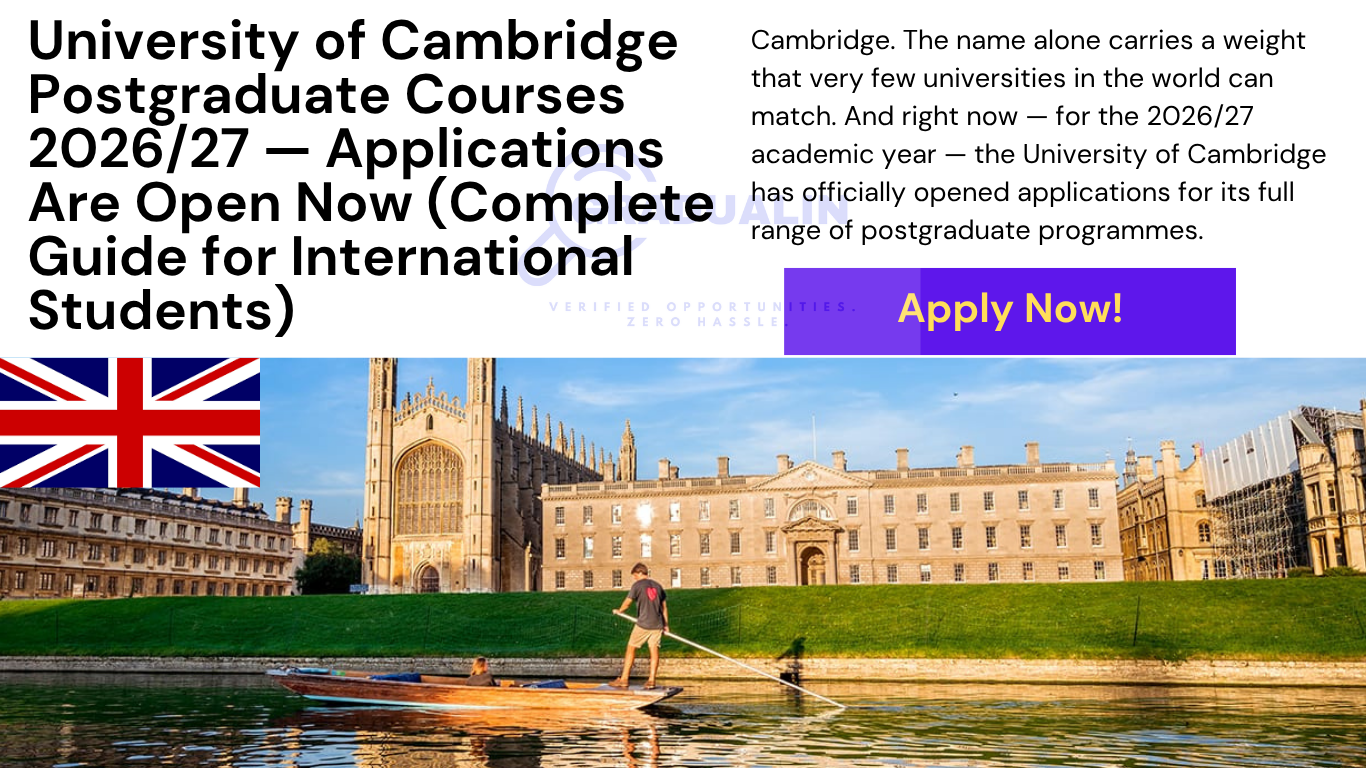
Cambridge. The name alone carries a weight that very few universities in the world can match. And right now — for the 2026/27 academic year — the University of Cambridge has officially opened applications for its full range of postgraduate programmes. That means over 300 courses across PhD, MPhil, Master’s, Diploma, and Certificate levels are currently accepting applicants from around the world.
If you have been thinking about studying at one of the most celebrated universities in human history, this is your window. This complete guide on Gradualin walks you through every open course category, what Cambridge looks for, how to apply, funding options, and exactly what makes this opportunity worth pursuing.
📋 Quick Summary Table
| Detail | Information |
| University | University of Cambridge |
| Country | United Kingdom 🇬🇧 |
| Cycle Status | ✅ OPEN — Applications for 2026/27 now accepted |
| Total Courses Available | 300+ postgraduate programmes |
| Degree Types | PhD, MPhil, MSt, MASt, PGDip, PGCert |
| Study Mode | Full-time and Part-time options available |
| Open To | International Students Worldwide |
| Application Portal | apply.postgraduate.study.cam.ac.uk |
| Course Directory | postgraduate.study.cam.ac.uk/courses |
| Funding Available | Yes — University, Gates, Commonwealth, and more |
🎓 About the University of Cambridge — A Legacy Like No Other
The University of Cambridge was founded in 1209, making it over 800 years old and one of the oldest universities in the world. It consistently ranks among the top 3 universities globally across every major ranking system — QS, Times Higher Education, and the Academic Ranking of World Universities.
Here is what makes Cambridge genuinely exceptional:
Cambridge is not just prestigious on paper. It is a place where Isaac Newton developed calculus, where Watson and Crick described the structure of DNA, and where generations of researchers have shaped the modern world. The university has produced 121 Nobel Prize winners — more than any other institution on Earth.
What makes the postgraduate experience here unique is the supervision system. Every Cambridge postgraduate student is assigned a personal supervisor — an expert in their specific field who guides their research directly. This is not a lecture-hall model. It is intense, personal, and intellectually demanding in the best possible way.
For Gradualin readers considering UK postgraduate study, Cambridge is the benchmark — and with applications now open, the timing could not be better.
🎓 Currently Open Courses — 2026/27 Cycle
The Cambridge postgraduate course directory lists 354 courses in total across all levels and departments. Many are currently open for 2026/27 applications. Below is a representative breakdown of confirmed open programmes across key disciplines, based on the official course directory (verify each course’s status at the official portal before applying, as some are marked “Closed this cycle”):
🔬 Science, Technology & Engineering
- 2D Materials of Tomorrow — PhD (EPSRC CDT) | 3–4 years full-time
- Advanced Chemical Engineering — MPhil | 11 months full-time
- Advanced Materials for the Energy Transition — MPhil | 11 months full-time
- Aerosol Science — PhD (EPSRC CDT) | 3–4 years full-time
- Applied Mathematics and Theoretical Physics — PhD | 3–4 years full-time
- Astrophysics — MASt | 9 months full-time
- Basic and Translational Neuroscience — MPhil | 11 months full-time
- Biochemistry — PhD | 3–4 years full-time
- Astronomy — MPhil | 12 months full-time
🌍 Social Sciences, Law & Policy
- AI Ethics and Society — MSt | 21 months part-time
- American History — MPhil | 9 months full-time
- Applied Criminology and Police Management — MSt | 2 years part-time
- Applied Criminology, Penology and Management — MSt | 2 years part-time
🎭 Humanities, Arts & Languages
- Anglo-Saxon, Norse and Celtic — MPhil | 9 months full-time
- Anglo-Saxon, Norse and Celtic — PhD | 3–4 years full-time
- Archaeological Research — MPhil | 10 months full-time
- Archaeological Science — MPhil | 10 months full-time
- Archaeology — MPhil | 10 months full-time
- Archaeology — PhD | 3–4 years full-time
- Assyriology — MPhil | 10 months full-time
🌏 Area Studies & International Programmes
- Asian and Middle Eastern Studies — PhD | 3–4 years full-time
- Asian and Middle Eastern Studies (Chinese Studies) — MPhil | 11 months full-time
- Asian and Middle Eastern Studies (Classical Islamic History and Culture) — MPhil | 11 months full-time
- Asian and Middle Eastern Studies (East Asian Popular Culture) — MPhil | 11 months full-time
- Asian and Middle Eastern Studies (Hebrew & Pre-Modern Jewish History) — MPhil | 11 months full-time
- Asian and Middle Eastern Studies (Hebrew and Semitic Studies) — MPhil | 11 months full-time
- Asian and Middle Eastern Studies (Japanese Studies) — MPhil | 11 months full-time
- Asian and Middle Eastern Studies (Korean Studies) — MPhil | 11 months full-time
- Asian and Middle Eastern Studies (Modern Middle Eastern Studies) — MPhil | 11 months full-time
- Asian and Middle Eastern Studies (Muslim-Jewish Relations) — MPhil | 11 months full-time
🏥 Medicine & Life Sciences
- Antarctic Studies — PhD | 3–4 years full-time
- Anthropocene Studies — (check status)
- And many more across clinical medicine, public health, genetics, and pharmacology (see full directory)
📌 This is a representative sample. The full directory lists 354 courses. To see all currently open programmes, visit postgraduate.study.cam.ac.uk/courses and look for courses without the “Closed this cycle” label.
🎓 Types of Cambridge Postgraduate Degrees — Explained
Cambridge offers several distinct degree types. Here is what each one means:
- PhD (Doctor of Philosophy): The standard research doctorate — typically 3–4 years full-time (or 4–7 years part-time). You conduct original research under a supervisor and submit a thesis. This is the route for those pursuing an academic or senior research career.
- MPhil (Master of Philosophy): A one-year postgraduate degree available in both taught and research formats — typically 9–12 months full-time. One of Cambridge’s most popular entry-level postgraduate routes.
- MSt (Master of Studies): Usually a part-time taught degree, often 21 months to 2 years. Common in professional and interdisciplinary fields.
- MASt (Master of Advanced Study): A 9-month intensive taught degree, typically in STEM disciplines. Highly competitive and designed for students with strong undergraduate backgrounds.
- PGDip (Postgraduate Diploma): A shorter qualification, usually 9 months, often part-time.
- PGCert (Postgraduate Certificate/Award): The shortest postgraduate qualification type offered by Cambridge.
🎓 Eligibility Criteria
Requirements vary by course, but general criteria for Cambridge postgraduate admission include:
- ✅ A strong undergraduate degree — typically a First Class or upper Second Class Honours (or international equivalent) from a recognized university
- ✅ Open to international applicants from all countries worldwide
- ✅ English language proficiency — Cambridge accepts IELTS, TOEFL, and C1 Advanced (CAE). Minimum requirements vary by course (check individual programme pages)
- ✅ Research proposal required for most PhD and research MPhil applications
- ✅ Academic references — typically two or three academic referees required
- ✅ Relevant academic background aligned to the chosen programme
- ✅ For some programmes (especially PhD): identifying a potential supervisor before applying is strongly recommended
Note on English Language: Cambridge requires formal English test scores for most international applicants. However, applicants whose previous degree was taught entirely in English may be exempt from submitting a test score — verify this with the individual programme requirements.
🎓 Who Should Apply — And Who Should Not
✅ Apply if you:
- Hold a strong undergraduate (or Master’s) degree in your chosen field
- Are passionate about research, academic inquiry, or professional development at the highest level
- Want access to Cambridge’s world-class supervision system, libraries, and research networks
- Are prepared to apply for funding alongside your course application
- Can commit to the rigorous academic demands of Cambridge postgraduate study
- Are an international student seeking one of the world’s most recognized degrees
❌ Don’t apply if you:
- Are looking for a distance-learning or fully online postgraduate programme — Cambridge is campus-based in Cambridge, UK
- Do not meet the academic entry requirements (check each course page individually)
- Are applying to a programme already marked “Closed this cycle” — look for the open ones only
- Do not have a compelling research proposal for research degrees
🎓 Funding & Scholarships at Cambridge
Here is the most important thing to know: Cambridge has substantial funding available, and you can apply for most of it at the same time as your course application. Key funding sources include:
- 🏆 Gates Cambridge Scholarship — one of the world’s most prestigious fully funded awards for outstanding international postgraduate students at Cambridge. Covers full tuition + living allowance (verify current deadline)
- 🌍 Cambridge Commonwealth, European & International Trust — partial and full awards for students from Commonwealth countries and beyond
- 🎓 Cambridge International Scholarships — for PhD students from outside the UK
- 💷 College Awards — each of Cambridge’s 31 colleges has its own funding pots; applying to a college means access to these awards
- 🔬 Research Council Funding (UKRI) — for eligible students on specific PhD programmes
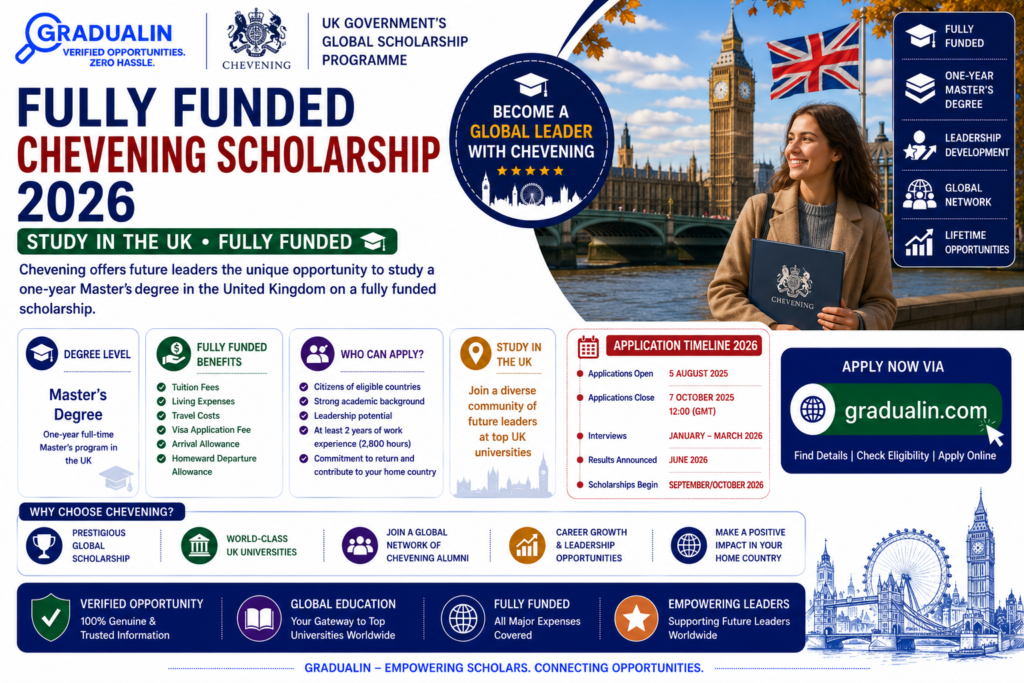
- 🌐 External & Government Scholarships — including Chevening (UK government), Commonwealth Scholarship, and country-specific awards
For the full funding guide, visit: postgraduate.study.cam.ac.uk/funding
🎓 Required Documents
Most Cambridge postgraduate applications require:
- Academic transcripts — all previous university qualifications
- Personal statement — outlining your academic background, research interests, and reasons for choosing Cambridge
- Research proposal — essential for PhD and research MPhil programmes (typically 2–3 pages)
- Two or three academic references — submitted directly by your referees through the online portal
- English language certificate — IELTS, TOEFL, or CAE (unless exempt)
- CV / Academic résumé
- Application fee — a non-refundable application processing fee applies (verify current amount at the official site)
- Writing samples or portfolios — required by some humanities and arts programmes
🎓 Step-by-Step Application Process
Applying to Cambridge postgraduate programmes is a detailed but manageable process. Here is how to approach it:
- Browse the Course Directory at postgraduate.study.cam.ac.uk/courses — filter for open courses only (avoid those labelled “Closed this cycle”)
- Read your chosen course page thoroughly — note the specific entry requirements, deadline, and any supervisor identification guidance
- Identify a potential supervisor (for research degrees) — browse departmental pages and email prospective supervisors before applying
- Choose your college — Cambridge has 31 colleges; you can express a college preference or leave it open during application
- Register and start your application at apply.postgraduate.study.cam.ac.uk
- Complete the application form — personal details, academic history, course selection, college preference, funding applications
- Upload all required documents — transcripts, personal statement, research proposal, CV, English test scores
- Nominate your referees through the portal — they will receive an automated invitation to submit their references
- Pay the application fee and submit
- Track your application via the Applicant Self-Service portal — decisions are communicated through this system
Pro tip from Gradualin: Cambridge has multiple application deadlines per year for many courses, with early deadlines often linked to funding competitions (like the Gates Scholarship). Applying early significantly improves both your admission and funding prospects.
🎓 Important Deadlines
Cambridge sets course-specific deadlines rather than a single universal deadline. Key points to know:
| Detail | Information |
| 2026/27 Cycle Status | ✅ OPEN NOW |
| Deadlines | Vary by course — check each individual course page |
| Early Deadline Benefit | Applications submitted by the first deadline are considered for most funding competitions |
| Gates Cambridge Deadline | Typically October/November for non-US applicants (verify officially) |
| Rolling Admissions | Some research programmes accept applications on a rolling basis |
📌 Always check your specific course page for its exact deadline. Visit postgraduate.study.cam.ac.uk/apply/application-deadlines for the full deadline guide.
🎓 Why Cambridge — Why Now
Let’s be direct about what a Cambridge postgraduate degree actually means for your life and career.
It opens every door. A Cambridge degree is recognized at the highest levels globally — in academia, government, international organizations, law, medicine, finance, and technology. The name alone gives your CV a credibility that is extremely difficult to achieve anywhere else.
The research environment is unmatched. Cambridge’s libraries, laboratories, and interdisciplinary networks represent centuries of accumulated intellectual infrastructure. The University Library holds over 10 million items. The Cavendish Laboratory produced the discovery of the electron, the neutron, and the structure of DNA. You will be working inside one of the greatest research ecosystems on earth.
The college system is genuinely special. Each of Cambridge’s 31 colleges is a self-contained community — with its own dining hall, library, social spaces, and welfare support. Your college becomes your home base and social network for the duration of your studies, making Cambridge an unusually tight-knit community for a world-famous institution.
Cambridge, the city, is extraordinary. With its iconic punt-lined River Cam, historic architecture, cycling culture, and vibrant arts scene, Cambridge is consistently rated one of the UK’s most desirable places to live. It is safe, compact, and deeply student-oriented.
And right now — with applications officially open — the opportunity is yours to take.
🎓 Frequently Asked Questions (FAQ)
Q: Are Cambridge postgraduate courses open to international students? A: Yes. Cambridge actively welcomes applications from students worldwide and has a dedicated international admissions team. The university’s postgraduate community is highly international, with students from over 150 countries.
Q: Do I need IELTS or TOEFL to apply? A: Most international applicants are required to submit an English language test score — Cambridge accepts IELTS Academic, TOEFL iBT, and Cambridge C1 Advanced (CAE). Applicants whose previous undergraduate or postgraduate degree was taught entirely in English may be eligible for an exemption — check your specific programme page.
Q: Can I apply to multiple Cambridge courses? A: You can only submit one postgraduate application per cycle at Cambridge. Choose your programme carefully before starting your application.
Q: How competitive is Cambridge postgraduate admission? A: Very competitive — Cambridge receives thousands of applications for a limited number of places. Strong academics, a compelling research proposal (for research degrees), excellent references, and early applications all significantly improve your chances.
Q: Can I apply for funding at the same time as my course? A: Yes. The Cambridge application system allows you to apply for University funding opportunities simultaneously with your course application — this is strongly recommended.
Q: What does “Closed this cycle” mean next to a course? A: It means that particular programme is not accepting applications for the 2026/27 intake. Focus your application on courses that do not carry this label.
🎓 Official Links & Contact
- 🌐 Course Directory (Open Courses): https://www.postgraduate.study.cam.ac.uk/courses
- 📋 Start Your Application: https://apply.postgraduate.study.cam.ac.uk/applicant/login
- 💰 Funding & Scholarships: https://www.postgraduate.study.cam.ac.uk/funding
- 📅 Application Deadlines: https://www.postgraduate.study.cam.ac.uk/apply/application-deadlines
- 🌍 International Students: https://www.postgraduate.study.cam.ac.uk/international
- 🏛️ Why Cambridge: https://www.postgraduate.study.cam.ac.uk/why-cambridge
🎓 Complete Summary Table
| Detail | Information |
| University | University of Cambridge |
| Country | United Kingdom 🇬🇧 |
| Cycle | 2026/27 — OPEN NOW |
| Programmes Available | 300+ (PhD, MPhil, MSt, MASt, PGDip, PGCert) |
| Study Mode | Full-time and Part-time |
| Application System | Cambridge Applicant Portal |
| English Test Required | Yes (IELTS / TOEFL / CAE) — exemptions possible |
| Funding Available | Gates Cambridge, Cambridge Trust, College Awards + more |
| Deadlines | Course-specific — check individual pages |
| Open To | International students worldwide |
| Official Directory | postgraduate.study.cam.ac.uk/courses |
🔗 Explore More Opportunities on Gradualin
Browse by Category:
You Might Also Like:
- 🇬🇧 Fully Funded PhD Scholarships in the UK 2026
- 🇦🇺 Fully Funded Scholarships in Australia 2026
- 🇺🇸 Fully Funded Scholarships in the USA 2026
- 🇮🇹 Study in Italy 2026 — Complete Guide
- 🇫🇮 Finland Scholarships 2026 — Tuition Waivers
Stay updated with the latest scholarships, jobs, and opportunities at Gradualin.com — your trusted guide to studying abroad for free.