
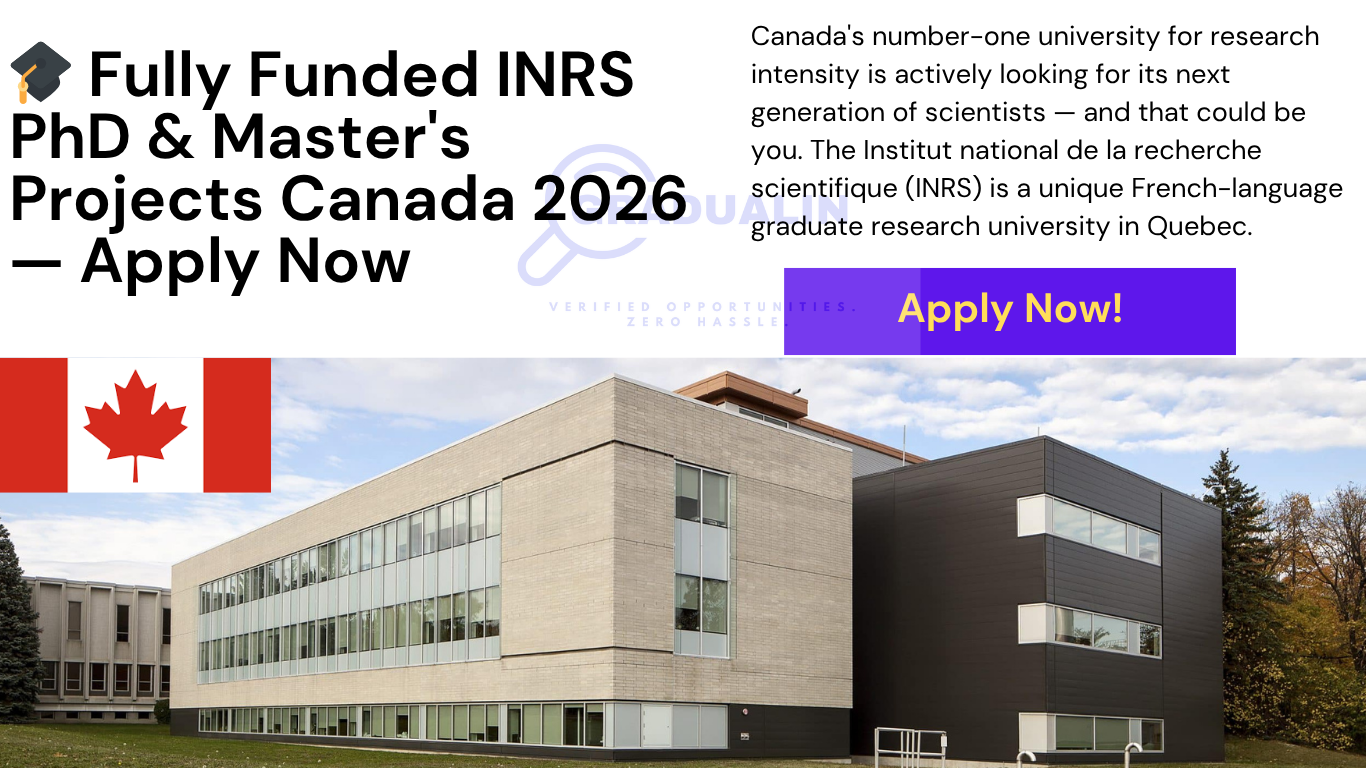
Canada’s number-one university for research intensity is actively looking for its next generation of scientists — and that could be you. The Institut national de la recherche scientifique (INRS) is a unique French-language graduate research university in Quebec, and it recruits Master’s and PhD students year-round for funded research projects spanning health sciences, water and environment, energy and materials, telecommunications, urban studies, and more.
This isn’t your typical application to a large, anonymous university. At INRS, every student works directly alongside a professor in a close, mentored research environment — with financial support offered on most projects. If you’ve been dreaming of studying in Canada, doing meaningful research, and building a career in science or engineering, this guide has everything you need to know: how INRS works, what projects are available, how you get funded, and exactly how to apply.
📋 Quick Info Box
| Detail | Information |
| Institution | INRS — Institut national de la recherche scientifique |
| Country | Canada 🇨🇦 |
| Province | Québec |
| Degree Levels | Master’s (M.Sc.) & Doctorate (Ph.D.) |
| Funding | Financial support offered on most projects |
| Intakes | Fall, Winter, and Summer — year-round recruitment |
| Research Areas | Health, Environment, Energy, Materials, Telecom, Urban Studies |
| Language | French (primary); free French courses available |
| Open To | International & Domestic Students |
| Official Website | inrs.ca |
| Project Listings | Find a Project |
🎓 Opportunity Overview
INRS is not like other universities. Founded in 1969 by the Government of Quebec, it was created with a single, powerful mission: to advance research and train highly qualified scientists who could contribute to the social, economic, and technological development of Quebec and the world.
The results speak for themselves. INRS has been ranked number one in Canada for research intensity for nearly a decade, thanks to the expertise of its professors and the excellence of its students. It operates with no undergraduate programs — every single student at INRS is a graduate researcher. That means more funding, more lab time, more supervision, and more publications per student than at virtually any other institution in the country.
INRS brings together professors, researchers, graduate students, and postdoctoral fellows across four research centres in Montreal, Quebec City, Laval, and Varennes, and offers 26 distinct and highly specialized programs — including 14 master’s and 8 doctorates — with research profiles or without.
The project-based model is what makes INRS truly exceptional. Instead of applying to a program and hoping for the best, you browse actual research projects that professors are actively funding and recruiting for — then apply directly to the one that matches your background and interests. INRS professors recruit year-round, but there are more options in the spring, so it pays to keep an eye on the listings.
🎓 Benefits & Financial Support
Here’s the best part: the vast majority of INRS research projects come with financial support built in. This is not a vague promise — it is a structured feature of how graduate study at INRS works.
What financial support at INRS typically includes:
- ✅ Institutional scholarships for full-time graduate students — paid per term across your enrollment period
- ✅ Supervisor research grants — most supervisors directly fund their students from active research grants
- ✅ Supplemental tuition fee exemptions specifically for international students — a significant reduction in the fees non-Quebec students would otherwise pay (verify current amounts on official website)
- ✅ External scholarship support — INRS actively encourages students to apply for government-funded scholarships from agencies like NSERC, FRQNT, CIHR, and SSHRC
- ✅ International mobility scholarships — for students who want to spend part of their studies at universities in British Columbia, Japan, or New Zealand
Regular full-time students in the social sciences receive scholarship payments for three to four consecutive terms at the master’s level and six to eight terms at the PhD level. Students in health sciences or pure and applied sciences follow a similar structured payment schedule.
Here’s the big picture: At INRS, you’re not just a student paying tuition — you’re a funded researcher contributing to active, published science. The combination of institutional scholarships, supervisor grants, and external funding opportunities makes INRS one of the most financially accessible graduate research destinations in Canada for international students.
For context: INRS faculty receive more grant funding for their work than anyone else in Quebec and publish an impressive number of articles in scholarly journals every year. Professors with large grants fund multiple students — so your chances of finding a well-supported project are genuinely high.
🎓 Eligibility Criteria
INRS eligibility varies by project and program. Here are the general requirements that apply across most Master’s and PhD research projects:
Academic Requirements:
- ✅ A relevant undergraduate degree (for Master’s applicants) or a completed Master’s degree (for PhD applicants)
- ✅ Strong academic record — specific GPA thresholds vary by project and supervisor
- ✅ Prior research experience is a significant advantage (lab work, thesis, publications)
Language Requirements:
- ✅ French is the primary language of instruction and research at INRS
- ✅ If you are not yet proficient in French, INRS offers free French language courses for enrolled students
- ✅ IELTS/TOEFL may be required for English-language documentation as part of admissions, depending on your country of origin
- ✅ Contact your potential supervisor or INRS admissions to clarify language requirements for your specific situation (verify on official website)
Key point: French is the official language at INRS. If you are not yet proficient in French, you can take free language courses offered at INRS. Don’t let the language requirement stop you — many international students arrive with basic French and build fluency during their studies.
Other Requirements:
- ✅ A research supervisor must agree to supervise your studies before you can be formally admitted
- ✅ Specific technical skills depend entirely on the individual project (see project listings)
- ✅ International students must meet Canadian study permit requirements
🎓 Who Should Apply (And Who Should Not)
✅ Apply If You:
- Have a strong academic record in science, engineering, health, social sciences, or a closely related field
- Are genuinely interested in research — not just coursework — and want to contribute to published science
- Are open to living and working in French (or committed to learning it)
- Want a mentored, close-knit research environment with direct access to your supervisor
- Are interested in one of INRS’s five research areas: health, environment, energy/materials, telecommunications, or urban/social sciences
❌ Don’t Apply If You:
- Are looking for an undergraduate degree — INRS only offers graduate-level programs
- Are unwilling to engage with French as a working language during your studies
- Want a coursework-only graduate degree with no research commitment
- Are not prepared to secure a supervisor’s agreement before applying to a program
🎓 Research Areas & Available Programs
INRS’s research projects are organized around five major thematic centres, each based in different cities across Quebec. Here’s a complete overview:
🔬 1. Armand-Frappier Santé Biotechnologie Research Centre
Location: Laval, Quebec
Focused on health sciences and biotechnology, this centre is home to researchers working on infectious diseases, vaccines, immunology, cancer biology, and microbiology. Projects here span everything from virology to food safety to pharmaceutical development. If you have a background in biology, biochemistry, biomedical science, or microbiology — this is your home.
Graduate Programs Available:
- Biology
- Experimental Health Sciences
- Microbiology and Biotechnology
- Virology and Immunology
💧 2. Eau Terre Environnement Research Centre
Location: Quebec City, Quebec
This centre tackles some of the most pressing environmental challenges of our time — water quality, geosciences, and sustainable development. Projects range from drinking water treatment to geological risk assessment to climate impact modeling. A perfect fit for students in environmental engineering, geoscience, hydrology, or chemistry.
Graduate Programs Available:
- Earth Sciences
- Water Sciences
- Environment and Sustainable Development
⚡ 3. Énergie Matériaux Télécommunications (EMT) Research Centre
Location: Varennes and Montreal, Quebec
One of INRS’s most technically diverse centres, EMT covers energy systems, advanced materials, and telecommunications engineering. Projects include laser physics, photovoltaics, nanomaterials, wireless communications, signal processing, and more. Ideal for students in physics, electrical engineering, materials science, or computer engineering.
Graduate Programs Available:
- Energy and Materials Science
- Telecommunications
🏙️ 4. Urbanisation Culture Société Research Centre
Location: Montreal, Quebec
This centre focuses on the social, cultural, and urban dimensions of contemporary life — from urban planning and housing policy to demography and cultural analysis. A unique environment that bridges social science rigor with real policy impact. Strong fit for students in sociology, urban studies, demographics, and political science.
Graduate Programs Available:
- Urban Studies
- Population Studies
- Culture
- Knowledge Mobilization and Transfer
🌿 5. Ruralités Durables Research Centre (newest centre)
Location: Quebec
INRS’s newest research centre focuses on sustainable rural development — a rapidly growing field as governments worldwide grapple with rural depopulation, resource management, and regional inequalities. (Verify current project availability on the official website.)
🎓 Required Documents
When applying for a specific INRS research project, you’ll generally need to prepare:
- Curriculum Vitae (CV) — academic and research experience, publications, conferences
- Academic Transcripts — from all post-secondary institutions attended
- Letter of Intent / Research Statement — explaining your background, research interests, and why you want to work with this specific supervisor on this specific project
- Letters of Reference — typically 2–3 academic or professional references
- Proof of Language Proficiency — French and/or English, depending on requirements (verify with your target supervisor)
- Copy of your Degree — or proof of expected completion if currently enrolled
Each individual project and supervisor may have additional specific requirements — always check the project listing and contact the professor directly.
🎓 Step-by-Step Application Process
Before you can be admitted to a program of study at INRS, a faculty member must agree to supervise your graduate studies. Once this condition has been met, you can proceed to the next steps.
Here’s exactly how the process works:
- Browse the project listings — Go to inrs.ca/en/studies/masters-and-phd-projects/find-a-masters-or-phd-project/ and filter by your field, degree level, term, and whether financial support is offered.
- Use the “Find Your Research Supervisor” questionnaire — INRS offers a dedicated tool at inrs.ca/en/studies/find-your-research-supervisor/ that matches your interests to available supervisors in just a few steps. This is an underused but powerful starting point.
- Contact the supervisor directly — Once you’ve identified a project and professor you’re interested in, reach out by email. Introduce yourself, attach your CV, briefly describe your background, and express your interest in their specific project. Keep it concise and professional.
- Get the supervisor’s agreement — If the professor is interested, they will indicate their willingness to supervise you. This step is required before formal application.
- Apply for admission — With a supervisor confirmed, you can formally apply through INRS’s admissions process at inrs.ca/en/studies/how-to-apply/. Submit all required documents through the official portal.
- Apply for external scholarships — INRS strongly encourages all students to simultaneously apply for external funding from agencies like NSERC (natural sciences), FRQNT (Quebec government), CIHR (health research), or SSHRC (social sciences). Your supervisor can advise on which agency fits your research.
- Receive your admission decision — INRS will review your file, confirm your supervisor’s support, and issue a formal admission offer.
🎓 Important Dates & Deadlines
| Milestone | Details |
| Project Recruitment | Year-round — new projects added regularly |
| Peak Season | Spring — most new projects posted |
| Intakes Available | Fall, Winter, and Summer terms |
| Supervisor Contact | As early as possible — supervisors fill positions quickly |
| Individual Deadlines | Vary by project — check each listing carefully |
⚠️ There is no single universal deadline at INRS. Each project has its own timeline set by the supervising professor. The most important action you can take is to contact your target supervisor as soon as possible — positions can be filled months before the official intake.
📌 Bookmark this page and check back for updates. New projects are added throughout the year.
🎓 Why Apply — Why INRS & Quebec, Canada
Let’s be real: there are many graduate programs in the world. So why INRS?
Here’s what makes INRS genuinely different:
INRS has a professor-student ratio that allows for personalized supervision and close collaboration throughout the course of study. At larger universities, you might go weeks without seeing your supervisor. At INRS, you are an active member of a small, focused research team. Your name goes on the papers. Your ideas shape the research.
INRS has over 1,500 publications annually with international partners — meaning the research you do here will be read, cited, and built upon by scientists around the world.
Quebec is an extraordinary place to live as a graduate student. Montreal, where several INRS centres are located, is consistently ranked as one of the best student cities in the world — internationally diverse, culturally rich, affordable compared to other Canadian cities, and home to a thriving tech and life sciences ecosystem. Quebec City, where the Eau Terre Environnement centre is based, offers a stunning, historic European-style setting with some of the lowest rents among major Canadian cities.
For international students specifically, INRS is one of the few Canadian institutions that has built an explicit tuition exemption program to make graduate study financially accessible for students from outside Quebec. Add that to institutional scholarships and supervisor funding, and INRS becomes one of the most viable paths to a fully supported Canadian research degree.
And if you’re thinking long-term — if you’re thinking of making your home in Quebec after you graduate, it’s never too early to start gathering information on the necessary administrative procedures for permanent residency. Quebec has its own immigration stream (the Quebec Experience Program / Programme de l’expérience québécoise), which gives INRS graduates a meaningful advantage.
🎓 Frequently Asked Questions (FAQ)
Q: Can international students apply to INRS research projects? A: Yes. INRS actively welcomes international graduate students and describes itself as a multicultural French-language research and training institute in Quebec that offers a rich and rewarding experience on both the personal and scientific level. You will need to meet standard Canadian study permit requirements and INRS language requirements.
Q: Do I need to speak French to study at INRS? A: French is the primary working language at INRS. However, if you are not yet fluent, INRS offers free French language courses for enrolled students. Many international researchers arrive with intermediate French and develop full proficiency during their studies. Contact your potential supervisor to discuss language expectations for their specific project.
Q: Is IELTS or TOEFL required? A: INRS’s primary language requirement is French. English proficiency documentation may be required depending on your country of origin and specific program. Verify current language admission requirements at inrs.ca/en/studies/how-to-apply/ or contact the admissions office directly. (Verify on official website.)
Q: How do I find a research project that matches my background? A: Two tools: (1) browse the filterable project listings at inrs.ca/en/studies/masters-and-phd-projects/find-a-masters-or-phd-project/, filtering by degree level, research area, term, and financial support; and (2) use the “Find Your Research Supervisor” questionnaire at inrs.ca/en/studies/find-your-research-supervisor/ to match your interests to available faculty in three steps.
Q: Can I get full funding as an international student? A: INRS strongly encourages students to take advantage of its own scholarship and financial assistance programs as well as those offered by private and public funding agencies. Many projects are listed with financial support offered, and INRS also has a supplemental tuition fee exemption program specifically for international students. The exact funding package depends on your supervisor and project. (Verify on official website.)
Q: When should I contact a potential supervisor? A: As early as possible. Research positions at INRS fill on a rolling basis. The spring semester typically sees the most new project postings, but supervisors recruit year-round. Don’t wait for a “deadline” that may never come — reach out now.
🎓 Official Source & Links
- 🌐 INRS Main Website: https://inrs.ca/en/
- 🎓 Find a Master’s or PhD Project: inrs.ca/en/studies/masters-and-phd-projects/find-a-masters-or-phd-project/
- 🔍 Find a Research Supervisor: inrs.ca/en/studies/find-your-research-supervisor/
- 📋 How to Apply: inrs.ca/en/studies/how-to-apply/
- 💰 Scholarships & Financial Aid: inrs.ca/en/studies/scholarships-and-financial-aid/
- 🌍 Future International Students: inrs.ca/en/studies/future-students/future-international-students
🎓 Complete Summary Table
| Detail | Information |
| Institution | INRS — Institut national de la recherche scientifique |
| Country | Canada 🇨🇦 |
| Province | Québec |
| Campuses | Montreal, Quebec City, Laval, Varennes |
| Degree Levels | Master’s & PhD (26 specialized programs) |
| Research Focus Areas | Health/Biotech, Water/Environment, Energy/Materials/Telecom, Urban/Social Sciences, Rural Studies |
| Funding | Institutional scholarships + supervisor grants + tuition exemptions for international students |
| Language | French (free courses available) |
| Intakes | Fall, Winter, Summer — year-round |
| Who Can Apply | International & domestic graduate students |
| First Step | Browse projects → Contact supervisor → Get agreement → Apply formally |
| Project Listings | Find a Project |
| Official Website | inrs.ca |
🔗 Explore More on Gradualin
Browse by Category:
Related Opportunities You’ll Love:
- 🎓 Fully Funded PhD Scholarships in the UK 2026
- 🎓 Fully Funded Scholarships in the USA 2026
- 🎓 Fully Funded Scholarships in Australia 2026
- 🎓 Study in Italy 2026 — Complete Guide
- 🎓 Finland Scholarships & Tuition Waivers 2026
Stay updated with the latest scholarships, jobs, and opportunities at Gradualin.com — your trusted guide to studying abroad for free.