
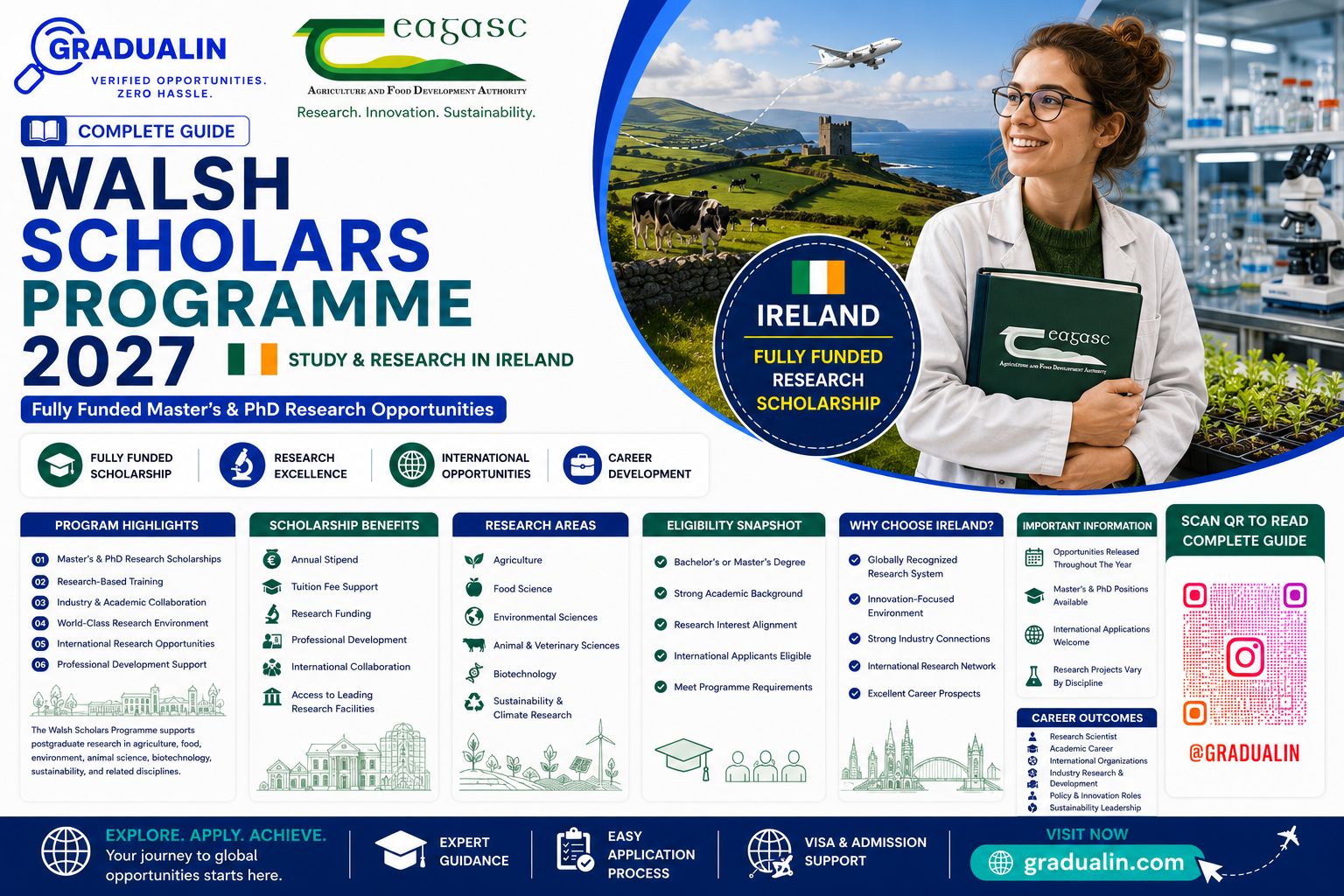
Ireland isn’t the first country that comes to mind when most students think about funded PhD opportunities — but it absolutely should be. The Teagasc Walsh Scholars Programme is one of Ireland’s most established postgraduate scholarship schemes, and right now it has multiple fully funded PhD and MSc positions open with deadlines hitting at the end of June and early July 2026. If you’re a science, agriculture, food, or environmental graduate looking to pursue research at the intersection of real-world impact and cutting-edge science, this one is worth reading carefully.
| Detail | Information |
| Organisation | Teagasc — Agriculture and Food Development Authority |
| Country | Ireland |
| Degree Level | PhD (primarily) / MSc |
| Annual Grant | €24,000 per annum |
| New Places Per Year | Up to 35 |
| Total Active Scholars | ~140 at any time |
| Annual Programme Budget | €3.65 million |
| Current Openings | 10 positions (PhD + MSc) |
| Nearest Deadlines | 26 June 2026 & 3 July 2026 |
| Official Link | Browse Open Positions |
🎓 About the Walsh Scholars Programme
The Walsh Scholars Programme is Teagasc’s flagship postgraduate research initiative, named after the late Dr Tom Walsh — the first Director of Ireland’s Agricultural Research Institute and a foundational figure in building Irish agricultural science. The programme has been running for over 25 years and has trained generations of researchers who now work across Irish and international academia, government, and industry.
Teagasc itself is Ireland’s national Agriculture and Food Development Authority — a state agency that combines research, advisory services, and education across every aspect of Irish food and farming. Its research centres are distributed across the country, and scholars are embedded within these facilities alongside leading scientists, with joint supervision from Irish university partners.
Here’s what makes the programme genuinely distinctive: this isn’t a standard university-run scholarship. Scholars work inside Teagasc’s national research infrastructure — think dedicated dairy, livestock, crop, and food science facilities — while being formally enrolled at a partner university for their degree. You get the resources of a government research agency combined with the academic standing of an Irish university. That combination is rare.
With some 140 scholars active at any one time and up to 35 new positions awarded each year, this is a well-established, high-volume programme — not a tiny competitive award that only materialises for a handful of people annually.
🎓 Benefits and Funding
The Walsh Scholars Programme is fully funded. Here’s what scholars receive:
- Annual stipend of €24,000 per annum for the full duration of the award
- PhD duration is normally 3 to 4 years (fully funded for that period)
- MSc duration is a maximum of 2 years (only awarded in exceptional circumstances)
- Supervision from leading Teagasc researchers and co-supervisors at Irish universities
- Access to Teagasc’s state-of-the-art national research facilities — laboratories, pilot plants, experimental farms, and analytical infrastructure
- Opportunities for international collaboration, conference travel, and research visits
- Professional development training covering research skills, communication, leadership, and problem-solving
- Membership of a cohort-based research community with peer support built in
Note: The €24,000 figure is the annual grant. Tuition fees and other costs should be verified with the specific supervisor and partner university at application stage (verify on official website).
🎓 Eligibility Criteria
This is important — the Walsh Scholars Programme has a specific application structure that differs from most scholarship programmes:
- Applications are not made directly by students. They are made by academic staff at Irish third-level colleges in collaboration with a Teagasc researcher. The academic team submits a project proposal, and if successful, they then invite eligible students to apply.
- To be eligible as a student, you need to hold a relevant undergraduate degree (typically a first or upper second class honours Bachelor’s degree in a relevant discipline — verify specific requirements with your target supervisor)
- Research must fall within Teagasc’s broad scope: agriculture, horticulture, food science, agri-food economics, rural development, rural environment, or climate
- Programmes must be full-time and research-based — taught (non-research) postgraduate programmes are not funded
- Location should preferably be at a Teagasc Research Centre
- International graduates may apply through advertised individual project positions — if a position is currently advertised on the opportunities page, the invitation to apply is open to eligible graduates regardless of nationality (verify on official website)
🎓 Who Should Apply — and Who Shouldn’t
✅ This is a strong fit for you if:
- You have a Bachelor’s degree in agriculture, food science, biology, environmental science, animal science, veterinary science, or a related field
- You’re passionate about research that directly shapes Irish or global food systems, climate policy, or agricultural practice
- You want to work inside a professional national research institution, not just within a university department
- You’re motivated by applied science — the kind of work that feeds into government policy and industry practice, not just academic journals
- You want a funded programme with structured professional development built in
❌ This is likely not suitable if:
- You’re looking for a taught or coursework-based postgraduate programme — Walsh Scholars is research-only
- Your field falls entirely outside agriculture, food, environment, or rural development
- You want to be based in a city campus environment — most positions are at Teagasc’s rural research centres
- You’re expecting to apply directly without first connecting with a supervisor — the system requires engagement with a Teagasc researcher or academic collaborator
🎓 Current Open Positions — 2026
Here are all the live opportunities currently advertised, with their deadlines. Each position has a specific PDF with full project details, supervisor names, and application instructions:
Closing 26 June 2026:
Closing 3 July 2026 (5:00 pm):
- MSc Ref 2024014 — Optimising Irish Pot Still Whiskey Production Through the Use of Native Grain Crops
- PhD Ref 2025202 — Optimising Perennial Ryegrass Traits to Improve Productivity and Sustainability in Grass-Based Livestock Systems
- PhD Ref 2025206 — Designing a Full Farm System Bio-Economic Model for the Irish Hill Sheep Industry
- PhD Ref 2025207 — Genetics and Advisory Innovations to Reduce Slaughter Age in Irish Beef Cattle
- PhD Ref 2025210 — Assessing the Impact of Methane Inhibitors on Rumen Composition, Milk Composition and Product Quality
- PhD Ref 2025213 — Selecting Protein Variants of k-Casein and β-Lactoglobulin to Enhance Cheddar Cheese and Whey Protein Manufacture
- PhD Ref 2025214 — Selecting Protein Variants of β-Casein to Diversify the Functional Properties of Irish Dairy Products
- PhD Ref 2026001 — Nitrogen Management Strategies for Perennial Ryegrass/White Clover Swards to Improve Grazing Dairy Systems Productivity
- PhD Ref 2026011 — Post-Weaning Nutritional Management to Optimise Lifetime Performance of Dairy-Beef Cattle
Download each PDF for the full project description, supervisor contact details, and specific eligibility requirements. Apply as directed within each document.
🎓 Required Documents
Specific requirements vary by project and supervisor, but applications for Walsh Scholar positions typically include:
- Cover letter / letter of motivation addressed to the named supervisor(s)
- Full curriculum vitae including academic qualifications, grades, and relevant experience
- Official academic transcripts for your undergraduate (and postgraduate if applicable) degree
- Degree certificates or proof of award
- At least two academic references (contact details or letters, as directed in each project PDF)
- English language proof if your primary language is not English (verify requirement with supervisor)
Always read the specific project PDF carefully — each supervisor may have slightly different document requirements and application instructions.
🎓 Step-by-Step Application Process
- Browse the current opportunities at the https://teagasc.ie/about/research-innovation/the-walsh-scholars-programme/walsh-scholars-opportunities/
- Download the PDF for any project that interests you and read it fully — it will contain the project description, supervisor names, what Teagasc is looking for in a candidate, and exactly how to apply
- Contact the named supervisor if you have genuine questions about the project or want to express interest before formally applying — this is encouraged
- Prepare your application documents as specified in each project PDF
- Submit your application directly to the supervisor by the stated deadline (not to Teagasc centrally) — each project specifies its own submission instructions
- Meet the deadline precisely — the 3 July deadline is listed as 5:00 pm Irish time; submissions after this will not be considered
💡 Practical Tip: Before applying, read your target supervisor’s recent publications. Mentioning a specific piece of their work in your cover letter demonstrates genuine research interest and significantly strengthens your application.
🎓 Important Dates
| Deadline | Positions |
| 26 June 2026, 5:00 pm | PhD Ref 2017273 (Dairy Systems Environmental Modelling) |
| 3 July 2026, 5:00 pm | All remaining 9 PhD and MSc positions |
These are the only current deadlines. New positions will be advertised in the coming months — a fresh call for proposals typically goes out in June each year, with a closing date in early September, and positions begin opening from that cohort shortly after.
Bookmark this page and check back for updates — new positions are added on a rolling basis throughout the year.
🎓 Why Apply — Why Ireland and Teagasc
Ireland punches far above its weight in agricultural and food science research. The country is one of Europe’s most significant dairy exporters, and Teagasc sits at the centre of the scientific infrastructure that supports that sector. When you work as a Walsh Scholar, you’re not doing theoretical research that collects dust on a shelf — your work feeds directly into the advisory and policy decisions that shape Irish and European farming.
Here’s what that means practically: supervisors are often published, internationally recognised scientists. Facilities include dedicated pilot plants, experimental herds, molecular biology laboratories, and sensory science suites. Ireland itself is an English-speaking EU member state, which makes it genuinely accessible for international graduates — a visa pathway exists for non-EU researchers, and the country’s science community is closely integrated with European research networks.
For researchers focused on climate, food security, and sustainable agriculture, this is one of the most directly impactful places to do your PhD in Europe right now.
🎓 Frequently Asked Questions
Q: Can I apply directly as an international student without contacting a supervisor first? A: For positions currently advertised on the opportunities page, applications are directed to the named supervisor. The PDF for each project specifies how to apply. International graduates are generally welcome to apply for advertised positions — but you must follow the specific instructions in the project PDF, and the supervisor will assess your eligibility.
Q: Is the €24,000 per year stipend taxable in Ireland? A: Research stipends in Ireland have particular tax treatments — this is something you should clarify with your supervisor or Teagasc’s finance team at application stage (verify on official website).
Q: Are there new positions coming after the July deadline? A: Yes. Teagasc issues a call for new project proposals each June, with a September closing date. New PhD positions arising from that call typically open for student applications in the months that follow. Bookmark the opportunities page and check it regularly.
Q: Can I do the programme part-time? A: The Walsh Scholars Programme funds full-time research programmes only. Part-time arrangements are not supported.
Q: What universities are involved? A: Walsh Scholars are enrolled at Irish third-level universities (verify the specific partner university in each project PDF). Positions are based preferably at Teagasc Research Centres around Ireland, with the supervising academic drawn from a university partner.
Q: Is this programme open to MSc research as well? A: Yes, but MSc positions are awarded only in exceptional circumstances and have a maximum funded duration of 2 years. The vast majority of positions are PhD.
🎓 Official Source
Walsh Scholars PhD Opportunities — TeagascAbout the Walsh Scholars Programme
For queries: walshscholarships@teagasc.ie
Tel: +353 (0)59 9183478
Head Office: Teagasc, Oak Park, Carlow, R93 XE12
🎓 Summary Table
| Detail | Information |
| Programme | Teagasc Walsh Scholars Programme |
| Organisation | Teagasc — Agriculture and Food Development Authority |
| Country | Ireland |
| Degree | PhD (3–4 years) / MSc in exceptional cases (2 years) |
| Annual Grant | €24,000 |
| Positions Per Year | Up to 35 new places |
| Current Open Positions | 10 (9 PhD + 1 MSc) |
| Research Areas | Agriculture, Food, Environment, Climate, Rural Economy |
| Nearest Deadline | 26 June 2026 (1 position) |
| Main Deadline | 3 July 2026, 5:00 pm (9 positions) |
| Open To | Graduates with relevant undergraduate degrees |
| Official Contact | walshscholarships@teagasc.ie |
| Opportunities Page | Apply Here |
Explore More Opportunities on Gradualin
Finland Scholarships 2026 — Tuition Waivers & Grants for International StudentsFully Funded PhD Scholarships in the UK 2026
Fully Funded PhD Positions in Switzerland 2026
Top 10 Fully Funded Scholarships in Asia 2027
Study in Italy 2026 — Guide for International Students
Browse all categories:
Scholarships | Jobs & Internships | Events & Conferences | Guidelines & ResourcesStay updated with the latest scholarships, jobs, and opportunities at:
Gradualin.com — your trusted guide to studying abroad for free.