
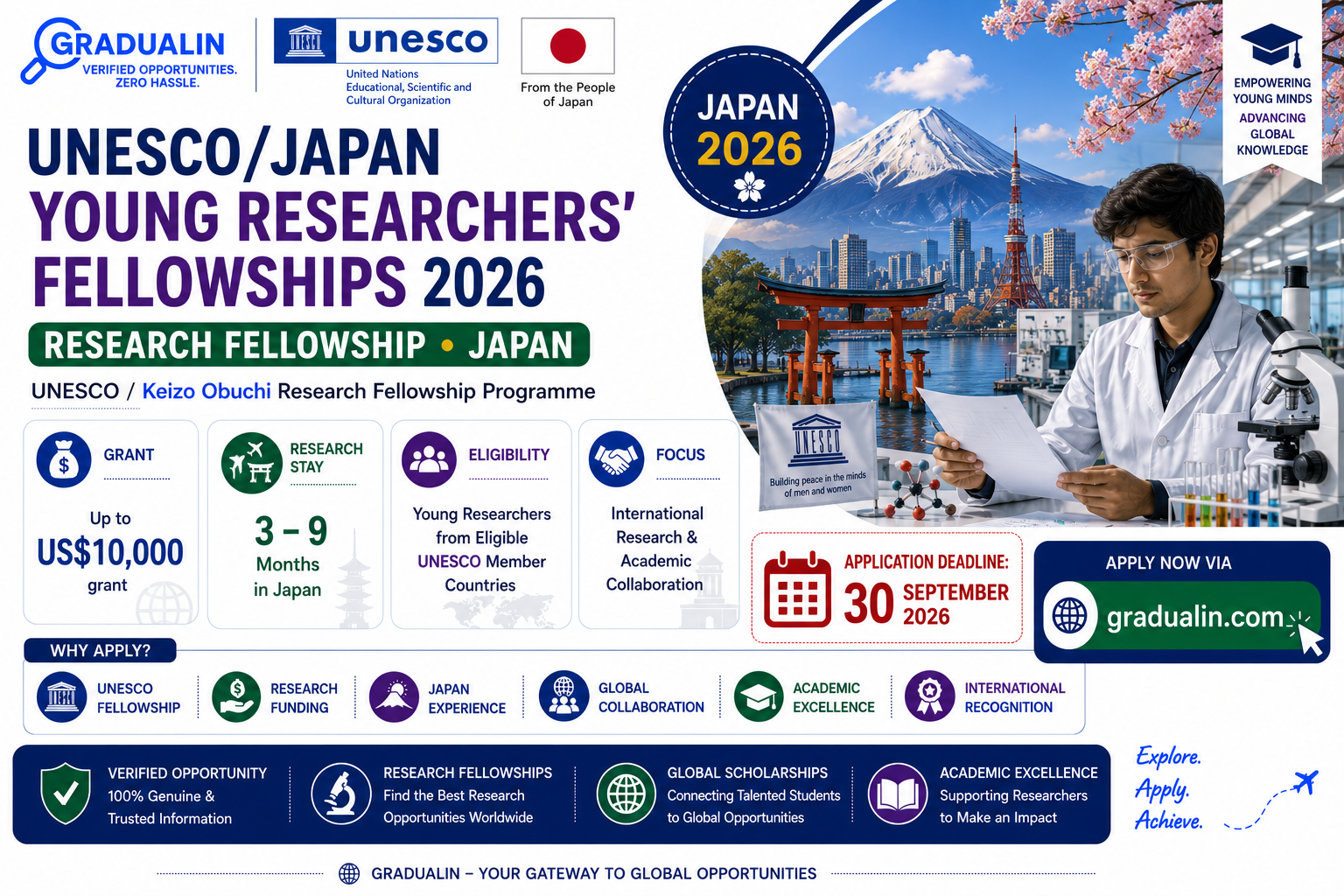
UNESCO/Japan Young Researchers’ Fellowship 2026 — Up to $10,000 for Research in Japan
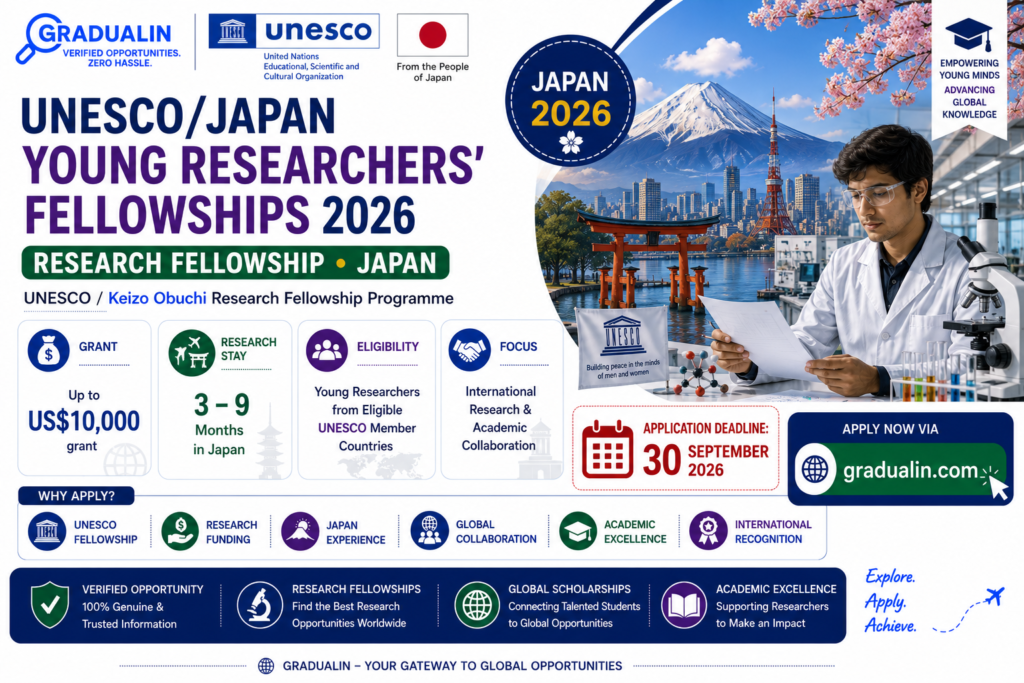
Ten researchers from Africa, Small Island Developing States, Ukraine, and Türkiye will spend up to nine months conducting postgraduate research at Japanese universities — fully backed by a grant of up to US$10,000 — under the UNESCO/Japan Young Researchers’ Fellowships Programme (also known as the UNESCO/Keizo Obuchi Research Fellowships Programme). The Cycle 2026 application is now open, with a deadline of 30 September 2026. If your research sits at the intersection of heritage conservation, artificial intelligence, or sustainable development, this guide tells you exactly what you need to know — and what most applicants get wrong.
| Detail | Information |
| Organisation | UNESCO & Government of Japan |
| Host Country | Japan |
| Degree/Level | Postgraduate Research |
| Funding | Up to US$10,000 (lump sum) |
| Duration | 3–9 months |
| Deadline | 30 September 2026 (midnight Paris time) |
| Open To | Nationals of invited Member States (Africa, SIDS, Ukraine, Türkiye) |
| Official Link | Apply Here |
A Research Fellowship with 25 Years of Track Record
The UNESCO/Keizo Obuchi Research Fellowships Programme has been running since 2001, funded through Japan’s contribution to UNESCO’s Funds-in-Trust mechanism for human resource capacity building. Over that time, it has supported 291 young researchers from 101 countries — a scale of reach that few bilateral research fellowships can match.
The 2026 cycle offers 10 fellowships, which is intentionally limited. This is not a mass-grant scheme: it is a selective, peer-reviewed programme where quality of research and originality of proposal are the determining factors. Unlike the Erasmus+ Marie Skłodowska-Curie Actions, which primarily serve European researchers and institutions, or the Japan Society for the Promotion of Science (JSPS) Postdoctoral Fellowships — which require nomination through institutional channels and typically target more advanced career stages — this programme is explicitly designed for early-career researchers from the Global South and countries in crisis (Ukraine). That makes it one of relatively few internationally competitive research fellowships that treats researchers from Sub-Saharan Africa and Pacific Island states as primary, not secondary, applicants.
Explore more Scholarships and Guidelines & Resources on Gradualin.
What the Fellowship Actually Covers
The grant of up to US$10,000 is paid as a lump sum and is designed to cover the full cost of the research stay in Japan. This is important to understand: the amount is not broken into separate stipend and travel lines. You receive one payment and manage it across the following eligible costs:
- International and domestic travel for the approved itinerary
- Accommodation throughout the fellowship period
- Medical insurance (mandatory — UNESCO arranges it, but the cost is deducted from your total grant before disbursement, so your net amount will be less than $10,000)
- Personal subsistence in Japan, including meals, local transportation, and incidental expenses
- Other research-related expenses, where directly applicable
The grant does not cover: tuition fees, computers or equipment, publication costs, or conference participation — unless conference attendance is clearly integral to the research and directly advances the project.
For a 3-month stay, $10,000 is workable in most Japanese cities outside central Tokyo. For a 9-month stay, it will require careful budgeting, particularly for accommodation. Researchers planning longer stays should factor this in honestly when building their research timeline and should discuss cost expectations with their proposed Japanese supervisor before applying.
Eligibility — Read This Carefully
This fellowship has a narrow eligibility profile. Meeting every criterion below is non-negotiable:
- Nationality: You must be a national of one of the invited Member States or Associate Members listed in Annex 1. The 2026 cycle covers 47 African states, select Asia-Pacific Small Island Developing States, 16 Latin American and Caribbean states, and two European states — Ukraine and Türkiye. Pakistan, India, Bangladesh, and most of South and Southeast Asia are not on the 2026 invited list.
- Age: No more than 40 years old at the time of application.
- Qualifications: Must hold at least a Master’s degree or equivalent in a field relevant to the proposed research.
- Language: Must demonstrate sufficient proficiency in the language of instruction or supervision at your proposed Japanese host institution. UNESCO uses its own language assessment certificate (Annex 5) — not IELTS. (Verify exact language requirements on the official website.)
- Host institution acceptance: You must have already secured a letter of acceptance from a Japanese academic supervisor before applying. This is a hard requirement, not something you can obtain after being selected.
- Submission route: Applications must go through your country’s National Commission for UNESCO — UNESCO will not accept direct submissions.
Who Should Apply — and Who Probably Shouldn’t
✅ Strong fit if you:
- Are a researcher from an eligible African, Pacific Island, Caribbean, Ukrainian, or Turkish institution under 40 with a Master’s or higher
- Have a defined postgraduate research project in heritage conservation, AI for sustainable development, or AI and education
- Have already established contact with a potential Japanese supervisor or institution
- Are prepared to spend 3–9 months in Japan during February–December 2027
- Have the discipline to work independently within a lump-sum budget framework
❌ Not the right fit if you:
- Are from Pakistan, India, Bangladesh, Nepal, or most of South/Southeast Asia — your country is not on the 2026 invited list
- Have not yet completed a Master’s degree
- Are over 40 at the time of application
- Do not yet have a Japanese supervisor — this is a prerequisite, not a step you complete after selection
- Expect a monthly stipend structure; the lump-sum model requires personal financial management
Research Areas for Cycle 2026
UNESCO has defined four primary research clusters for 2026, each with multiple sub-areas. Your proposal must identify one primary area and one corresponding sub-area from Annex 2.
Heritage Conservation and Management Includes cultural heritage for sustainable development, heritage protection in conflict zones, sustainable cultural tourism, and preservation of digital documentary heritage. This stream suits researchers from humanities, archaeology, cultural studies, and urban planning backgrounds.
AI for Sustainable Management of Natural Resources and Climate Action Covers AI applications in water modelling, ecosystem monitoring, geohazard assessment, and the integration of indigenous knowledge with AI-based environmental data. Strong fit for environmental scientists and engineers.
Ethical, Inclusive, and Human-Centred AI for Sustainable Development Addresses responsible AI in research, algorithmic bias, digital divides, AI governance, and the rule of law. Well-suited to researchers in law, social science, public policy, and computer science.
AI for Sustainable Cities, Infrastructure, and Societal Resilience Includes AI for urban water management, hazard prediction, pollution monitoring, and participatory urban governance. Interdisciplinary proposals connecting engineering with governance are explicitly welcomed.
AI and Education A broad cluster covering AI pedagogy, teacher competencies, AI ethics in higher education, green AI literacy, and media information literacy. Strong fit for education researchers and curriculum specialists.
Browse related opportunities in Jobs & Internships and Events & Conferences on Gradualin.
Required Documents
- Completed Application Form (Annex 3)
- Research Proposal using the official template (Annex 4)
- Academic documents (transcripts, degree certificates)
- Recommendation letter
- Host institution acceptance letter — from a named Japanese supervisor confirming they will oversee your research
- UNESCO Certificate of Language Knowledge (Annex 5) — this replaces IELTS or TOEFL as the language evidence mechanism for this programme
- Any additional documents required by your National Commission
Step-by-Step Application Process
- Read the Application Guide in full. Download it from the official page. The guide contains eligibility nuances that this article summarises but cannot fully reproduce.
- Contact your National Commission for UNESCO. Each country’s commission has its own internal procedures and deadlines — many set earlier national cut-offs than UNESCO’s 30 September date. Find your commission’s contact at pax.unesco.org.
- Secure your Japanese supervisor first. This is the step most applicants underestimate. Cold emails to Japanese professors convert poorly. Use your institution’s existing international research networks, prior conference contacts, or UNESCO Chair networks in Japan. A warm introduction through a mutual academic contact dramatically improves response rates. Start this process at least 3–4 months before the deadline if you don’t already have a contact.
- Prepare all documents using the official templates (Annexes 3, 4, and 5). Do not substitute your own formats — the Selection Committee expects the template structure.
- Submit to your National Commission at least two weeks before UNESCO’s 30 September deadline. If your commission’s internal deadline is earlier, that date governs.
- Once nominated by your National Commission, submit the online application form and supporting documents to keizoobuchi.fellowships@unesco.org. UNESCO only accepts applications that arrive through National Commission nomination — direct applications are not processed.
Important Dates
| Milestone | Date |
| Cycle 2026 application opens | July 2026 |
| UNESCO submission deadline | 30 September 2026, midnight Paris time |
| Recommended national submission | At least 2 weeks before 30 September |
| Fellowship period in Japan | February 2027 onward |
| Latest completion date | December 2027 |
Bookmark this page and check back for updates.
Why Japan — and Why This Fellowship
Japan is not the most common destination for researchers from Africa or the Pacific Islands, and that is precisely what makes this fellowship strategically valuable. Japanese universities — particularly institutions like the University of Tokyo, Kyoto University, Osaka University, and the National Institute of Informatics — are world leaders in AI research, robotics, and disaster risk reduction. Researchers who complete a fellowship here return with both the technical exposure and the professional network that comes from working inside Japan’s academic system, not just visiting it.
For heritage researchers specifically, Japan’s approach to intangible cultural heritage preservation — institutionalised through decades of national policy — offers a practical comparative framework that cannot be replicated in a literature review. For AI researchers, Japan’s governance approach to AI ethics and human-centred design is distinct from both the US and EU models, providing a genuinely different analytical lens.
The fellowship period in Japan also falls during 2027, a year in which several UNESCO-led international AI governance reviews and heritage assessments are scheduled, meaning fellows may find natural points of entry into broader UNESCO processes.
Gradualin Editor’s Note: This is a genuinely competitive fellowship — 10 awards across more than 80 invited countries means the selection rate is well under 1%. For average applicants, the single biggest barrier is not the research proposal itself; it is securing the host supervisor in Japan before the application is submitted. If you do not yet have that contact, treat finding a supervisor as the actual first step of your application, not a formality. For strong applicants with an established Japanese academic contact and a well-defined research problem in any of the five thematic areas, this is one of the most credible research fellowships available to researchers from Sub-Saharan Africa and the Pacific — and the UNESCO/Japan brand carries significant weight in academic CVs.
FAQ
These questions are based on what students most commonly search about this programme.
Can I apply directly to UNESCO without going through my National Commission? No. UNESCO explicitly states that only applications nominated by a National Commission will be accepted. Submitting directly to keizoobuchi.fellowships@unesco.org without a prior National Commission nomination will result in your application being rejected regardless of its quality. Contact your National Commission first — and do it early, because many commissions run their own competitive selection before forwarding nominees to UNESCO.
Is IELTS required for this fellowship? No, IELTS is not used. UNESCO uses its own language assessment instrument — the UNESCO Certificate of Language Knowledge (Annex 5 of the application package). The language you demonstrate proficiency in must be the language of instruction or supervision at your proposed Japanese host institution. English is common, but Japanese is also accepted if your supervisor conducts supervision in Japanese. Download Annex 5 from the official page for the exact format.
Can I apply if my research topic doesn’t fit neatly into one of the five areas? Applicants are required to select one primary research area and one corresponding sub-area from Annex 2. If your topic genuinely spans more than one area — for example, AI governance intersecting with educational policy — identify the area that best captures your primary contribution and note the interdisciplinary dimension in your research proposal. The Selection Committee explicitly values interdisciplinary research “connecting these themes with social, ethical, governance and contextual dimensions.”
What happens if I am nominated by my National Commission but not selected by UNESCO? UNESCO’s final selection is made by Japanese authorities based on the Selection Committee’s recommendation, with consideration for gender equality and regional diversity. Being nominated by your National Commission is a significant achievement in itself, but it does not guarantee UNESCO selection. If not selected in this cycle, the programme runs annually — request feedback from your National Commission and refine your proposal and supervisor relationship for the next cycle.
Is the $10,000 grant enough to live in Japan for 9 months? For a 9-month stay, $10,000 requires careful planning. Medical insurance costs are deducted before disbursement, reducing the net amount. Accommodation in Japan outside major city centres can be managed on a modest budget, and university dormitories for visiting researchers are often the most cost-effective option. Discuss accommodation options directly with your Japanese supervisor before applying — many institutions have designated housing for visiting researchers. (Verify current costs on the official website and with your host institution.)
Official Sources
- Programme page: UNESCO/Japan Young Researchers’ Fellowship 2026
- Application Guide: Download PDF
- Invited Member States: Annex 1
- Research Areas: Annex 2
- Application Form: Annex 3
- Research Proposal Template: Annex 4
- Language Certificate: Annex 5
- National Commissions Directory: pax.unesco.org
- Contact: keizoobuchi.fellowships@unesco.org
Summary
| Detail | Information |
| Organisation | UNESCO & Government of Japan |
| Host Country | Japan |
| Degree/Level | Postgraduate Research |
| Funding | Up to US$10,000 (lump sum) |
| Duration | 3–9 months |
| Number of Awards | 10 |
| Fellowship Period | February–December 2027 |
| Deadline | 30 September 2026 |
| Open To | Nationals of invited Member States (Africa, SIDS, Ukraine, Türkiye) |
| Age Limit | 40 years or under at time of application |
| Minimum Qualification | Master’s degree or equivalent |
| Official Link | Apply Here |
Related reading:
- Top 10 Fully Funded Scholarships in Asia 2027
- Fully Funded Scholarships in the USA 2026
- Study in Germany 2026
- Top Fully Funded Scholarships in Saudi Arabia 2026
- Fully Funded Scholarships in Australia 2026
Stay updated with the latest scholarships, jobs, and opportunities at Gradualin.com — your trusted guide to studying abroad for free.
Author: Faseeh Sultan — MSIT, PhD Scholar; 7 Years in Education