
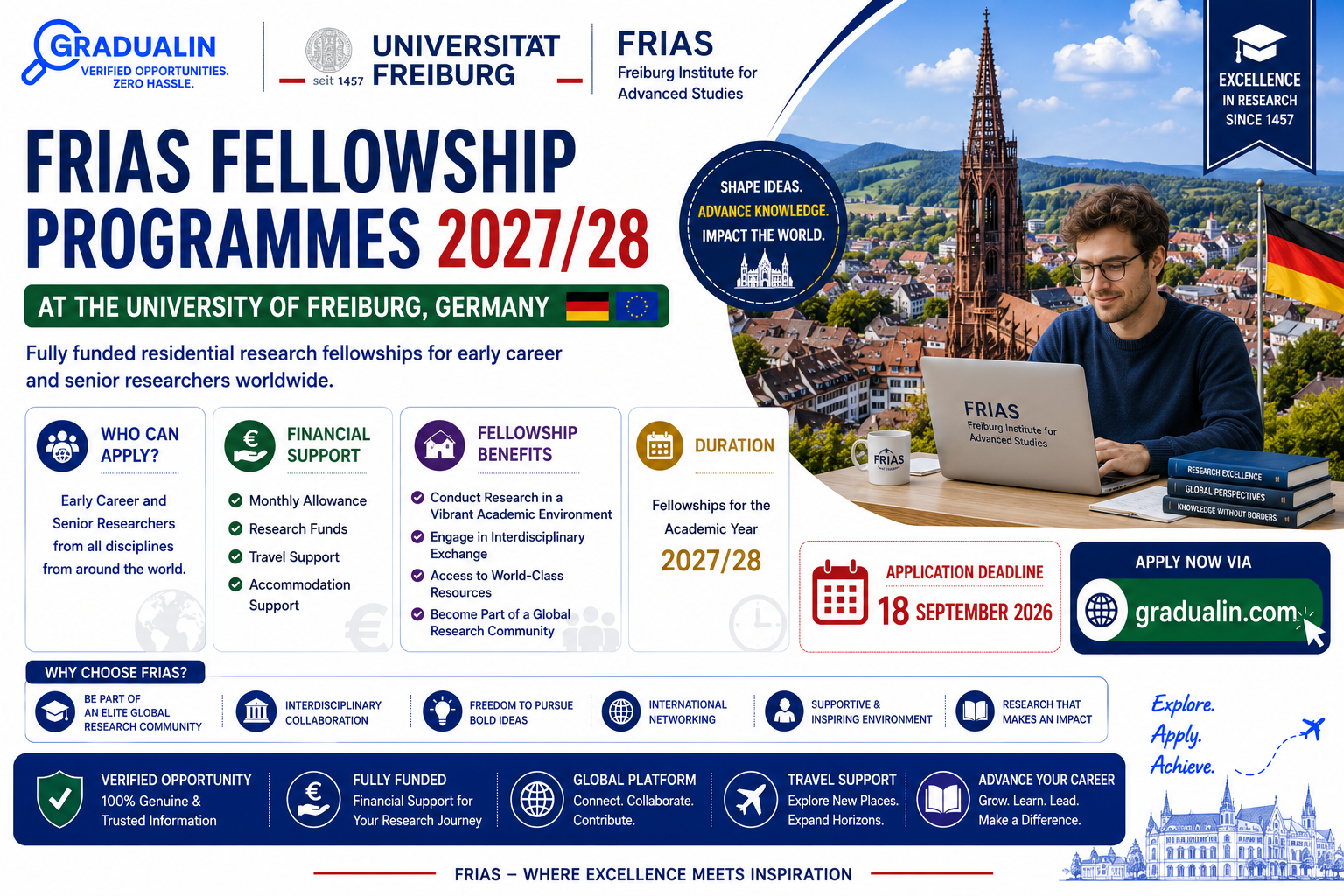
FRIAS Early Career Fellowship 2027-28 — €5,300/Month Research Grant at the University of Freiburg
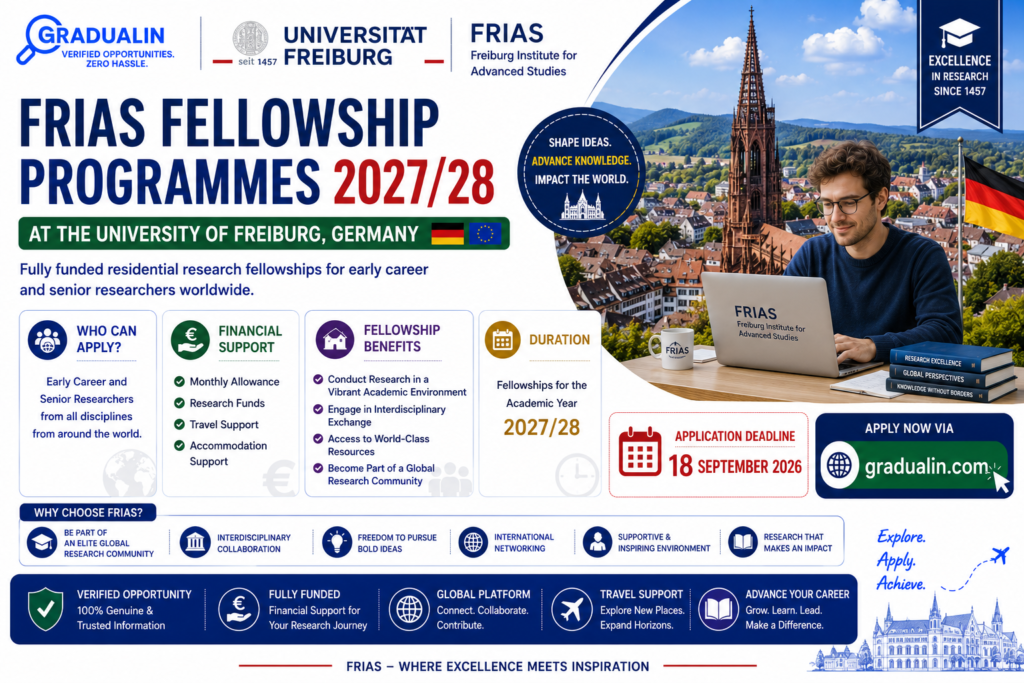
The Freiburg Institute for Advanced Studies (FRIAS) is one of the few research fellowships in Europe that genuinely does not care where you are from, what field you work in, or whether you are based at a German university — as long as your research is exceptional. For the academic year 2027-28, FRIAS is offering individual Early Career Fellowships of 4 to 10 months to researchers worldwide, with a monthly stipend of approximately €5,300 pre-tax, fully furnished office space, travel reimbursement, and a research cost contribution.
The application deadline is 18 September 2026 at 13:00 CET. This guide explains exactly who qualifies, what the €5,300 package actually covers, how competitive the selection is, and what a strong application looks like — information you will not find consolidated on the official FRIAS page alone.
| Detail | Information |
| Institution | Freiburg Institute for Advanced Studies (FRIAS) |
| Host University | University of Freiburg |
| Country | Germany |
| Level | Post-doctoral (Early Career) |
| Fellowship Duration | 4 to 10 months |
| Fellowship Period | 1 September 2027 – 31 August 2028 |
| Monthly Stipend | ~€5,300 pre-tax + social security |
| Open To | All nationalities, all disciplines |
| Application Deadline | 18 September 2026, 13:00 CET |
| Official Link | Apply Here |
🎓 About the FRIAS Early Career Fellowship
The Freiburg Institute for Advanced Studies was established as the international research college of the University of Freiburg, one of Germany’s oldest universities, founded in 1457. FRIAS operates on a simple but powerful premise: give outstanding researchers protected time — free from teaching obligations and administrative load — to focus entirely on a single research project.
This places FRIAS in a different category from most European postdoctoral fellowships. Unlike the Marie Skłodowska-Curie Postdoctoral Fellowships, which require applicants to move to a different country and typically involve a collaborating institution, FRIAS allows researchers already based in Germany — including at the University of Freiburg itself — to apply. Applicants from outside Germany who come to Freiburg for the fellowship period are equally welcome.
The programme is strictly discipline-neutral. Humanities scholars, social scientists, natural scientists, and experimentalists all compete under the same framework — with differentiated requirements for experimental scientists who need to identify a host laboratory in Freiburg in advance. The University of Freiburg’s eleven faculties and research profile spanning fields from environmental science to legal theory to neuroscience gives fellows genuine options across disciplines.
The honest editorial note: FRIAS describes an expected success rate of approximately 5% of all eligible applications. This is one of the most competitive early career fellowships in Europe. Do not confuse eligibility with competitiveness — meeting the minimum criteria puts you in the pool, not near the top of it.
🎓 Fellowship Benefits
- Monthly employment contract with the University of Freiburg at approximately €5,300 per month pre-tax and pre-social security contributions (verify exact net amount based on your tax situation on official page)
- Full-time employment contract for the duration of the fellowship (not a tax-free stipend — this is a proper salary contract)
- Research cost contribution (specific amount not published — verify in the application manual)
- Travel reimbursement for inbound and outbound journeys to Freiburg (if applicable)
- Fully furnished office space at FRIAS; single occupancy wherever possible, double occupancy otherwise
- Teaching replacement reimbursement: if you hold an employment contract at your home institution during the fellowship, FRIAS can reimburse your home institution for teaching replacement costs
- Family support services: assistance finding accommodation suitable for families, access to the University of Freiburg’s Family Service for childcare, kindergarten, and school enrolment
Note: Fellows with an existing home-institution contract receive alternative compensation rather than a new employment contract — see the Application Manual for specifics.
🎓 Eligibility Criteria
Formal requirements — all must be met:
- Completed doctoral degree at time of application
- Maximum eight years of post-doctoral experience after the PhD (documented time off for family reasons, medical leave, or non-academic activities does not count against this limit — maternity is calculated at 18 months per child)
- At least six months of research or study experience at an academic institution in a country different from the country where your first academic degree was awarded (conference attendance, holidays, and summer schools do not count)
- Research project must be feasible at the University of Freiburg (experimental scientists must confirm a host laboratory and submit a Letter of Support before applying)
- No English language test requirement is listed — the application is submitted in English, but no IELTS/TOEFL score is required or requested (verify on official page)
- No age limit applies, though the selection panel expects achievements to match the candidate’s “academic age”
Academic quality minimum:
- 4 peer-reviewed publications since 1 January 2022 (monographs count as three publications; preprint server articles, book chapters, and anthology contributions count; textbooks, reprints, and book reviews do not)
- Papers already accepted but not yet published are eligible — include the editor’s letter of acceptance
🎓 Who Should Apply — and Who Probably Shouldn’t
✅ Strong fit:
- Early career researchers 3–8 years post-PhD with a focused, self-contained project ready to produce outputs within 10 months
- Researchers who want dedicated writing or analysis time — the fellowship is explicitly structured for both concluding projects (turning research into publications) and preliminary projects (building toward a major grant application)
- Scholars outside Germany who want a structured entry point into the German academic ecosystem and the University of Freiburg’s network
- Researchers with strong publication records relative to their career stage — four peer-reviewed papers since 2022 is the floor, not the target
❌ Not a good fit:
- Researchers whose project depends on field work outside Freiburg — the fellowship is residential and extended fieldwork cannot be funded
- Applicants with fewer than four peer-reviewed publications since January 2022 (this is a hard gate, not a soft benchmark)
- Researchers expecting a fully remote or hybrid arrangement — full-time presence at FRIAS is mandatory
- Experimental scientists who have not yet secured a host laboratory in Freiburg before applying (a Letter of Support is a required document at submission)
🎓 Available Fields / Disciplines
FRIAS does not restrict applications by discipline. All fields that can be supported at the University of Freiburg are eligible, including but not limited to:
- Humanities: history, literature, philosophy, cultural studies, art history
- Social sciences: sociology, political science, economics, law, education
- Natural sciences: biology, chemistry, physics, mathematics, earth sciences
- Engineering and applied sciences (where laboratory infrastructure is available)
- Interdisciplinary and cross-disciplinary projects
FRIAS explicitly encourages applicants to review the University of Freiburg’s research strengths before applying. Framing your project in relation to existing Freiburg research clusters — where genuine overlap exists — is a practical way to strengthen the feasibility dimension of your proposal.
🎓 Required Documents
- Online application form — includes abstract, layman’s abstract, ethical issues table, and motivation statement (filled directly in the portal, not uploaded)
- Contact details for two evaluators — must know you personally, must not be current collaborators, supervisors, or affiliated with your institution; must have institutional email addresses
- Project proposal — maximum 3,000 words (this limit includes footnotes, headers, footers, and bibliographical references — a common trap for applicants who miscalculate length); must follow mandatory structure: research field and abstract → aims/framework/methodology → work plan → innovative potential → ethical issues → references; maximum 4 graphs
- CV — maximum 2 pages, mandatory template from the application portal
- Publication list — maximum 8 publications total (4 must be post-January 2022 and peer-reviewed), mandatory template from portal
- Copy of PhD diploma — with certified translation if original is not in a Latin script
- Letter of Support from host laboratory — experimental scientists only
- Experiment sketch and timetable — experimental scientists only
One practical note: FRIAS requires evaluators to use a standardised evaluation form — individual recommendation letters are not accepted. Contact your evaluators early; they will be reached out to between 28 September and 2 October 2026, with their assessment due 9 October.
🎓 Step-by-Step Application Process
- Review the Application Manual — the 3,000-word limit and mandatory project structure are enforced strictly; proposals exceeding the word count are not considered
- Register on the FRIAS application portal — download the mandatory CV and publication list templates from inside the portal before drafting
- Identify two evaluators — confirm their willingness early; they need institutional email addresses and must submit their evaluations by 9 October 2026
- Draft your project proposal using the mandatory six-section structure — draft first, word-count second; hitting 3,000 words precisely (including references) is harder than it looks
- Prepare the layman’s abstract — this is filled into the portal form, not uploaded as a PDF, and must communicate your research to a general audience (selection panels read these; treat it as seriously as the technical proposal)
- Complete the ethical issues table in the portal — be accurate; FRIAS conducts its own preliminary screen even if you flag no issues
- Submit by 18 September 2026 at 13:00 CET — late applications are not considered under any circumstances
Practical tip: The 3,000-word project proposal limit is absolute and includes every word in the document — headers, footers, references, footnotes. Many competitive applicants prepare the proposal in a plain text environment first, count words there, then format for PDF submission. Discovering a word count problem after formatting costs hours.
🎓 Important Dates
| Milestone | Date |
| Call for Applications Published | July 2026 |
| Application Deadline | 18 September 2026, 13:00 CET |
| Basic Eligibility Check | September 2026 |
| Evaluators Contacted by FRIAS | 28 September – 2 October 2026 |
| Evaluator Submission Deadline | 9 October 2026 |
| International Peer Review | October 2026 – January 2027 |
| Final Selection by SAB | February 2027 |
| Notification of Selected Fellows | March 2027 |
| Fellowship Period Begins | 1 September 2027 |
Bookmark this page and check back for updates.
🎓 Why Apply — and Why Freiburg
Freiburg im Breisgau is consistently ranked among Germany’s most livable cities — compact, bike-friendly, and positioned on the edge of the Black Forest with direct rail connections to Basel, Zurich, and Strasbourg. For researchers, this geography matters: the University of Freiburg’s proximity to Swiss and French academic institutions makes cross-border collaboration practically easy.
The university itself, founded in 1457, is not simply old — it consistently appears in the top tier of German research universities and hosts eleven faculties with over 240 degree programmes. For early career researchers, a FRIAS fellowship on the CV signals that your work was selected through a rigorous, externally peer-reviewed, international competition at a 5% acceptance rate. That is a credential with genuine weight in academic hiring.
The employment contract structure — rather than a tax-free stipend — means fellows contribute to German social security and receive standard employment benefits, which can matter for long-term residency planning.
Gradualin Editor’s Note: This fellowship is genuinely competitive, and the 5% success rate should be taken literally, not as a motivational disclaimer. For an average-to-good early career researcher, this is a reach application — one worth submitting if your project is genuinely original and your publication record is strong relative to your field’s norms. The fellowship is best suited for researchers who are 4–7 years post-PhD, have a clearly bounded project ready for focused execution, and can write a compelling proposal within a rigid 3,000-word structure. If your post-doctoral record is still developing, shortlisting this for the following cycle may produce a stronger application.
🎓 FAQ
These questions are based on what researchers most commonly search about this programme.
Does fieldwork outside Freiburg disqualify my application? Not automatically, but your research project must be feasible without extended external fieldwork during the fellowship period. FRIAS is a residential programme — full-time presence is mandatory. Short absences such as conference attendance, archive visits, or collaborator visits are permitted with directorate approval. If your project is fundamentally fieldwork-dependent, this is the wrong fellowship for that particular project.
Can I apply if I am currently employed at the University of Freiburg? Yes. FRIAS explicitly states that applicants currently working at the University of Freiburg are eligible. There is no home-institution exclusion. However, those with an existing employment contract at their home institution receive a different financial arrangement (alternative compensation rather than a new employment contract) — details are in the Application Manual.
Do I need to disclose AI use in my application? Yes. FRIAS requires disclosure of any generative AI tools used in preparing the proposal — specifying which model, for what purpose, and to what extent. Tools used only for grammar, style, or translation checks do not need to be disclosed. This applies to the proposal itself; application forms may have separate requirements.
What if my eight-year post-doctoral limit has been extended by family or medical leave? The eight-year maximum is counted from your PhD completion date, but documented time off — including maternity leave (calculated at 18 months per child), paternity leave, or medical leave — can be formally excluded. The leave must have occurred within the relevant period and must be documentable. Contact fellowships@frias.uni-freiburg.de for guidance on your specific case before applying.
Is there an English language test requirement? No IELTS, TOEFL, or equivalent score is required or requested as part of the application. The application is submitted in English, and fellows are expected to work in an English-language academic environment at FRIAS. (Verify on official page in case of updates.)
Can I apply with a project in a non-Western academic tradition or a non-European language? Yes — FRIAS is open to all disciplines and nationalities. If your PhD diploma is in a non-Latin script (Cyrillic, Arabic, Chinese, etc.), you must provide an official certified translation with your application.
🎓 Official Sources
- Official Call Page: FRIAS Early Career Fellowship 2027-28
- Application Portal: Apply Here
- Application Manual (PDF): Download Manual
- Contact Email: fellowships@frias.uni-freiburg.de
- Postal Address: FRIAS, Albertstr. 19, 79104 Freiburg im Breisgau, Germany
🎓 Summary
| Detail | Information |
| Institution | Freiburg Institute for Advanced Studies (FRIAS) |
| Host University | University of Freiburg |
| Country | Germany |
| Level | Post-doctoral (Early Career) |
| Fellowship Duration | 4 to 10 months |
| Fellowship Period | 1 September 2027 – 31 August 2028 |
| Monthly Stipend | ~€5,300 pre-tax + social security |
| Open To | All nationalities, all disciplines |
| Application Deadline | 18 September 2026, 13:00 CET |
| Official Link | Apply Here |
Browse more opportunities by category:
Scholarships | Jobs & Internships | Events & Conferences | Guidelines & Resources
Related opportunities you may find useful:
- Study in Germany 2026
- Fully Funded PhD Scholarships in the UK 2026
- Fully Funded PhD Positions in Switzerland 2026
- Study in Netherlands 2026
Stay updated with the latest scholarships, jobs, and opportunities at Gradualin.com — your trusted guide to studying abroad for free.
Author: Faseeh Sultan — MSIT, PhD Scholar | 7 Years in Education