
University of Melbourne PhD in Science 2026: Funding Explained, Scholarships Ranked, and What International Applicants Must Know
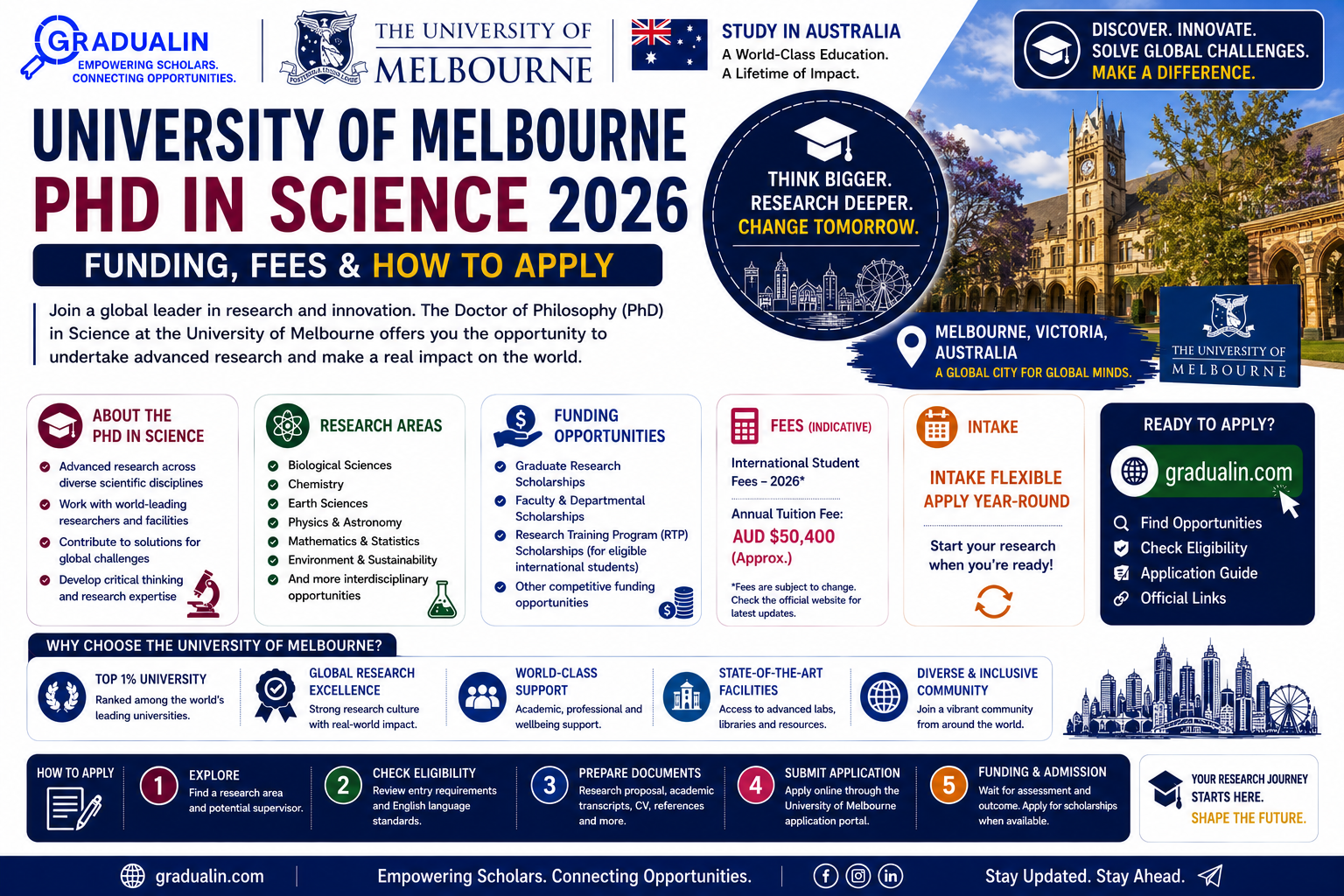
There’s a detail buried in the University of Melbourne’s PhD in Science funding structure that misleads a significant number of prospective international applicants every year: domestic students receive an automatic tuition scholarship upon admission, while international applicants receive no such guarantee — and with a 2026 indicative first-year fee of AUD $54,976, the financial stakes of misunderstanding that distinction are severe.
This guide maps the full funding landscape for Melbourne’s Doctor of Philosophy (Science) — every scholarship layer, who it’s available to, which awards stack, and what a genuinely competitive application looks like from the outside. It’s the article you read before you read the official page.
| Detail | Information |
| University | The University of Melbourne |
| Country | Australia (Parkville, Victoria) |
| Degree | Doctor of Philosophy — Science (DR-PHILSCI) |
| Duration | 4 years full-time / 8 years part-time; expected 3 years FT |
| Intake | Flexible — rolling admissions year-round |
| International Fee (2026 indicative) | AUD $54,976 per year |
| Domestic Funding | RTP Fee Offset — automatic on admission |
| International Funding | Melbourne Research Scholarship / RTP Stipend — competitive |
| Official Link | Course Page |
🎓 About the University of Melbourne and This Program
The University of Melbourne holds the distinction of being Australia’s #1 university and ranked #22 globally. That’s not marketing — it translates directly into supervisor quality, laboratory infrastructure, and the value an employer or grant committee places on your doctoral credential.
The Doctor of Philosophy (Science) is a pure research degree: no coursework requirements, no grade points, just an independent research project that culminates in an original thesis and a genuine contribution to knowledge. Candidates work within one of several research disciplines including Agriculture, Food and Ecosystem Sciences, BioSciences, Chemistry, Geography, Earth and Atmospheric Sciences, Mathematics and Statistics, Physics, and Veterinary Science — with access to more than 500 academic researchers across those fields.
Compared to PhD programs at peer institutions, Melbourne’s structure differs in two meaningful ways. First, the joint PhD pathway lets candidates conduct research at both Melbourne and a top-ranked international partner institution — something the Australian National University, for example, also offers but in fewer fields. Second, the optional 3–6 month industry internship during candidature is formally integrated into the degree, giving it a practical career dimension that many European research PhDs — particularly in Germany and Switzerland, where doctoral programs are almost exclusively thesis-track — simply don’t build in at the institutional level.
🎓 How Funding Actually Works: The Layered Structure
Most scholarship guides describe Melbourne PhD funding as if it’s one scholarship. It isn’t. There are at minimum four separate financial instruments at play, and knowing which layer you’re competing for is the difference between a realistic plan and a false expectation.
Layer 1 — RTP Fee Offset (Domestic only, automatic) All domestic students admitted to a Master by research or Doctoral degree at Melbourne automatically receive the Research Training Program Fee Offset Scholarship, which covers the Australian Government’s contribution toward tuition costs. There is no application — it comes with admission. International students do not receive this automatically.
Layer 2 — Stipend Scholarships (Competitive, open to international) The Research Training Program (RTP) Scholarship and the Melbourne Research Scholarship (MRS) are the Faculty of Science’s two principal graduate research scholarships. Both provide a living stipend plus a full fee offset. For international applicants, a full fee offset on an AUD $54,976/year program is transformative. You do not apply for these separately — you are automatically assessed when you submit your course application. But automatic assessment is not automatic award: these are competitive scholarships with limited places, and the strength of your research proposal, academic record, and supervisor support all factor into selection.
Layer 3 — Top-Up Scholarships (Automatic consideration, mixed eligibility)
- Elizabeth and Vernon Puzey Scholarship — an additional $10,000 per year pro-rata, held concurrently with MRS or RTP. Australian citizens only.
- Rowden White Scholarship — a one-off $6,500 payment, available to both domestic and international students, and stackable with MRS or RTP. This is the one meaningful additional award international students can realistically access.
Layer 4 — Specialist Domestic Awards (Separate applications required) These are easy to miss because they require their own applications outside the course form:
- Fay Marles Scholarship — for applicants of Australian Indigenous descent or facing compelling compassionate circumstances
- Sir John and Lady Higgins Research Scholarship — for research in chemistry or biochemistry related to pastoral and agricultural industries
- Ernst and Grace Matthaei Scholarship — for research in optics
If you’re eligible for any of these and fail to submit a separate application, you won’t be considered regardless of your course application quality.
🎓 Who Should Apply — and Who Probably Shouldn’t
✅ Domestic (Australian) applicants in any STEM science field — automatic tuition coverage, realistic shot at MRS or RTP stipend, and Puzey top-up makes this one of the most comprehensively funded PhD pathways in Australia ✅ International applicants with strong publication records, a defined research proposal, and an identified supervisor — competitive MRS/RTP places are achievable for candidates with a clear project ✅ Candidates in chemistry/biochemistry (Higgins Scholarship eligibility), optics (Matthaei), or those facing compelling circumstances (Fay Marles) ✅ Students interested in dual-institution research through the joint PhD pathway ✅ Professionals wanting a doctorate that formally integrates an industry internship
❌ International applicants who plan to fund themselves at AUD $54,976/year without a scholarship in hand — the financial risk is too high to justify unless you have specific external funding already confirmed ❌ Applicants without a clear research question or prospective supervisor identified — with 500+ researchers, an unfocused application gets lost, and supervisors who are already committed to other candidates won’t be available mid-cycle ❌ Candidates expecting taught coursework as part of the degree — this is a pure thesis track ❌ Part-time applicants who are international students, since the international duration is stated as 4 years full-time only on the official page
🎓 Available Research Fields
The Faculty of Science spans the following research disciplines:
Agriculture, Food and Ecosystem Sciences · BioSciences · Chemistry · Geography, Earth and Atmospheric Sciences · Mathematics and Statistics · Physics · Veterinary Science
Each discipline has its own research clusters, lab facilities, and supervisor groups. Related study areas for which this PhD is eligible include Bioinformatics, Biomedical Sciences, Conservation, Data Science, Energy, Environmental Engineering, Food Science, Health Sciences, and Information Technology. The full supervisor and project listing is searchable via the University’s scholarships and research portal.
🎓 Required Documents
- Graduate research course application — this triggers automatic MRS and RTP consideration simultaneously
- Detailed research proposal — your single most important document; it should identify the research question, methodology, expected contribution, and your target supervisor
- Academic transcripts from all prior institutions (specific GPA threshold not published on the current entry-requirements page — verify on official website)
- Evidence of English-language proficiency for international applicants (specific IELTS/TOEFL scores not listed on the current page — verify on official website)
- Separate scholarship applications for the Fay Marles, Higgins, or Matthaei awards if eligible
🎓 Step-by-Step Application Process
- Before anything else, identify a supervisor. Contact potential supervisors directly to discuss your research interests and confirm availability — a supervisor who already knows your work will advocate for you within the department during scholarship assessment, which matters more than most official guides acknowledge.
- Build your research proposal around that supervisor’s active research agenda. Melbourne PhD proposals that align with a supervisor’s current funded project have a meaningfully better chance of scoring a stipend place than generic proposals on a general topic.
- Submit the main graduate research application through the How to Apply portal — this single submission covers course application, RTP scholarship consideration, and MRS assessment simultaneously.
- Submit separate scholarship applications for any specialist domestic awards (Fay Marles, Higgins, Matthaei) alongside, not after, the main application.
- Check the scholarships search tool for any additional Faculty-specific or philanthropic awards not surfaced on the main course page — Melbourne administers many hundreds of scholarships and not all appear in the standard course listing.
- Register for updates via the official notification form if your start date is flexible — the rolling intake means you can time your application strategically around supervisor availability rather than being locked into a fixed annual round.
🎓 Important Dates
| Item | Detail |
| Application intake | Flexible — year-round rolling admissions |
| 2026 international indicative fee | AUD $54,976 first year |
| Expected full-time candidature | 3 years (maximum 4 years FT / 8 years PT) |
| CRICOS code | 056958E |
| Course code | DR-PHILSCI |
Bookmark this page and check back for updates.
🎓 Why Apply — Why Melbourne and Why Australia
Melbourne’s practical case is straightforward: #1 in Australia, #22 in the world, with the graduate employment outcomes and research citation rates to back those rankings up. The Parkville campus places candidates in one of Australia’s most livable and internationally connected cities, with access to CSIRO partnerships, medical research institutes, and a life sciences and technology sector that has grown significantly over the last decade.
The joint PhD pathway deserves particular attention for internationally mobile applicants. If you’re accepted, you can potentially conduct part of your research at a partner institution in Europe, Asia, or North America — effectively earning two institutional affiliations on a single doctoral credential. That’s a rare structural advantage for candidates targeting international academic careers.
Gradualin Editor’s Note: For domestic Australian applicants, this is close to an unambiguous yes — automatic tuition support plus realistic access to a stipend makes it one of the best-funded PhD pathways in the country. For international applicants, the equation is sharper: come in with a confirmed supervisor, a focused proposal, and ideally some publication record, and the Melbourne Research Scholarship is genuinely achievable. Come in without those, and you’re looking at nearly AUD $55,000/year in fees with no safety net. The Rowden White’s $6,500 one-off is meaningful but doesn’t change that calculation. Apply strong, or confirm funding before you commit.
🎓 FAQ
These questions are based on what students most commonly search about this program.
Is the Melbourne PhD in Science fully funded for international students? Not automatically. All domestic students receive the RTP Fee Offset as an automatic tuition contribution. International students must be competitively selected for the Melbourne Research Scholarship or RTP Stipend, which provides both a living stipend and full fee offset. The Rowden White Scholarship ($6,500 one-off) is separately available to international students who are also awarded MRS or RTP.
What English language score do I need for the Melbourne PhD? The specific English-language requirement (IELTS/TOEFL/PTE score) is not stated on the current entry-requirements page. International applicants must verify the exact threshold via the official entry requirements page or by contacting the Faculty of Science admissions team at +61 3 9035 5511.
How competitive is the Melbourne Research Scholarship? Melbourne does not publish annual acceptance rate data for the MRS specifically. However, it is broadly understood within Australian graduate research that stipend places at Group of Eight universities are highly competitive, with strong proposals, high academic achievement, and supervisor backing being the primary differentiating factors (verify current competition figures on official website).
Can I work during my Melbourne PhD? The page does not address employment conditions during candidature, but international student visa conditions and part-time work entitlements are governed by Australian immigration rules rather than the university itself. The formal 3–6 month industry internship is a structured component built into the degree.
How do I find a supervisor before applying? The Faculty of Science’s supervisor and research project listings are browsable through the Melbourne scholarships portal and individual school pages. Direct contact via email with a short research interest summary and your academic background is standard practice and expected.
Is the joint PhD option available to all Science PhD candidates? The joint PhD pathway is available but requires specific arrangements with a partner institution. It’s not automatic — candidates should identify a joint PhD opportunity through Melbourne’s joint PhD information page before applying.
🎓 Official Source
Doctor of Philosophy (Science) — Course Page Fees & Scholarships Graduate Research Scholarships Melbourne Research Scholarship Scholarships Search Tool Phone: +61 3 9035 5511 | Local: 13 MELB (13 6352) The University of Melbourne, Grattan Street, Parkville, Victoria 3010, Australia
🎓 Summary Table
| Detail | Information |
| University | The University of Melbourne |
| Country | Australia — Parkville, Victoria |
| Degree | Doctor of Philosophy (Science) |
| Duration | 3 years expected (max 4 FT / 8 PT) |
| International Fee (2026) | AUD $54,976/year (indicative) |
| Domestic Funding | RTP Fee Offset — automatic on admission |
| International Funding | MRS / RTP Stipend — competitive; Rowden White $6,500 stackable |
| Top-Up (AU citizens) | Puzey Scholarship — $10,000/year additional |
| Intake | Flexible — rolling admissions |
| Official Link | Apply Here |
Explore more research funding opportunities in our Scholarships section, browse Jobs & Internships, check Events & Conferences, or read our Guidelines & Resources for PhD application strategy.
Related Readings:
Fully Funded Scholarships in Australia 2026 Fully Funded PhD Scholarships in the UK 2026 Fully Funded PhD Positions in Switzerland 2026 Top 10 Fully Funded Scholarships in Asia 2027 Finland Scholarships 2026 — Tuition Waivers Study in Germany 2026 — Guide for International Students
Stay updated with the latest scholarships, jobs, and opportunities at Gradualin.com — your trusted guide to studying abroad for free.
Author: Faseeh Sultan — MSIT, PhD Scholar | 7 Years in Education