
ViCAS Fellowship 2027–2028 — Funded Research Fellowship at the University of Vienna
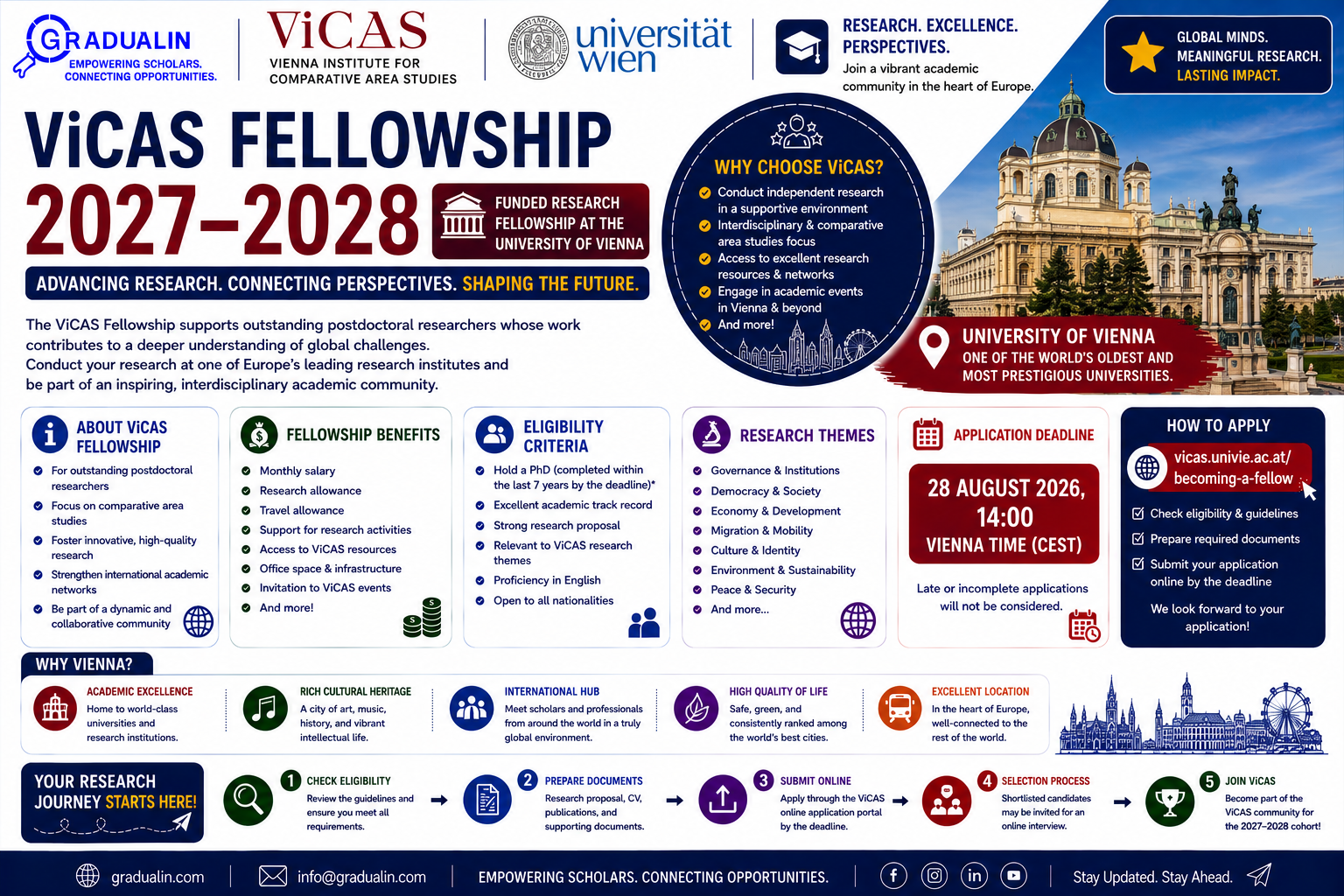
The Vienna Centre for Advanced Studies (ViCAS) at the University of Vienna has opened its fellowship call for the 2027–2028 academic year, and the deadline is closer than most applicants realise: Friday, 28 August 2026, at 14:00 Vienna Time. This is a serious, well-funded research fellowship open to international scholars from every academic discipline — no teaching, no mandatory grants to chase, just focused research time in one of Europe’s most intellectually alive cities. For Pakistani and South Asian scholars at the mid-career or advanced stage, this represents a rare opportunity to spend up to nine months at a top European university with a funded monthly stipend, office space, and access to one of the continent’s leading interdisciplinary research communities.
| Detail | Information |
| Institution | Vienna Centre for Advanced Studies (ViCAS), University of Vienna |
| Country | Austria |
| Fellowship Types | Mid-Career Fellowship / Advanced Fellowship |
| Residency Durations | 9 months (Oct–Jun) / 4 months Fall / 4 months Spring |
| Mid-Career Stipend | €5,079.50/month + €1,500 accommodation allowance |
| Advanced Stipend | €6,472.60/month + €1,500 accommodation allowance |
| Teaching Required | No |
| Disciplines | All academic disciplines |
| Deadline | 28 August 2026, 14:00 Vienna Time (CEST) |
| Open To | International scholars worldwide |
| Pakistani Students Eligible | Yes — no nationality restrictions stated |
| Official Link | Apply Here |
🎓 About the ViCAS Fellowship Program
The Vienna Centre for Advanced Studies is the University of Vienna’s flagship institute for hosting visiting international researchers. Modelled on the classic Institute for Advanced Study format — where scholars are freed from routine academic obligations to pursue ambitious research — ViCAS is deliberately interdisciplinary. Each cohort of roughly 30 fellows per academic year is curated to create productive intellectual friction across disciplines: a political scientist, a historian, a molecular biologist, and a legal scholar may all share the same coffee room and, eventually, the same conference tables.
This cross-disciplinary design is not cosmetic. Unlike discipline-specific fellowships such as the DAAD Research Fellowship (which places scholars within specific German university departments) or the Marie Skłodowska-Curie Individual Fellowship (which is tied to a specific project and host institution), ViCAS offers scholars the freedom to deepen their own research agenda while genuinely engaging with colleagues outside their field. The intellectual environment is an asset in itself, not just the address.
The University of Vienna, founded in 1365, is one of the oldest and largest universities in the German-speaking world, with particular strengths in the humanities, social sciences, natural sciences, and law. Being embedded in this institution gives ViCAS fellows access to one of Europe’s most comprehensive university library systems, active faculty across dozens of disciplines, and a city — Vienna — that is consistently ranked among the most liveable in the world.
🎓 Fellowship Types and Funding
ViCAS offers two fellowship tracks, differentiated by career stage. Both come with substantial financial support.
Mid-Career Fellowship Designed for researchers at least three years post-PhD who have established independent research profiles. The financial package (if the fellow opts for employment by the University of Vienna):
- Monthly stipend: €5,079.50
- Monthly accommodation allowance: €1,500
- Additional €500 per month per accompanying child under 18
- Total monthly support (before tax): approximately €6,579.50
Advanced Fellowship For researchers at least eight years post-PhD with a demonstrated track record of academic leadership:
- Monthly stipend: €6,472.60
- Monthly accommodation allowance: €1,500
- Additional €500 per month per accompanying child under 18
- Total monthly support (before tax): approximately €7,972.60
Two Payment Options (Fellows Choose One):
Option 1 — University of Vienna Employment: The fellow is formally employed by the University of Vienna and receives the monthly salary directly. Social security contributions and Austrian income tax are deducted from the total payment. This requires a signed employment contract and an Austrian bank account.
Option 2 — Transfer to Home Institution: For fellows who remain employed by their home institution throughout the fellowship. The University of Vienna transfers a lump sum directly to the home institution, which then manages disbursement to the fellow. For a 9-month Mid-Career residency, this amounts to €63,000; for a 9-month Advanced residency, €76,500. For 4-month residencies, the amounts are €28,000 and €34,000 respectively.
For context: €5,079.50/month converts to approximately PKR 1.5–1.6 million per month at current rates (verify on xe.com for the latest conversion). This is a professional income, not a student stipend — it covers comfortable living in Vienna. Note that ViCAS does not cover relocation costs, visa/permit fees, or travel expenses.
🎓 Eligibility Criteria
Mid-Career Fellowship:
- Doctoral degree awarded at least 3 years before August 28, 2026 (i.e., PhD completed before August 28, 2023)
- Excellent research record relative to career stage
- Established independent research profile
- Written endorsement from a professor at the University of Vienna (mandatory — no exceptions)
Advanced Fellowship:
- Doctoral degree awarded at least 8 years before August 28, 2026 (i.e., PhD completed before August 28, 2018)
- Established track record of research excellence
- Demonstrable academic leadership
- Written endorsement from a professor at the University of Vienna (mandatory)
Important notes for all applicants:
- Career interruptions (parental leave, illness, etc.) since PhD completion are not counted toward academic age — the system accounts for this automatically
- ViCAS strongly prefers scholars who have not held an Austrian institutional affiliation in the five years prior to the deadline — this is a preference, not an absolute bar, but applicants with recent Austrian affiliations should address this directly in their applications
- No IELTS or TOEFL requirement is stated — however, all application materials must be submitted in English, and the supporting professor’s endorsement must also be in English or German
- Pakistani scholars: Eligible — no nationality restrictions apply; Pakistani researchers with PhDs from HEC-recognised or international universities who meet the career-stage requirements can apply
🎓 Who Should Apply — and Who Probably Shouldn’t
✅ Strong candidates:
- Mid-career or senior researchers with a clear, ambitious research project that would benefit from dedicated writing and thinking time
- Scholars who can identify a genuine intellectual connection to the University of Vienna’s academic community — and have already reached out to a potential supporting professor
- Researchers from fields where interdisciplinary dialogue adds real value (social sciences, humanities, environmental studies, law, history of science, etc.)
- Pakistani scholars who completed PhDs abroad (UK, USA, Europe, Australia) and have returned to Pakistani universities — this profile fits the “new perspectives to Vienna” preference well
- Researchers working on South Asia, Islamic studies, development economics, international law, or post-colonial history will find relevant faculty at the University of Vienna to connect with
❌ Less likely to be competitive:
- Applicants who cannot secure a University of Vienna professor’s endorsement before August 28 — this is a hard requirement, not a formality
- Experimental scientists who need a fully equipped lab: ViCAS has no laboratory space, and any practical work must be arranged through the supporting faculty member (and must stay under 40% of time)
- Researchers whose work is very early-stage or primarily conceptual without a clear deliverable for the fellowship period
- Scholars currently affiliated with an Austrian institution — ViCAS preference runs strongly against this profile
Gradualin Editor’s Note: ViCAS is a legitimate, well-resourced fellowship at a serious European institution, and it is genuinely open to scholars from everywhere — including Pakistan. The funding is competitive by European standards. The most important thing for South Asian applicants to understand is that the University of Vienna professor endorsement is not optional and cannot be arranged at the last minute. This is the single biggest reason qualified applicants fail. Start reaching out to Vienna faculty now — email a professor whose research overlaps with yours, attach your CV and a one-page project summary, and ask if they would be willing to provide support. That conversation needs to happen well before the August 28 deadline.
🎓 Disciplines and Research Areas
ViCAS explicitly welcomes applications from all academic disciplines — this is a genuine cross-disciplinary institution, not a social sciences or humanities-only programme. In recent cohorts, fellows have come from:
- Humanities: history, philosophy, literary studies, linguistics, classical studies
- Social Sciences: political science, sociology, economics, anthropology, education
- Natural and Life Sciences: biology, environmental science, cognitive science (note: no lab space at ViCAS itself)
- Law and Legal Studies: international law, comparative law, human rights
- Interdisciplinary fields: science and technology studies, gender studies, area studies, global history
The selection committee actively curates cohorts for disciplinary balance and intellectual diversity — this means that a strong application in an underrepresented field may have an advantage over a comparably strong application in an overrepresented one.
🎓 Required Documents
All documents must be submitted in English, in PDF format, with filenames following the convention Surname_Givenname_DocumentType.pdf.
- Evidence of academic independence (Mid-Career Fellows only) — up to 5,000 characters; demonstrate intellectual leadership, independent funding, team leadership, or a distinct academic identity
- List of up to 10 most important publications — include author names, title, source, publication date, and DOI where available
- List of up to 10 most important invited talks — include title, type (keynote, plenary, invited lecture), event name, location, and year
- Motivation statement — up to 5,000 characters; explain why ViCAS specifically is the right environment for this project
- Value to the University of Vienna statement — up to 5,000 characters; describe your intellectual contribution to ViCAS and the wider university (teaching does not count here — focus on research exchange)
- PhD certificate (first PhD, in English or German; include certified translation if in another language)
- CV with publication list — CV maximum 5 pages (publication list not counted toward limit); table format preferred
- Research proposal — up to 10,000 characters; address research question, methodology, originality, interdisciplinary contribution, and (if applicable) experimental work plans
- Professor endorsement — submitted directly by the University of Vienna professor through the ViCAS Support Module
Note for Pakistani applicants: If your PhD is from a Pakistani university and the certificate is in Urdu or another language, include a translation into English in the same PDF file. Certified translation is not required at the application stage, but have it ready in case of selection.
🎓 Step-by-Step Application Process
- Find a supporting professor at the University of Vienna — search faculty at ufind.univie.ac.at or ucrisportal.univie.ac.at; identify someone whose research aligns with yours and email them directly with your CV and a brief project summary. Do this immediately — this step takes the most time.
- Create a University of Vienna u:account at account.forms.univie.ac.at — you need this to access the application portal
- Open your application file in the portal at fellow.careers.univie.ac.at — note: opening this link automatically creates an application file; do not open it before Step 1 or your supporting professor will be unable to submit their endorsement until you delete your file
- Register your professor’s email in the ViCAS Support Module section of the application — the system does NOT automatically notify them, so email them separately with the support portal link and a reminder of the deadline
- Complete all application sections — motivation statement, value statement, evidence of academic independence (Mid-Career only), publication list, invited talks list
- Upload all PDF documents — CV with publication list, research proposal, PhD certificate
- Confirm your professor has submitted their endorsement — check status in your application portal; follow up proactively as their submission is required before you can finalise yours
- Submit by 28 August 2026, 14:00 Vienna Time (CEST) — late submissions are not accepted; the system has a save-and-continue function so you can work in stages
Practical tip: Your research proposal is where applications succeed or fail. Write it for a broad interdisciplinary audience — selection reviewers come from different fields and will not follow highly technical disciplinary language. Lead with the research question in plain terms, explain why it matters, and be specific about what you will produce during the residency.
🎓 Important Dates
| Milestone | Date |
| Call Opens | Now open |
| Application Deadline | Friday, 28 August 2026 — 14:00 Vienna Time |
| Outcomes Communicated | Mid-December 2026 at the latest |
| Full Residency Start | 1 October 2027 |
| Fall Residency End | 31 January 2028 |
| Spring Residency Start | 1 March 2028 |
| Full/Spring Residency End | 30 June 2028 |
📌 Bookmark this page — we update deadlines as soon as changes are announced.
🎓 Why Apply — Why Vienna and the University of Vienna
Vienna is not just a beautiful city — it is a functional academic hub. The University of Vienna’s 180+ degree programmes and 10,000+ staff make it one of the largest universities in the German-speaking world, with particular depth in the humanities, legal studies, and social sciences. For scholars working on topics with a European, historical, or global dimension, the university’s library system — one of the most comprehensive in Central Europe — is a genuine research asset.
ViCAS specifically positions fellows as part of the University’s intellectual community, not as visitors on the periphery. The expectation of on-site presence throughout the fellowship is not a burden — it is what creates the intellectual environment that makes this fellowship worth applying for. The centre actively organises seminars, colloquia, and events where fellows present and engage with each other and with Vienna faculty.
For South Asian and Pakistani scholars, Vienna offers specific advantages: the University of Vienna has research groups working on South Asian studies, Islamic intellectual history, post-colonial studies, and international development — disciplines where Pakistani researchers frequently have both expertise and primary source access that European colleagues lack.
Gradualin Editor’s Note: For Pakistani scholars at the right career stage who have an international-quality research agenda, ViCAS is one of the better-structured European fellowships available right now. The funding is real, the environment is genuinely interdisciplinary, and the no-teaching model means you can actually finish a book chapter or a substantial paper. The main challenge — and the one worth solving early — is the University of Vienna professor requirement. It sounds bureaucratic, but it is actually a design feature: it forces a real connection between the fellow and Vienna’s academic community. Treat it as an opportunity, not an obstacle. A well-chosen supporting professor becomes a genuine intellectual interlocutor, not just a signature on a form.
🎓 Frequently Asked Questions
These questions are based on what students and scholars most commonly search about this program.
Can Pakistani scholars apply for ViCAS Fellowship? Yes. ViCAS invites applications from international scholars worldwide and lists no nationality restrictions. Pakistani researchers who meet the career-stage eligibility requirements (PhD at least 3 years old for Mid-Career, 8 years for Advanced) and can secure a University of Vienna professor endorsement are fully eligible to apply.
Is IELTS or TOEFL required for the ViCAS Fellowship? No IELTS or TOEFL requirement is mentioned in the official guidelines. All application materials must be submitted in English, and your supporting professor’s endorsement must be in English or German. If your PhD certificate is in a language other than English or German, include an English translation (certification not required at application stage).
Does my PhD from a Pakistani university qualify for ViCAS eligibility? Yes, as long as your PhD was formally awarded (or your viva/defence was passed) the required number of years before August 28, 2026. The academic age is calculated from the date of your successful defence or the date shown on your PhD certificate. There is no requirement that the PhD be from a specific country or accreditation system.
How do I find a University of Vienna professor to support my application? Search the University of Vienna’s faculty directory at ufind.univie.ac.at using your research area as keywords. Identify professors whose work intersects with yours and send a professional email introducing yourself, attaching your CV and a one-page project summary, and requesting their endorsement. Start this process as early as possible — August is the academic summer period and professors may respond slowly.
What is the difference between Option 1 and Option 2 financial support? Option 1 makes you a University of Vienna employee — you receive a monthly salary with Austrian taxes and social contributions deducted. Option 2 is for scholars who remain employed by their home institution throughout the fellowship; their home institution receives a lump sum from Vienna which it then passes on. For Pakistani scholars at Pakistani universities, Option 2 may be logistically simpler if their institution agrees to the collaboration agreement.
Can a scholar apply who currently works in Austria? It is possible, but ViCAS gives strong preference to scholars without a current or recent (within 5 years) institutional affiliation in Austria. Applicants in this situation should address this directly in their application and explain the specific circumstances.
🎓 Official Source and Contact
- Program page: ViCAS — Becoming a Fellow
- Application portal: Apply Here
- Applicant guidelines (PDF): ViCAS Guidelines for Applicants 2027–2028
- Contact: vicas@univie.ac.at | Academic Coordinator: Dr. Hilde Janssens
- Address: Universitätsring 1, 1010 Wien, Austria
- Q&A page: ViCAS Questions & Answers
🎓 Summary
| Detail | Information |
| Institution | Vienna Centre for Advanced Studies (ViCAS), University of Vienna |
| Country | Austria |
| Fellowship Types | Mid-Career / Advanced |
| Residency Durations | 9 months or 4 months (Fall or Spring) |
| Mid-Career Stipend | €5,079.50/month + €1,500 accommodation |
| Advanced Stipend | €6,472.60/month + €1,500 accommodation |
| Teaching Required | No |
| Disciplines | All academic disciplines |
| Deadline | 28 August 2026 — 14:00 Vienna Time |
| Pakistani Students Eligible | Yes |
| Official Link | Apply Here |
Explore more opportunities on Gradualin:
Related reading:
- Study in Germany 2026 — Guide for International Students
- Fully Funded PhD Scholarships in the UK 2026
- Fully Funded PhD Positions in Switzerland 2026
- Top 10 Fully Funded Scholarships in Asia 2027
- Finland Scholarships 2026 — Tuition Waivers for International Students
Stay updated with the latest scholarships, jobs, and opportunities at Gradualin.com — your trusted guide to studying abroad for free.
Author: Faseeh Sultan — PhD Scholar & MSIT | 7 Years in Education