
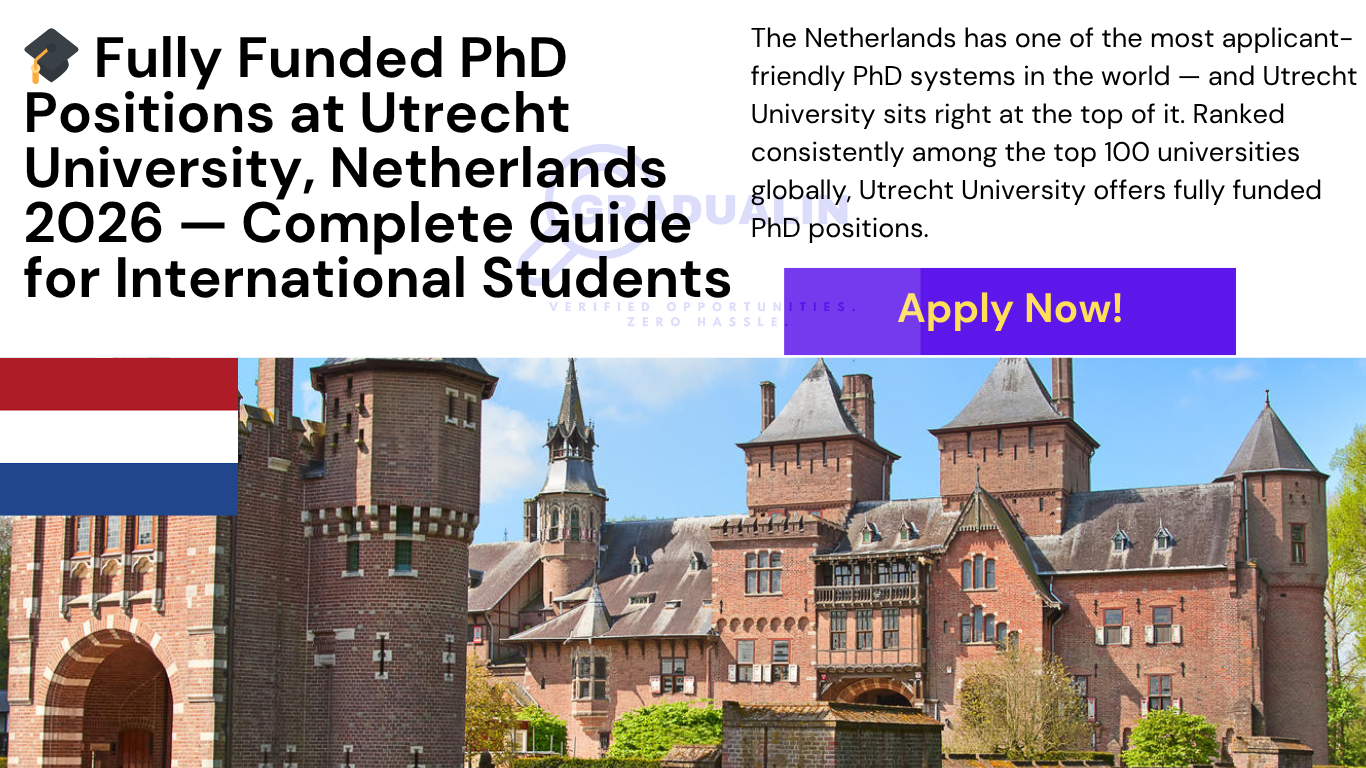
The Netherlands has one of the most applicant-friendly PhD systems in the world — and Utrecht University sits right at the top of it. Ranked consistently among the top 100 universities globally, Utrecht University offers fully funded PhD positions where candidates are employed as university staff, earn a competitive monthly salary under the national Collective Labour Agreement (CAO), and enjoy some of the most robust employee benefits in Europe. With approximately 300 new PhD candidates starting every year — and around 25% of them coming from outside the Netherlands — this is a university that truly lives its international ambition.
At Gradualin, we give you the full picture — salary facts, eligibility, application process, and all the insider details that help you apply with confidence. If you hold a Master’s degree and are ready for four years of cutting-edge research in one of Europe’s most exciting and liveable countries, read every word of this guide.
📋 Quick Summary
| Detail | Information |
| University | Utrecht University (UU) |
| Country | Netherlands 🇳🇱 |
| City | Utrecht |
| Degree Level | PhD (Doctorate) |
| Fields Available | Science, Medicine, Law, Humanities, Geosciences, Veterinary Medicine, Social Sciences |
| Funding Type | Fully Funded — Salaried Employment (CAO-NU) |
| Monthly Gross Salary | €3,059–€3,881 (Salary Scale P, CAO Dutch Universities) |
| Extra Allowances | 8% holiday allowance + 8.3% year-end bonus |
| PhD Duration | 4 Years (standard) |
| Open To | International Students — All Nationalities |
| IELTS Required | Not always — English proficiency required (confirm per vacancy) |
| Official Jobs Portal | uu.nl/en/organisation/working-at-utrecht-university/jobs |
| PhD Info Page | uu.nl/en/organisation/phd-programmes |
🎓 About Utrecht University — 390 Years of Science and Impact
Utrecht University (Universiteit Utrecht — UU) is one of the oldest and most celebrated universities in the Netherlands, founded in 1636. In 2026, it proudly celebrates 390 years of research, education, and collaboration — a remarkable milestone that underscores its enduring commitment to shaping knowledge and society.
Today, Utrecht University is a research university comprised of seven faculties that collectively cover the full spectrum of human knowledge — from molecular biology and veterinary medicine to law, philosophy, geosciences, and social sciences. The university is home to staff and students from 130 different countries, creating a genuinely global academic community in the heart of the Netherlands.
The numbers speak for themselves. Every year, approximately 300 new PhD candidates begin their research at Utrecht University. Around one in four comes from outside the Netherlands — proof that this is not a locally focused institution but a truly international research environment. PhD candidates at Utrecht give their experience an average satisfaction score of 7.4 — a strong endorsement from the people who know it best.
Utrecht University’s research impact is world-class. The university has consistently earned top scores in international research assessments, and its researchers regularly lead breakthroughs in areas ranging from infectious diseases and climate science to human rights, cultural history, and pharmaceutical innovation. One in four current research projects is funded by competitive external grants — including prestigious awards from the Dutch Research Council (NWO) and the European Research Council (ERC).
Utrecht itself is one of the most vibrant and welcoming cities in the Netherlands — a medieval canal city just 30 minutes from Amsterdam by train, with a population of around 360,000, a massive student community, and a dynamic international culture.
🎓 Benefits and Funding — Exactly What You Will Receive
Here is what makes a PhD position at Utrecht University genuinely attractive — and how it compares to PhD systems elsewhere:
PhD candidates at Utrecht University are university employees. This is the fundamental distinction. You are not a student. You are a salaried member of staff, protected by Dutch labour law and the national Collective Labour Agreement for Dutch Universities (CAO-NU).
Here is what that means in real terms:
- ✅ Gross monthly salary of €3,059–€3,881 under Salary Scale P of the CAO-NU, for a full-time position of 36–40 hours per week (exact figure confirmed from current Utrecht University vacancy listings)
- ✅ 8% holiday allowance — paid on top of your base salary annually
- ✅ 8.3% year-end (13th month) bonus — a significant additional payment at the end of each year
- ✅ No tuition fees — as a salaried employee, you pay no PhD tuition. The university covers your research costs
- ✅ Pension contributions — enrolled in the ABP pension scheme, one of the largest in the world
- ✅ Paid parental leave — Dutch law provides generous parental leave provisions to all employees
- ✅ Access to the Dutch public healthcare system — compulsory health insurance (zorgverzekering), partially subsidised
- ✅ Flexible employment conditions — Utrecht University’s “multiple choice model” lets you customise some benefits to your preferences
- ✅ 30% Tax Ruling (Possible) — international researchers recruited from abroad may qualify for the Dutch 30% ruling, which exempts 30% of gross salary from income tax, dramatically increasing your take-home pay (eligibility criteria apply — confirm with the HR department)
- ✅ Career development — dedicated Career Services for PhD candidates, including workshops, individual coaching, career tests, and e-learning tools
- ✅ PhD psychologist — Utrecht University provides dedicated psychological support specifically for doctoral candidates
- ✅ Research travel and conference funding — project budgets cover attendance at international conferences and research stays abroad
Here is the perspective: A gross monthly salary of €3,059–€3,881 in Utrecht — with an 8% holiday bonus and 8.3% year-end bonus — translates to total annual gross earnings of approximately €40,000–€51,000 before tax. If you qualify for the 30% tax ruling, your effective take-home pay rises substantially. Utrecht is more affordable than Amsterdam, and its exceptional transport links mean you can live further afield and commute easily. This is a genuinely liveable, even comfortable, researcher’s income.
🎓 Eligibility Criteria
Requirements vary by individual vacancy, but the general conditions for PhD positions at Utrecht University are:
- ✅ Master’s degree (or equivalent) in a field relevant to the position — the degree must generally be completed by the start date of the appointment
- ✅ Strong academic record — competitive grades and demonstrated research potential
- ✅ Excellent written and spoken English — required across all positions. Dutch language skills are generally not required for PhD research (most research and supervision at UU is conducted in English)
- ✅ No mandatory IELTS/TOEFL score explicitly stated for most positions — English proficiency is assessed through your academic background, motivation letter, and interview (always confirm per individual vacancy)
- ✅ Open to all nationalities worldwide — approximately 25% of Utrecht PhD candidates are international
- ✅ Willingness to relocate to Utrecht — the position requires on-site presence; candidates from outside the Netherlands must officially register their address in the Netherlands by the contract start date
- ⚠️ For some EU Horizon Europe / Marie Skłodowska-Curie positions: the EU mobility rule may apply — candidates must not have resided in the Netherlands for more than 12 months in the 3 years before the vacancy deadline (check per posting)
- ✅ 30% ruling eligibility — recruited candidates coming from abroad who meet wage threshold conditions may qualify (verify with UU HR)
🎓 Who Should Apply — And Who Should Not
✅ Apply if you:
- Hold (or are close to completing) a Master’s degree in a field covered by Utrecht University’s seven faculties
- Have a genuine passion for independent research and can commit to 4 years of full-time doctoral work
- Want real employment — a monthly salary, pension, holiday allowances, and full Dutch labour rights
- Are excited about living in one of Europe’s most vibrant, safe, and well-connected countries
- Want to work in a truly international environment — research conducted in English, colleagues from 130 countries
- Are drawn to Utrecht’s research strengths: life sciences, pharmaceutical science, geosciences, social sciences, law, humanities, or veterinary medicine
❌ Do not apply if you:
- Do not hold or are far from completing a Master’s degree in the relevant field
- Cannot commit to full-time, on-site research for the full 4-year contract period
- Are looking for a part-time, remote, or distance PhD arrangement
- Are not prepared to relocate to the Netherlands
- Do not meet the academic profile described in the specific vacancy
🎓 Available Research Fields and Faculties
Utrecht University’s seven faculties generate PhD vacancies across an impressively broad range of disciplines. Recent and active PhD postings have spanned:
🔬 Faculty of Science
- Biology (plant stress responses, cell identity)
- Mathematics (algebraic geometry, NWO-funded projects)
- Chemistry and Pharmaceutical Sciences (analytical chemistry, regulatory innovation)
- Information and Computing Sciences (hybrid intelligence, AI, data science)
- Physics and Astronomy
🌍 Faculty of Geosciences
- Physical Geography (soil mapping, process-informed machine learning)
- Earth Sciences (groundwater systems, fine particle dynamics)
- Sustainable Development (hydrogen, energy efficiency, climate policy)
- Environmental Sciences
🐾 Faculty of Veterinary Medicine
- Population Health Sciences (animal health, epidemiology)
- Veterinary Pharmacology
- Animal welfare and neonatal immunity research
⚕️ Faculty of Medicine (UMC Utrecht)
- Molecular medicine and oncology
- Neurological and metabolic diseases
- Patient-centred geriatric care
⚖️ Faculty of Law, Economics and Governance
- Human rights and comparative law
- European and international law
- Public governance and administrative law
🧠 Faculty of Social and Behavioural Sciences
- Psychology (developmental, clinical, computational)
- Sociology and Social Policy
- Education and childhood adversity research
- Communication and media studies
📚 Faculty of Humanities
- Cultural history and heritage
- Linguistics and literary studies
- Philosophy and ethics
- Arts and gender studies (including queer studies, HIV/AIDS cultural history)
New vacancies across all these areas appear on the official Utrecht University jobs portal continuously throughout the year.
🎓 Required Documents
While exact requirements vary per vacancy, a standard Utrecht University PhD application typically includes:
- Curriculum Vitae (CV) — full academic and professional history, including any publications or research experience
- Motivation letter — tailored specifically to the research project and the department/group you are applying to
- Official Master’s degree diploma and transcripts — with certified English translation if not already in English or Dutch
- Reference letters — typically 2–3 academic references (requirements vary by vacancy)
- Publication list (if applicable)
- Research statement or writing sample (required for some positions, particularly in humanities and social sciences)
- Proof of English language proficiency (only if explicitly stated in the vacancy)
Note: All applications must be submitted electronically. Utrecht University uses a fully online application system accessible through the jobs portal. Hard copy applications are not accepted.
🎓 Step-by-Step Application Process
Here is exactly how to navigate the Utrecht University PhD application from start to finish:
Step 1: Regularly visit the Utrecht University Jobs Portal and the AcademicTransfer platform — both list current Utrecht PhD vacancies. Set up a job alert with your preferred research keywords so you are notified the moment a relevant position opens.
Step 2: Read each vacancy in full. Utrecht University PhD postings are detailed — they describe the research project, the team, the faculty, the exact salary, the contract structure (typically 18-month initial contract, extendable to 4 years), and all application requirements.
Step 3: Contact the named supervisor. Before formally applying, send a brief, well-written email introducing yourself, attaching your CV, and expressing specific interest in the research described. This is standard practice in Dutch academia and is strongly recommended.
Step 4: Prepare your full application package. Write your motivation letter as if speaking directly to the research group — explain why this specific project matters to you, what unique background you bring, and what you hope to achieve.
Step 5: Submit your application electronically through the link provided in the vacancy. Utrecht University’s application system is fully online — you will upload all documents through a portal and submit before the stated deadline.
Step 6: Shortlisted candidates are contacted for interview — typically held online (video call) or in person in Utrecht. Expect to discuss your research background, your understanding of the project, and your long-term academic or career ambitions.
Step 7: Successful candidates receive an employment contract — initially for 18 months, with extension to a full 4-year total upon a positive assessment in the first year or 18 months. You will then formally register as a PhD candidate at Utrecht University’s Graduate School.
Gradualin Pro Tip: Utrecht University PhD positions are highly competitive and often close within 2–4 weeks of posting. Never delay your application. Read the vacancy the day you find it — and aim to submit within the first week.
🎓 Important Dates and Deadlines
| Position Type | Deadline |
| Standard open PhD vacancies | Rolling — new postings continuously, individual deadlines |
| NWO Vici / Vidi / Veni funded positions | Posted throughout the year — check per vacancy |
| Horizon Europe / MSCA positions | Varies by project — check per posting |
| ROSANNA Fund for Women Scholarship | Annual — next deadline to be announced (check uu.nl) |
Active 2026 examples from the official portal:
- PhD in Analytical Chemistry (Pharmaceutical Sciences) — Deadline: 27 May 2026
- PhD in Fine Particles in Shallow Groundwater Systems (Geosciences) — Deadline: 21 June 2026
- PhD in Neonatal Piglet Immunity (Veterinary Medicine) — Deadline: 27 May 2026
- PhD in Global Talent Mobility (Social Sciences) — Deadline: Open (check portal)
⚠️ Deadlines are firm. The online system closes at midnight on the stated date. Bookmark uu.nl/en/organisation/working-at-utrecht-university/jobs and check it multiple times per week.
🎓 Why Apply — Why Utrecht, Why the Netherlands
Let us be direct: choosing Utrecht University for your PhD is choosing one of the most complete doctoral experiences available anywhere in Europe.
Utrecht University is ranked in the global top 100 and is particularly celebrated for its research quality assessments — consistently scoring at the highest levels in international evaluations. Its researchers have led pivotal breakthroughs in infectious disease (including COVID-19 research), climate science, cancer biology, social policy, and legal philosophy. When you join a Utrecht research group, you are working with people who are genuinely shaping their fields.
The Netherlands is one of the world’s most internationally oriented countries. English is spoken almost universally — in shops, government offices, and hospitals — making daily life as an international researcher remarkably easy. The Dutch work culture is famously direct, egalitarian, and focused on work-life balance. Your supervisor will respect your personal time. Your contribution will be valued.
Utrecht itself is one of Europe’s great hidden gems. It is smaller and more intimate than Amsterdam — fewer tourists, lower housing costs, a more manageable pace — yet just 30 minutes by train from Amsterdam’s Schiphol Airport and from the Hague. The city’s famous canals, medieval Dom Tower, thriving café culture, and vibrant student life of more than 70,000 students make it one of the most enjoyable cities in the Netherlands to live and work in.
And the career outcomes? Utrecht PhD graduates go on to leading positions in academia, government, international organisations, pharmaceuticals, finance, technology, and the creative industries. The structured career services — workshops, individual coaching, the PhACE programme for finishing PhDs, and the Work2Work transition support — ensure you are never left alone to figure out what comes next.
🎓 Frequently Asked Questions (FAQ)
Q: Is IELTS or TOEFL required to apply for a PhD at Utrecht University? A: For the vast majority of PhD positions at Utrecht University, no formal English test score is required. The university requires strong English proficiency, which is assessed through your academic background, motivation letter, and interview. Some positions may ask for a score — always read the individual vacancy and confirm with the contact person if uncertain.
Q: Can students from any country apply? A: Yes. Utrecht University PhD positions are open to applicants of all nationalities worldwide. Approximately 25% of PhD candidates at Utrecht come from outside the Netherlands, reflecting the university’s genuine international character.
Q: What is the salary structure for a PhD candidate at Utrecht University? A: PhD candidates at Utrecht are employed under Salary Scale P of the Collective Labour Agreement for Dutch Universities (CAO-NU). This means a gross monthly salary of €3,059–€3,881 for a full-time position (36–40 hours per week), plus an 8% holiday allowance and an 8.3% year-end bonus. Total annual gross earnings are typically between €40,000–€51,000 (verify current figures on official portal).
Q: What is the 30% ruling and can I benefit from it? A: The Dutch 30% ruling is a tax exemption available to certain international employees recruited from abroad. If eligible, 30% of your gross salary is treated as a tax-free allowance — significantly increasing your net take-home pay. Eligibility depends on your salary level, prior residence, and other conditions. Confirm your eligibility with Utrecht University’s HR department upon receiving an offer.
Q: How long is the PhD contract at Utrecht University? A: The standard PhD contract is 4 years in total (full-time). However, the initial appointment is typically for 18 months, with an extension to the full 4 years contingent on a positive assessment. Some positions offer an initial 12-month contract with a 3-year extension.
Q: Do I need to speak Dutch to do a PhD at Utrecht University? A: No. The vast majority of PhD research at Utrecht University is conducted in English. Supervision, research groups, and thesis writing are in English. While learning some basic Dutch is helpful for daily life and appreciated socially, it is not a requirement for the PhD itself.
Q: Is there support for international PhD candidates arriving in the Netherlands? A: Yes. Utrecht University provides dedicated support for incoming international researchers, including guidance on housing, visa requirements, registration, and practical matters through its international staff services. The university also offers a PhD psychologist for candidates experiencing stress or difficulty during their programme.
🎓 Official Sources and Contact
- PhD at Utrecht University — Main Page: uu.nl/en/organisation/phd-programmes
- Official Jobs Portal (Current Vacancies): uu.nl/en/organisation/working-at-utrecht-university/jobs
- AcademicTransfer (External Listings): academictransfer.com
- PhD in Utrecht — Full Info: uu.nl/en/organisation/phd-programmes/phd-in-utrecht
- Career Services for PhD Candidates: uu.nl/en/organisation/phd-programmes/during-your-programme/career-services-for-phd-candidates
- PhD Manual (Full PDF): PhD Manual — Utrecht University
- Contact Utrecht University: Heidelberglaan 8, 3584 CS Utrecht, Netherlands | Tel: +31 (0)30 253 35 50
🎓 Complete Summary Table
| Detail | Information |
| University | Utrecht University (UU) |
| Country | Netherlands 🇳🇱 |
| City | Utrecht |
| Founded | 1636 |
| Faculties | 7 |
| New PhD Candidates Per Year | ~300 |
| International PhD Share | ~25% |
| PhD Duration | 4 Years (18-month initial + extension) |
| Monthly Gross Salary | €3,059–€3,881 (CAO Scale P) |
| Holiday Allowance | +8% annually |
| Year-End Bonus | +8.3% annually |
| 30% Tax Ruling | Possible for eligible international candidates |
| Tuition Fees | None (employed researchers) |
| IELTS Required | Not typically — confirm per vacancy |
| Open To | All nationalities |
| Application Route | Online via UU jobs portal or AcademicTransfer |
| Deadlines | Rolling — individual per vacancy |
| Official Portal | uu.nl/en/organisation/phd-programmes |
🔗 Explore More Opportunities on Gradualin
Browse by Category:
Top Related Guides:
- 🇬🇧 Fully Funded PhD Scholarships in the UK 2026 for International Students
- 🇺🇸 Fully Funded Scholarships in the USA 2026
- 🇦🇺 Fully Funded Scholarships in Australia 2026 for International Students
- 🇮🇹 Study in Italy 2026 — Complete Guide for International Students
- 🇫🇮 Finland Scholarships 2026 — Tuition Waivers for International Students
Stay updated with the latest scholarships, jobs, and opportunities at Gradualin.com — your trusted guide to studying abroad for free.
One Response