
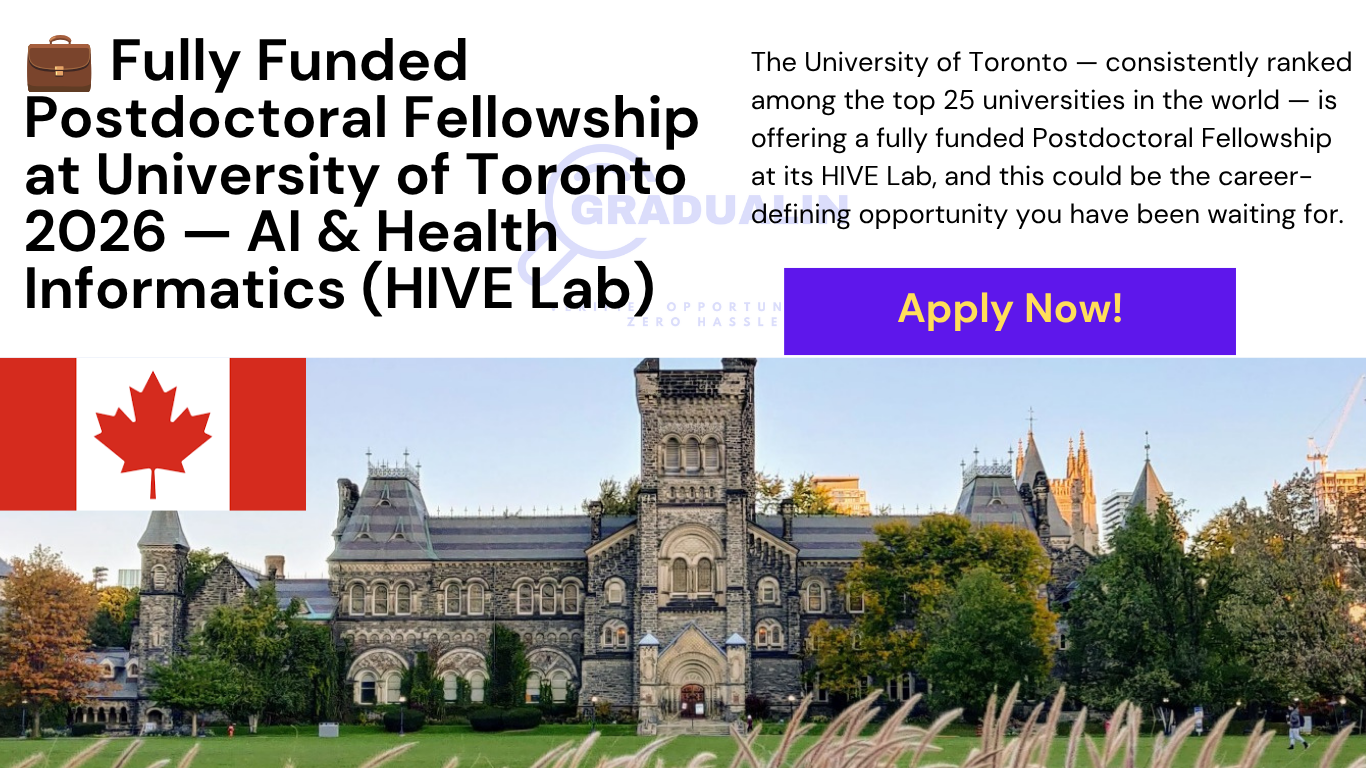
The University of Toronto — consistently ranked among the top 25 universities in the world — is offering a fully funded Postdoctoral Fellowship at its HIVE Lab, and this could be the career-defining opportunity you have been waiting for. With a competitive salary of CAD $65,000–$70,000 per year plus benefits, this position sits at the cutting edge of artificial intelligence, large language models, and public health research. Whether you are a freshly minted PhD graduate or finishing your doctoral studies, the HIVE Lab is actively looking for brilliant researchers who want to do work that genuinely matters. In this complete guide from Gradualin, you will find everything you need — position details, eligibility, application steps, deadlines, and expert tips — all in one place.
Quick Info Box
| Detail | Information |
| Organization | HIVE Lab, University of Toronto |
| School | Dalla Lana School of Public Health |
| Position Type | Postdoctoral Fellowship |
| Location | Toronto, Ontario, Canada |
| Salary | CAD $65,000–$70,000/year + benefits |
| Start Date | August–September 2026 |
| Duration | 1 year (extendable) |
| Deadline | Rolling — open until filled |
| Open To | International & domestic researchers |
| Official Link | https://www.hivelab-uoft.ca/position |
💼 About the HIVE Lab and the University of Toronto
The HIVE Lab (Health Informatics, Visualization, and Equity Lab) is housed within the prestigious Dalla Lana School of Public Health at the University of Toronto. It is an interdisciplinary research team working at the intersection of artificial intelligence, machine learning, data visualization, health informatics, and population health equity.
The University of Toronto itself needs no introduction. It is Canada’s top-ranked university and one of the most respected research institutions globally, home to over 700 research groups and generating some of the most cited academic work in the world. Toronto is consistently ranked as one of the most multicultural and livable cities on the planet — making it a genuinely exciting place to build a research career.
What sets the HIVE Lab apart is its sharp focus on responsible and trustworthy AI — building systems that are not just technically sophisticated but also ethically grounded and relevant to real-world health outcomes. This is not a lab where research sits in a drawer; it influences health policy, clinical practice, and population wellbeing.
The lab is led by Dr. Zahra Shakeri, and the team is known for its collaborative, inclusive, and high-impact academic culture.
💼 Salary, Benefits & Funding Details
Here is the best part — this is a paid, funded position, not an unpaid research role. Here is exactly what the selected fellow receives:
- 💰 Annual Salary: CAD $65,000–$70,000 (approximately USD $48,000–$52,000), based on qualifications and experience
- 🏥 Full benefits package included
- 📅 1-year appointment with the possibility of extension depending on funding availability
- 🏆 Fellows are also encouraged and supported to apply for external postdoctoral fellowships such as:
- Banting Postdoctoral Fellowships Program
- Provost’s Postdoctoral Fellowship Program
- Schmidt Science Fellows Award
- Data Sciences Institute Postdoctoral Fellowship
- Vector Institute Postdoctoral Scholarship
- China Scholarship Council funding
What makes this different from many research positions is the transparency around compensation — the lab openly lists its salary range, which is a strong signal of a fair and professional academic environment.
At the CAD $65,000–$70,000 range, this fellowship is well above the average postdoctoral stipend in Canada, which typically starts around CAD $45,000–$50,000. Toronto’s cost of living is manageable on this salary, especially with benefits included.
💼 Eligibility Criteria
The HIVE Lab has set clear and achievable requirements for this role. Here is who qualifies:
Required Qualifications:
- ✅ A completed PhD — or be near completion — in Computer Science, Biomedical Informatics, Data Science, Biostatistics, Health Informatics, or a related field
- ✅ Strong expertise in AI, machine learning, large language models (LLMs), and/or natural language processing (NLP)
- ✅ Solid background in causal inference, causal machine learning, or causal AI
- ✅ Strong publication record relative to career stage
- ✅ Excellent scientific writing and oral communication skills
- ✅ Strong programming, analytical, and methodological abilities
- ✅ Ability to work both independently and collaboratively in interdisciplinary projects
- ✅ Genuine interest in health, public health, or population-level AI applications
Preferred (Bonus) Qualifications:
- 🌟 Experience with health data, clinical text, or electronic health records
- 🌟 Experience in responsible AI, fairness, interpretability, or trustworthy LLM evaluation
- 🌟 Experience leading grant applications or collaborative research
- 🌟 Strong record of presenting at conferences
- 🌟 Experience mentoring students
⚠️ Regarding English Language Tests (IELTS/TOEFL): The position listing does not specify a mandatory IELTS or TOEFL requirement for postdoctoral applicants. As this is a research fellowship rather than a degree program, applicants are evaluated primarily on their research background and publication record. However, strong written and verbal English communication skills are expected. (Verify directly with the lab if you have concerns about language documentation.)
💼 Who Should Apply — And Who Should Not
✅ Apply if you:
- Have a PhD (completed or near completion) in a relevant field
- Have published or are actively publishing research in AI, NLP, or causal methods
- Are passionate about applying technology to improve public health
- Want to work in an inclusive, high-impact research environment in Canada
- Are seeking a well-paid, prestigious research position that builds your independent career
❌ Don’t apply if you:
- Do not have a background in AI, machine learning, or data science
- Are looking for a purely clinical or laboratory-bench science role
- Are still in the early years of your PhD without any publications or substantial projects
- Are not prepared to also pursue external fellowship funding during the appointment
💼 Research Focus Areas and Projects
The HIVE Lab works across several exciting and impactful research themes. As a Postdoctoral Fellow, you will have the opportunity to contribute to projects in:
- 🤖 Artificial Intelligence & Large Language Models (LLMs) applied to health data
- 🧠 Natural Language Processing (NLP) for clinical text and public health datasets
- 📊 Causal Inference & Causal AI to understand health outcomes and disease mechanisms
- ⚖️ Health Equity — designing AI systems that are fair and inclusive
- 🔍 Responsible & Trustworthy AI — interpretability, uncertainty quantification, and evaluation of AI in healthcare
- 📈 Data Visualization for health informatics and population health
- 🌍 Precision Public Health — using data-driven methods to improve health systems
The HIVE Lab sits adjacent to groundbreaking life sciences research happening across the University of Toronto. For context, the broader university is home to cutting-edge biomedical work — including, for example, a dedicated HIV research lab at U of T Scarborough led by Prof. Christina Guzzo, which studies the molecular mechanisms of viral infection and immune response. This speaks to the University of Toronto’s deep commitment to health sciences research at every level — from molecular biology to AI-driven public health.
💼 Required Documents
To apply for this Postdoctoral Fellowship, you will need to prepare the following:
- 📄 A current, up-to-date Curriculum Vitae (CV)
- 📚 Three selected publications or manuscripts (published, under review, or pre-print)
- 📧 Names and email addresses of two references (academic supervisors or collaborators)
- 📝 A one-page research statement that covers:
- Your previous research experience
- Your expertise in AI/LLMs, NLP, and causal methods
- Your proposed research interests and goals at the HIVE Lab
Keep your research statement focused, specific, and tailored to the HIVE Lab’s work. Generic statements are easy to spot — take the time to show that you understand what the lab does and why your background is a strong fit.
💼 Step-by-Step Application Process
Applying to the HIVE Lab Postdoctoral Fellowship is straightforward. Here is exactly what to do:
- Prepare your documents — CV, three publications, two referee contacts, one-page research statement
- Visit the official application form at: https://forms.gle/A8moqhrhoHcP5ZgBA
- Complete the Google Form — fill in all required fields carefully and honestly
- Upload your documents as requested in the form
- Submit your application — applications are reviewed on a rolling basis, meaning the earlier you apply, the better your chances
- Follow up if needed — you may also reach out to Dr. Zahra Shakeri directly at zahra[dot]shakeri[@]utoronto[dot]ca for specific queries
💡 Pro Tip from Gradualin: Since this is a rolling deadline, do not wait. Positions like this are filled as soon as the right candidate is found. Apply as soon as your documents are ready.
💼 Important Dates
| Milestone | Date |
| Position Start Date | August–September 2026 |
| Application Deadline | Rolling — open until filled |
| Review Process | Ongoing after submission |
⚠️ There is no fixed closing date for this position. This means it could close at any time once the right candidate is selected. Bookmark this page and check back for updates — and apply as early as possible.
💼 Why Apply — Why the University of Toronto and Toronto, Canada
Canada is one of the most welcoming countries in the world for international researchers, and the University of Toronto is its crown jewel of research excellence. Here is why this fellowship is a once-in-a-career opportunity:
🏙️ Toronto is one of North America’s most multicultural cities — over 50% of residents were born outside Canada. You will never feel like an outsider here.
🎓 University of Toronto is ranked #1 in Canada and consistently in the global top 25, with world-class libraries, computational resources, and interdisciplinary networks.
🔬 The HIVE Lab specifically works on research with direct policy and patient-outcome implications — your work will not just be published in journals, it will shape how healthcare systems use AI.
🤝 The lab values diversity, collaboration, and mentorship, meaning you will grow not just as a researcher but as a future academic leader.
🌐 A postdoctoral position at the University of Toronto is a powerful career credential recognized globally in academia, industry, government, and international health organizations.
💡 Toronto’s thriving tech and AI ecosystem — including the Vector Institute for AI — means networking and career opportunities beyond academia are exceptional.
💼 Frequently Asked Questions (FAQ)
Q: Is this fellowship open to international applicants? A: Yes. The HIVE Lab explicitly encourages applications from diverse international backgrounds. Canada’s postdoctoral visa pathways are well-established for international researchers.
Q: Do I need IELTS or TOEFL to apply? A: The position listing does not require a formal English language test score. Strong English communication skills are expected, but the focus is on your research credentials and publication record. Verify with the lab directly if you have specific concerns.
Q: Can I apply if I haven’t finished my PhD yet? A: Yes. The listing specifically states that candidates who are “near completion” of a PhD are welcome to apply. Make sure your expected graduation date is clearly mentioned in your application.
Q: What is the salary and is it competitive? A: The salary is CAD $65,000–$70,000 per year plus benefits, which is above the typical Canadian postdoctoral stipend. This is a paid, professional research position — not an unpaid fellowship.
Q: Can the fellowship be extended beyond one year? A: Yes, extension is possible depending on funding availability and performance. Fellows are also encouraged to apply for external fellowships that can supplement or extend their funding.
Q: What is the focus of the research at the HIVE Lab? A: The HIVE Lab focuses on AI, LLMs, NLP, causal inference, data visualization, health equity, and responsible AI — all applied to health informatics and public health.
💼 Official Application Links
- 🌐 HIVE Lab Official Page: https://www.hivelab-uoft.ca/position
- 📋 Application Form (Postdoc): https://forms.gle/A8moqhrhoHcP5ZgBA
- ✉️ Contact: zahra[dot]shakeri[@]utoronto[dot]ca
- 🏫 Dalla Lana School of Public Health: https://www.dlsph.utoronto.ca/
💼 Summary Table
| Detail | Information |
| Position | Postdoctoral Fellow |
| Lab | HIVE Lab |
| University | University of Toronto |
| School | Dalla Lana School of Public Health |
| Location | Toronto, Ontario, Canada |
| Fields | AI, LLMs, NLP, Causal AI, Health Informatics |
| Salary | CAD $65,000–$70,000/year + benefits |
| Duration | 1 year (extendable) |
| Start Date | August–September 2026 |
| Deadline | Rolling — apply ASAP |
| Open To | International & domestic researchers |
| Application Form | https://forms.gle/A8moqhrhoHcP5ZgBA |
🔗 Explore More Opportunities on Gradualin
Browse by Category:
Top Scholarship Guides:
- 🇦🇺 Fully Funded Scholarships in Australia 2026 for International Students
- 🇬🇧 Fully Funded PhD Scholarships in the UK 2026 for International Students
- 🇺🇸 Fully Funded Scholarships in the USA 2026 for International Students
- 🇮🇹 Study in Italy 2026 — Complete Guide for International Students
- 🇫🇮 Finland Scholarships 2026 — Tuition Waivers for International Students
- 🌏 Top 10 Fully Funded Scholarships in Asia 2027 for International Students
Related Articles You May Like:
Stay updated with the latest scholarships, jobs, and opportunities at Gradualin.com — your trusted guide to studying and researching abroad for free.