
Hoover Fellows Program 2027 — Paid Research Fellowship at Stanford University
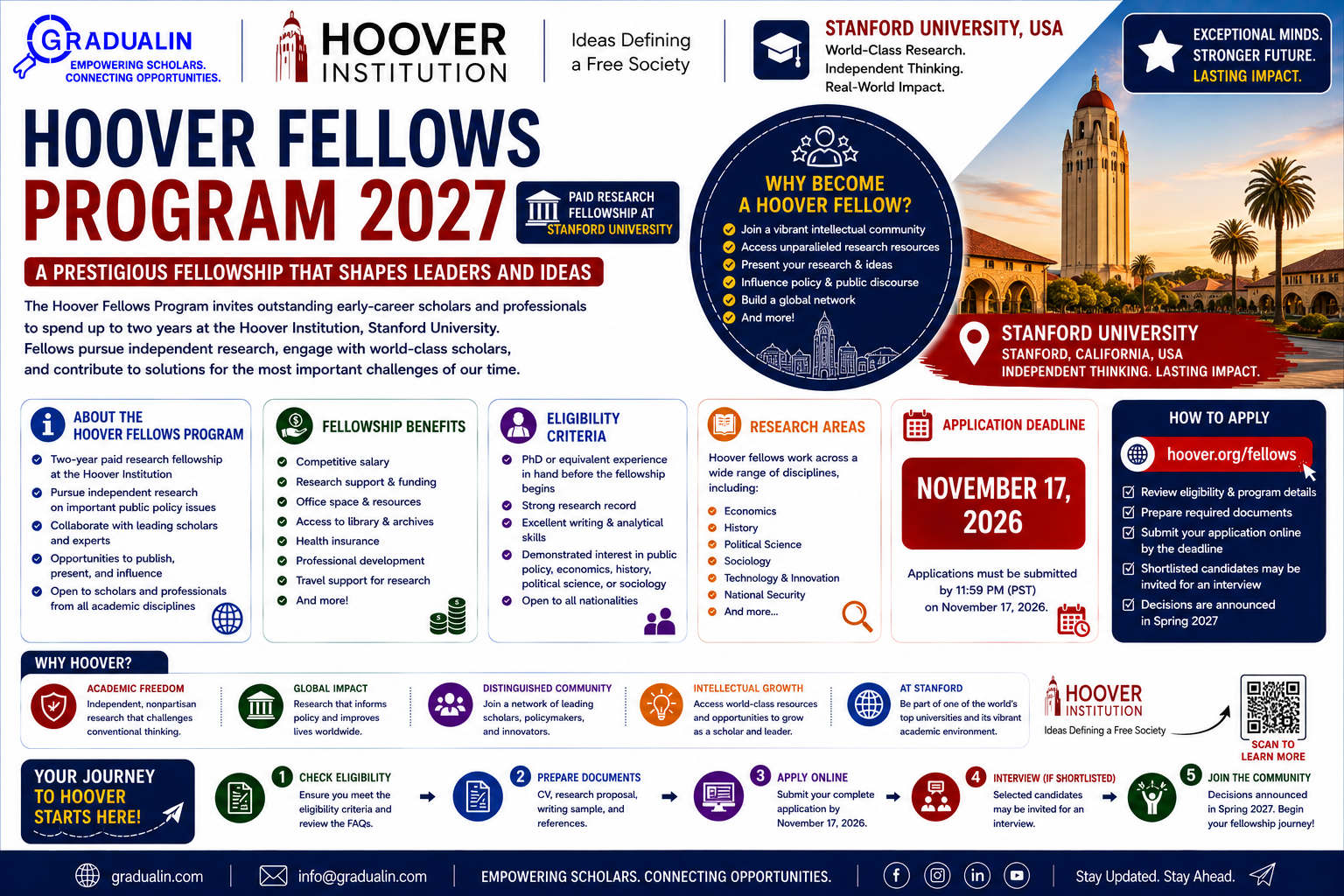
If you are an early-career scholar in economics, political science, history, or public policy, the Hoover Fellows Program at Stanford University is one of the most competitive and financially generous academic fellowships available anywhere in the United States. With a base salary ranging from $169,950 to $230,000 plus a $20,000 annual housing allowance, this is not a stipend-based fellowship — it is a full professional research appointment. The deadline for the 2027 cycle is November 17, 2026, and applications are now open. This guide covers everything international scholars — including those from Pakistan and South Asia — need to know before applying.
| Detail | Information |
| Institution | Hoover Institution at Stanford University |
| Country | United States |
| Level | Post-doctoral / Early-Career |
| Funding Type | Full Salary + Housing Allowance |
| Base Salary | $169,950 – $230,000 per year |
| Housing Allowance | $20,000 per year |
| Appointment Duration | 1 to 3 years (renewable) |
| Teaching Required | No |
| Deadline | November 17, 2026 |
| Open To | International scholars (EEO employer) |
| Pakistani Students Eligible | Yes — Hoover is an equal opportunity employer welcoming all nationalities |
| Official Link | Apply Here |
🎓 About the Hoover Institution Fellowship
The Hoover Institution is one of America’s oldest and most influential policy research centers, housed on the campus of Stanford University in Palo Alto, California. Founded in 1919, it has produced scholarship that has shaped economic policy, national security strategy, and governance debates at the highest levels. Unlike university departments, Hoover is structured as a pure research environment — its fellows hold no mandatory teaching load, freeing them entirely for scholarship, writing, and policy engagement.
The Hoover Fellows Program is the institution’s flagship appointment for early-career academics. It sits at the senior end of fellowship opportunities — comparable in prestige and compensation to the Miller Institute at UC Berkeley or the Society of Fellows at Harvard, but with a strong policy-outreach dimension that sets it apart. Where Harvard’s Society of Fellows focuses primarily on humanistic and scientific disciplines, Hoover’s program is explicitly oriented toward policy-relevant research in economics, political science, history, and international relations. Scholars who want their work to reach policymakers — not just peer reviewers — will find Hoover’s platform unusually powerful.
The fellowship term runs from one to three years, with potential for renewal, giving fellows genuine time to complete book manuscripts, publish in top journals, and build a research profile.
🎓 Benefits and Compensation
This is where the Hoover Fellows Program separates itself from most academic fellowships:
- Base salary: $169,950 – $230,000 per year (verified on the official posting — one of the highest salary ranges for a non-tenured research fellowship in the United States)
- Annual housing allowance: $20,000 — meaningful given Stanford’s location in the San Francisco Bay Area, where housing costs are substantial
- No teaching obligations — fellows dedicate 100% of their time to research and writing
- Access to Stanford’s broader research community, including libraries, colloquia, and interdisciplinary networks
- Institutional support for publication, working papers, and public engagement
- Location on Stanford’s main campus in Stanford, CA — one of the world’s most resource-rich academic environments
For context: $169,950 USD converts to approximately PKR 47–48 million annually at current exchange rates (verify current rates). This is a professional salary, not a student stipend.
🎓 Eligibility Criteria
- Must hold a Ph.D. or equivalent doctoral degree in a relevant field — economics, history, international relations, national security, political science, or public policy
- Candidates who expect to complete their degree by September 1, 2027 are also eligible to apply
- Must be positioned as an early-career scholar — the program explicitly targets scholars building their research profile, not senior tenured faculty
- No IELTS or TOEFL requirement stated on the official posting — however, all application materials must be submitted in English (verify directly with the program if you have questions about language documentation)
- No nationality restrictions — Hoover Institution is an equal employment opportunity and affirmative action employer, explicitly welcoming applications from candidates of all national origins
- Pakistani students: Eligible — Pakistani doctoral graduates and PhD candidates from HEC-recognized universities who meet the academic criteria can apply
🎓 Who Should Apply — and Who Probably Shouldn’t
✅ Strong candidates:
- Scholars with a completed or near-complete PhD in economics, political science, history, or public policy from a reputable university
- Researchers whose work has clear implications for public policy — not just theoretical contributions
- Candidates with at least one strong working paper, publication, or draft book chapter ready to submit
- Scholars interested in engaging with a non-partisan but policy-oriented intellectual environment
- Pakistani scholars from top universities (LUMS, QAU, NUST, or those with international PhD training) who have developed a strong policy-relevant research agenda
❌ Less likely to be competitive:
- Applicants with no publications, working papers, or draft manuscripts — the program requires submitting samples of scholarly work
- Researchers in fields outside Hoover’s core areas (engineering, medicine, hard sciences, fine arts)
- Scholars seeking a teaching position — Hoover offers no teaching, which some early-career academics actually need for their CV
- PhD students in the very early stages of their programs (pre-dissertation) — the expectation is demonstrable research output
Gradualin Editor’s Note: This is a highly selective program at one of the world’s most recognized institutions. For Pakistani and South Asian scholars, the strongest path into this fellowship typically runs through an international PhD — from a US, UK, or European university — rather than directly from a domestic degree. That said, Pakistani scholars with PhDs from strong international programs who are working on Pakistan, South Asia, or international policy questions are genuinely competitive. The compensation and platform make it worth a serious, well-prepared application.
🎓 Research Areas and Fields
The Hoover Institution’s scholarly activities cluster around four broad domains. Fellows are expected to work within or across these areas:
- Economic Policy — fiscal policy, monetary economics, development economics, labor markets
- Politics and Government — democratic governance, elections, legislative studies, state capacity
- History — American history, modern international history, military history, applied history
- International Affairs — national security, foreign policy, great-power competition, regional studies (Middle East, Asia-Pacific, South Asia)
Scholars whose research sits at the intersection of these areas — for example, the political economy of development, or the history of international institutions — are particularly well-positioned. Hoover also runs specialized working groups on national security, technology and governance, and the Middle East, which fellows can engage with.
Explore the full list of Hoover Research Programs for a complete picture of active scholarly communities.
🎓 Required Documents
Submit all of the following through the online portal by 11:59 PM PT on November 17, 2026:
- Cover letter or statement of interest — describe your academic background, experience, and why Hoover is the right environment for your research
- One or more recent publications, working papers, or draft book chapters — this is your scholarly writing sample; quality matters more than quantity
- Curriculum vitae (CV) — comprehensive academic CV including education, publications, presentations, and relevant experience
- Statement of future research plans — maximum two pages; outline what you plan to work on during the fellowship
- Three letters of recommendation — must specifically address your research accomplishments and potential for future research
Note for Pakistani applicants: If your doctoral degree is from a Pakistani university, it is advisable to have your HEC degree attestation completed before the appointment stage (not necessarily before applying, but have it ready if selected). If your PhD is from an international institution, standard degree verification processes apply.
🎓 Step-by-Step Application Process
- Review the official posting at hoover.org/hoover-fellows-program — confirm your field aligns with Hoover’s research priorities
- Prepare your scholarly writing sample — this is the most important element; choose your strongest recent work that demonstrates policy-relevant insight
- Draft your two-page research plan — be specific about what you will write or study during the fellowship; vague plans are a red flag for selection committees
- Request your three letters of recommendation early — give referees at least four to six weeks’ notice; they should speak to your research potential specifically
- Create an account on the SMAply portal and begin your application at hoover.smapply.us
- Upload all documents in the formats specified by the portal
- Submit before 11:59 PM Pacific Time on November 17, 2026 — late submissions are not accepted
Practical tip: Your research statement is where most applications are decided. Do not write a generic summary of your dissertation — describe specifically what you will produce at Hoover, for what audience, and why it matters for policy. Selection committees respond to scholars who already think like policy-engaged researchers, not just disciplinary specialists.
🎓 Important Dates
| Event | Date |
| Applications Open | Now open |
| Application Deadline | November 17, 2026 — 11:59 PM PT |
| Fellowship Start (approximate) | September 2027 |
| Appointment Duration | 1–3 years |
📌 Bookmark this page — we update deadlines as soon as changes are announced.
🎓 Why Apply — Why the Hoover Institution at Stanford
The Hoover Institution sits at a genuinely unusual intersection: it is simultaneously a rigorous academic research center and a policy-facing institution with real influence in Washington, DC and beyond. Fellows here are not writing into a vacuum — their work is read by policymakers, journalists, and public intellectuals.
Stanford’s campus itself is one of the most resource-rich academic environments on earth. The Bay Area concentration of universities, think tanks, technology companies, and government offices creates networking and collaboration opportunities unavailable at virtually any other fellowship location.
The no-teaching model is significant for early-career scholars specifically. The period immediately after a PhD — typically the most productive in terms of raw research output — is often diluted by teaching loads at most universities. Hoover removes that constraint entirely, giving fellows two to three years of focused writing time at a salary that makes financial stress a non-factor.
For scholars from Pakistan and South Asia working on governance, economic development, South Asian security, or international political economy, Hoover’s working groups — particularly those covering the Middle East, Asia-Pacific, and national security — offer genuine intellectual communities, not just a prestigious address.
Gradualin Editor’s Note: This fellowship is genuinely worth the effort of a serious application for scholars who are in the right field at the right stage. The compensation is extraordinary for a research-only position, the platform is real, and the intellectual environment is stimulating. For Pakistani scholars specifically, this is one of the few US-based fellowships where policy-relevant expertise on South Asia is likely to be viewed as an asset rather than a niche. That said, the competition is intense — applicants without at least one strong publication or working paper will struggle to stand out.
🎓 Frequently Asked Questions
These questions are based on what students and scholars most commonly search about this program.
Can Pakistani scholars apply for the Hoover Fellows Program? Yes. The Hoover Institution explicitly states it is an equal employment opportunity and affirmative action employer, welcoming applications regardless of national origin. Pakistani scholars who hold a PhD (or expect to complete one by September 1, 2027) in a relevant field are fully eligible to apply.
Is IELTS or TOEFL required for this fellowship? The official posting does not list an IELTS or TOEFL requirement. However, all application materials — including your cover letter, research statement, and writing samples — must be submitted in English. If you are uncertain whether language documentation is needed in your case, contact the program directly at hooverfellowship@stanford.edu.
Does Hoover accept applicants who haven’t finished their PhD yet? Yes — candidates who expect to complete their doctoral degree by September 1, 2027 are eligible to apply in the current cycle.
What is the salary for Hoover Fellows? The official posting states a 12-month base salary range of $169,950 to $230,000, plus a $20,000 annual housing allowance. This is a professional salary, not a student stipend.
Does Hoover require HEC-attested degrees from Pakistani applicants? HEC attestation is not explicitly required at the application stage. However, if you are selected, your university credentials will need to be verified as part of the appointment process. It is advisable for Pakistani applicants with degrees from Pakistani universities to have HEC attestation ready in advance to avoid delays.
How competitive is this fellowship? The Hoover Institution does not publicly disclose application numbers, but it is considered one of the most competitive early-career research fellowships in the United States. Successful applicants typically have strong research records, at least one publication or working paper, and a clear, policy-relevant research agenda.
🎓 Official Source and Contact
- Official program page: Hoover Fellows Program
- Application portal: Apply Here — SMAply
- Contact email: hooverfellowship@stanford.edu (checked periodically — allow several days for a response)
- Address: Hoover Institution, 434 Galvez Mall, Stanford, CA 94305-6003
🎓 Summary
| Detail | Information |
| Institution | Hoover Institution at Stanford University |
| Country | United States |
| Level | Post-doctoral / Early-Career Research Fellowship |
| Funding Type | Full Salary + Housing Allowance |
| Base Salary | $169,950 – $230,000 per year |
| Housing Allowance | $20,000 per year |
| Appointment Duration | 1 to 3 years |
| Teaching Required | No |
| Deadline | November 17, 2026 |
| Open To | International scholars (all nationalities) |
| Pakistani Students Eligible | Yes |
| Official Link | Apply Here |
Explore more opportunities on Gradualin:
Related reading:
- Fully Funded Scholarships in the USA 2026
- Fully Funded PhD Scholarships in the UK 2026
- Top 10 Fully Funded Scholarships in Asia 2027
- Study in USA 2026 — Guide for International Students
Stay updated with the latest scholarships, jobs, and opportunities at Gradualin.com — your trusted guide to studying abroad for free.
Author: Faseeh Sultan — PhD Scholar & MSIT | 7 Years in Education