

📅 Last Updated: 26 October 2026
Max Planck IMPRS PhD 2027 — Funded Nano-Physics PhD, Germany
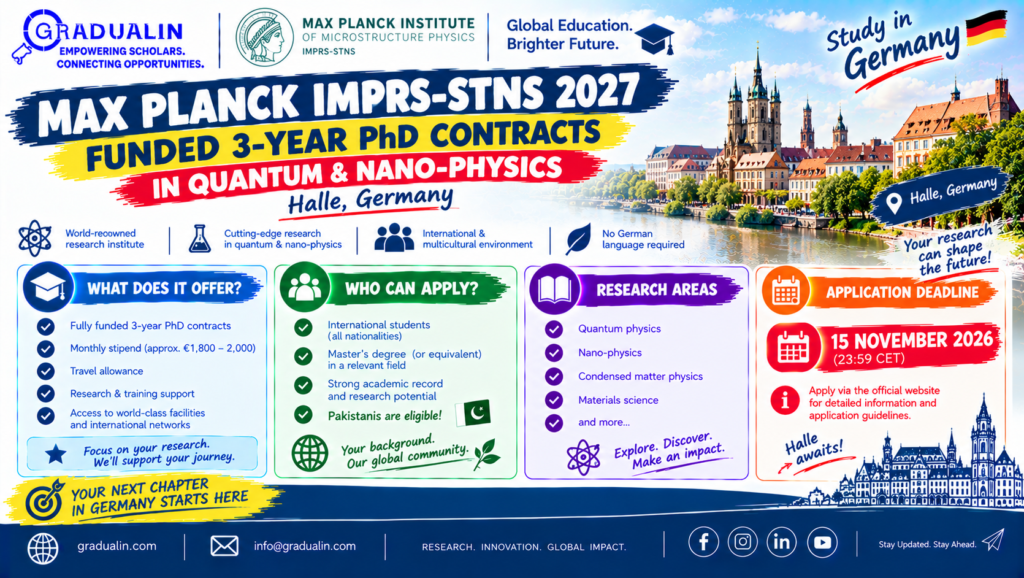
A PhD at a Max Planck Institute is one of the strongest starts to a research career in physics, and this call comes with a proper job contract, not just a stipend. The International Max Planck Research School for Science and Technology of Nano-Systems (IMPRS-STNS), run jointly by the Max Planck Institute of Microstructure Physics and Martin Luther University Halle-Wittenberg (MLU), is recruiting PhD students across 12 research projects in superconductivity, spintronics, twistronics and quantum nanodevices. Positions are fully funded employment contracts on the German public-sector pay scale (pay group 13), with health insurance, pension contributions, 30 days’ paid leave and no tuition fees. You need a master’s in physics, materials science or chemistry. The working language is English, and applicants of any nationality are welcome. Applications close on 15 November 2026.
| 🏛️ Graduate School | IMPRS for Science and Technology of Nano-Systems (IMPRS-STNS) |
| 🔬 Host Institutions | Max Planck Institute of Microstructure Physics + Martin Luther University Halle-Wittenberg, Halle (Saale), Germany |
| 📚 Research Topics | 12 projects in quantum materials, superconductivity, spintronics and nanofabrication |
| 💼 Funding | Employment contract on public-sector pay group 13 (TVöD at the MPI or TV-L at the university) |
| ➕ Benefits | Statutory health insurance, pension contributions, 30 days’ annual leave, no tuition fees |
| ⏳ Contract | 3 years initially |
| 🎓 Requirement | Master’s in physics, materials science, chemistry or a related field (with a thesis) |
| 🗣️ Language | English (no German needed) |
| 📅 Deadline | 15 November 2026, 23:59 CET |
| 📢 Shortlist | By 18 December 2026, then interviews with supervisors |
| 🚀 Start | From spring 2027 (most in summer or autumn 2027) |
| 🇵🇰 Pakistani Students Eligible | Yes. “You do not need to be in Germany, or hold a European passport, to apply” |
| 🔗 Official Page | IMPRS-STNS Call 2026 |
About IMPRS-STNS and the Max Planck Institute of Microstructure Physics
The Max Planck Society is Germany’s leading basic-research organisation. Its International Max Planck Research Schools (IMPRS) are structured PhD programmes run with partner universities. IMPRS-STNS is based in Halle (Saale), where the MPI of Microstructure Physics and MLU share one campus. Research focuses on nanoscale and quantum materials: how electrons, spins and light behave in engineered structures, and how to turn those effects into future electronic, spintronic and quantum devices.
Some projects are in the NISE department led by Prof. Stuart Parkin, a pioneer of spintronics and magnetic memory, so students work with world-class cleanrooms, cryogenic measurement systems and imaging tools.
How it compares: many PhD scholarships abroad pay a tax-free stipend without pension or full social insurance. IMPRS-STNS positions are employment contracts: you’re a salaried researcher with German social insurance, which matters for health cover, family visas and later permanent residence. Compared with our CiM-IMPRS Münster guide (life sciences), STNS is firmly physics, materials and chemistry.
🔬 The 12 Research Projects (Call 2026)
| # | Project | Focus |
|---|---|---|
| 1 | Controlling the direction of supercurrent in quantum devices | Superconducting diodes, quantum interference, microwaves |
| 2 | Creating quantum materials and exploring unconventional superconductivity | Layer-by-layer growth; magnetism meeting superconductivity |
| 3 | Chirality in 3D twistronics | Twisted 3D structures; glovebox fabrication and ARPES |
| 4 | Exploring quantum nanodevices with atomic-scale precision | Quantum device fabrication; measurements down to about 20 mK |
| 5 | Josephson-junction arrays | Nanofabrication and cryogenic measurement |
| 6 | Transfer of chiral information: chiral-induced spin selectivity | Centrochirality, helical polymers and spin selectivity |
| 7 | Emerging spin dynamics for next-generation spintronic devices | Atomically engineered spintronic materials |
| 8 | Opto-spintronics | Photon-spin-charge interplay (SNOM, SHG, RMCD) at cryogenic temperatures |
| 9 | Engineering quantum coherence in Josephson junctions | Superconductivity, magnetism and topology |
| 10 | Coherent spin transfer in spin-triplet superconductor-magnon hybrids | Superconducting ferromagnet heterostructures |
| 11 | Skyrmion-superconductor interfaces in van der Waals heterostructures | vdW fabrication and magnetic imaging below 50 K |
| 12 | Atomic layer engineering and 3D nanofabrication for quantum and spintronic devices | Oxide electronics, spintronics, superconductivity |
Each project page lists its supervisor, contact scientist and required skills. For example, project 1 asks for “enthusiasm for practical work in the cleanroom and with low-temperature measurement systems”, with nanofabrication or cryogenic experience desirable but not required. See the full list on the research topics page.
💰 Contract and Benefits
- ✅ A fully funded employment contract, not a stipend, with either the MPI (TVöD) or MLU (TV-L)
- ✅ Pay group 13 on the German public-service scale. PhD contracts are usually part-time percentages (for example 65–75%), roughly €2,900–3,400 gross a month depending on the percentage and employer (verify on official website)
- ✅ Statutory health insurance and pension contributions
- ✅ 30 days of paid annual leave
- ✅ No tuition fees for the doctorate or the programme
- ✅ A 3-year initial contract
- ✅ Structured training within the IMPRS, plus access to Max Planck facilities
In PKR: €3,000 gross is roughly PKR 9 lakh or more a month before tax (check the current rate). After German tax and social contributions, the net amount is lower but still comfortable in Halle, one of eastern Germany’s more affordable university cities.
📋 Eligibility
- A master’s degree in physics, materials science, chemistry or a related field, including a final thesis project, completed before you start
- Working language: English. No German is needed to apply. The FAQ doesn’t list a required English test (verify on official website)
- No nationality restriction: you don’t need to be in Germany or hold an EU passport
- Interest and aptitude for experimental work (cleanroom, cryogenics, spectroscopy), depending on the project
- A bachelor’s degree alone is not enough
🇵🇰 Pakistani students: eligible. Strong fits are MS or MPhil graduates in physics, materials or nanoscience, or chemistry from QAU, PIEAS, GCU Lahore, LUMS, NUST (SCME), COMSATS, Punjab University and the IST. Thesis experience with thin films, magnetic materials, superconductors, 2D materials or device fabrication is a big plus. APS certification isn’t required for PhD positions in Germany, but you’ll need HEC-attested degrees for the visa (verify on official website).
✅ Apply if you…
- Have an MS or MPhil (with a thesis) in physics, materials science or chemistry
- Enjoy hands-on lab work: fabrication, low temperatures, optics
- Are interested in quantum materials, superconductivity or spintronics
- Have two academic referees who know your research
- Want a salaried PhD with German social security
❌ Skip it if you…
- Only have a bachelor’s degree
- Want a purely theoretical or computational PhD (most projects are experimental)
- Have a background unrelated to physics, materials or chemistry
- Can’t prepare a project-specific motivation letter by 15 November
- Need to start before spring 2027
📄 Required Documents
- CV
- Full transcripts (bachelor’s and master’s)
- Degree certificate, or the date you expect to receive it
- Motivation letter naming the project you’re applying for
- Two reference letters from academic supervisors you’ve worked with. If they aren’t ready, the FAQ says you can apply without them, and upload instructions will follow
HEC note for Pakistani applicants: upload clear scans of your degrees and transcripts with a grading-scale explanation. Start HEC attestation now, because you’ll need attested documents for the German national (D) visa if you’re selected.
🪜 Step-by-Step: How to Apply
- Read all 12 projects on the research topics page and shortlist 1–2 that match your thesis.
- Read the project page carefully. Each one has its own instructions, supervisor and contact person.
- Write a targeted motivation letter naming the project. Link your master’s thesis, lab skills (XRD, AFM, SEM, lithography, PPMS, cryostats and so on) and research goals to it.
- Ask two academic referees for letters now.
- Apply through the MPI Halle online portal (softgarden) linked from the project page, and select your research topic.
- Submit before 15 November 2026, 23:59 CET (about 04:00 PKT on 16 November).
- Shortlist by 18 December 2026, then an interview with your prospective supervisor.
- If selected: sign the contract and apply for a German national (D) visa for researchers or employment at the German embassy or consulate in Pakistan (check current rules with the embassy).
📅 Important Dates
| Milestone | Date |
|---|---|
| Call open | Now |
| Application deadline | 15 November 2026, 23:59 CET |
| Shortlist notification | By 18 December 2026 |
| Supervisor interviews | After shortlisting (verify on official website) |
| Start dates | From spring 2027 (most in summer or autumn) |
🌍 Why Apply
Quantum materials and spintronics sit at the heart of next-generation computing, memory and sensing. A PhD at a Max Planck Institute gives you excellent equipment, top-level supervision and a name that opens doors to postdocs and industry R&D worldwide, including semiconductors, quantum technology and advanced materials. Being salaried with German social insurance also makes life in Germany more stable, and it counts towards later residence options.
❓ Frequently Asked Questions
Can Pakistani students apply for the Max Planck IMPRS-STNS PhD?
Yes. The FAQ says you don’t need to be in Germany or hold a European passport to apply. You need a master’s in physics, materials science, chemistry or a related field, with a thesis.
Is this a scholarship or a job?
It’s a fully funded employment contract on the German public-service pay scale (pay group 13), with health insurance, pension contributions and 30 days of annual leave. There are no tuition fees.
How much is the salary?
Pay is based on pay group 13 of the TVöD (MPI) or TV-L (university) scale. PhD contracts are usually part-time percentages, roughly €2,900–3,400 gross a month depending on the percentage. Check the exact rate in the official FAQ tables.
Do I need German or IELTS?
No German is needed. The working language is English. The FAQ doesn’t list a specific English test, so show your English skills through your motivation letter, publications or an English-medium degree (verify on official website).
Can I apply with a bachelor’s degree?
No. A completed master’s degree with a final thesis project is required before you start.
What happens after I apply?
You’ll hear by 18 December 2026 whether you’re shortlisted. The next step is an interview with your prospective supervisor. Positions start from spring 2027, with most in summer or autumn.
🔗 Official Sources
- IMPRS-STNS Call 2026
- Research topics (12 projects)
- FAQ
- Max Planck Institute of Microstructure Physics
- Contact: imprs@mpi-halle.mpg.de · +49 345 5582-833
📊 Summary Table
| Detail | Information |
|---|---|
| Programme | IMPRS for Science and Technology of Nano-Systems |
| Hosts | MPI of Microstructure Physics + MLU Halle-Wittenberg |
| Projects | 12 (quantum materials, superconductivity, spintronics) |
| Funding | Employment contract, pay group 13, 3 years |
| Benefits | Health insurance, pension, 30 days’ leave, no tuition |
| Requirement | Master’s (physics, materials, chemistry) |
| Language | English |
| Deadline | 15 November 2026, 23:59 CET |
| Pakistani Students | Eligible |
Explore more on Gradualin: Scholarships, Jobs & Internships, Events & Conferences, and Guidelines & Resources.
Stay updated with the latest scholarships, jobs, and opportunities at Gradualin.com — your trusted guide to studying abroad for free.