
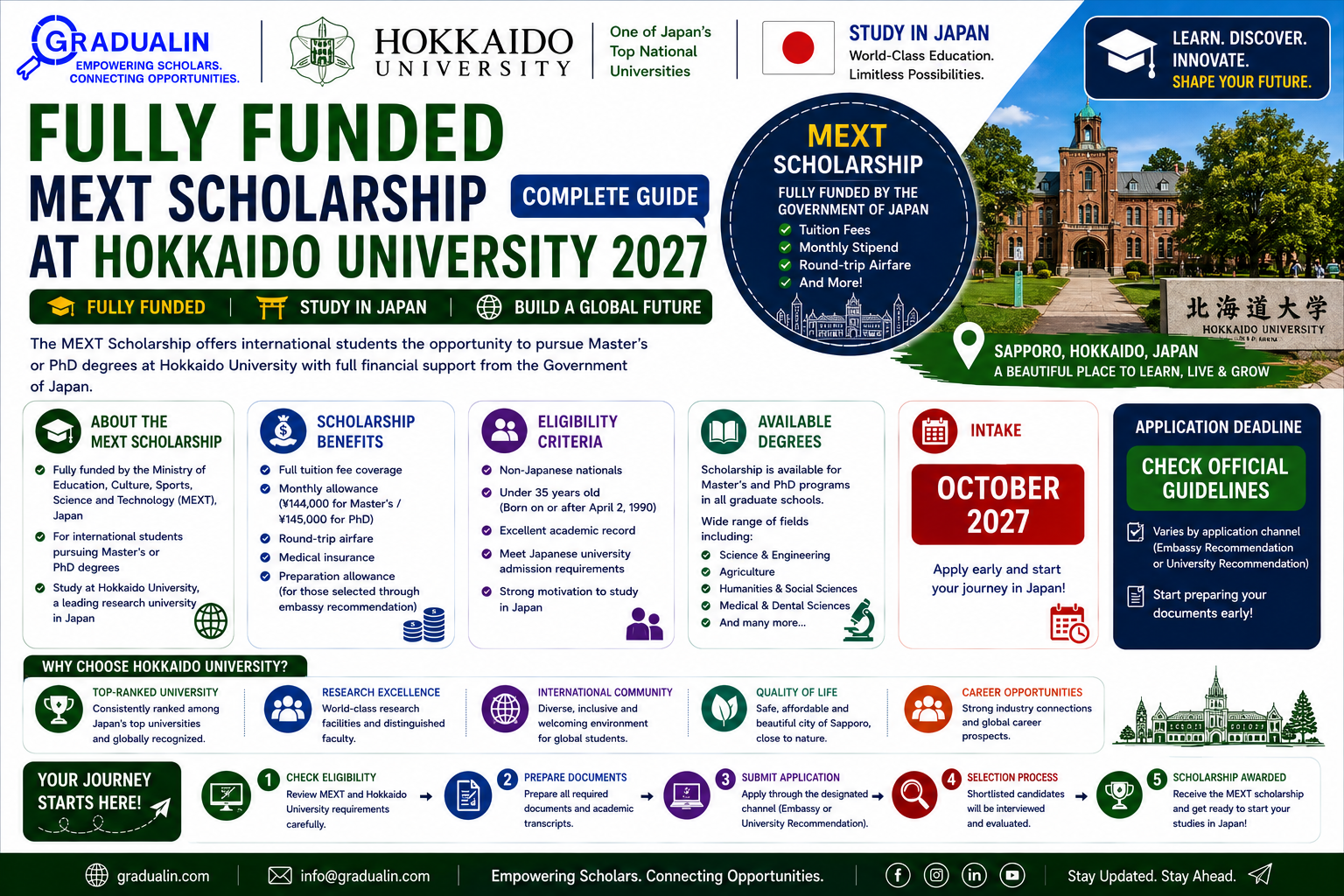
Fully Funded MEXT Scholarship at Hokkaido University 2027 — Complete Guide
Japan’s government-funded MEXT Scholarship is one of the most comprehensive fully funded awards available to international graduate students anywhere in the world — and Hokkaido University offers multiple access routes to it, including a dedicated pathway that requires no IELTS if your prior degree was taught in English. If you are a Pakistani, South Asian, or international student aiming for a Master’s or PhD in Japan, this guide covers every route, every document, and every deadline you need to know for the 2027 intake.
| Detail | Information |
| University | Hokkaido University (Hokudai) |
| Country | Japan |
| City | Sapporo, Hokkaido |
| Degree Level | Master’s and PhD (select undergraduate routes also exist) |
| Funding Type | Fully Funded |
| Application Routes | Embassy Recommendation / University Recommendation |
| Intake | October 2027 |
| University Recommendation Deadline | November 2026 (varies by graduate school) |
| Embassy Recommendation (Pakistan) | April–May cycle — closed for 2027; monitor for 2028 |
| Open To | All nationalities |
| Pakistani Students Eligible | ✅ Yes — Embassy of Japan in Islamabad and Consulate-General Karachi both process applications |
| Official Link | Hokkaido University Scholarships Page |
🎓 About Hokkaido University and the MEXT Scholarship
Hokkaido University — known locally as Hokudai — was founded in 1876 as Sapporo Agricultural College. Today it ranks #179 in the QS World University Rankings 2027, sits among Japan’s top ten national universities, and hosts approximately 18,000 students from nearly 100 countries. Its graduate schools are particularly strong in environmental science, life sciences, engineering, agriculture, and veterinary medicine — fields where Japanese research output consistently leads globally.
The MEXT Scholarship (Ministry of Education, Culture, Sports, Science and Technology) is the Japanese government’s flagship international scholarship programme. Unlike university-funded awards that tap institutional endowments, MEXT is funded directly by the Japanese government, which means the stipend, tuition waiver, and airfare benefits are fixed and guaranteed for the full programme duration — not dependent on budget cycles or departmental funding. This makes it meaningfully more secure than most university-funded fellowships, including some well-known European options.
Hokkaido University is one of the few Japanese institutions that offers all three MEXT application routes — Embassy Recommendation, University Recommendation, and (when available) Domestic Selection — plus specific programme-linked Special Quota pathways through its graduate schools. That breadth of access makes it a stronger practical target than many other Japanese universities where only one route is realistically available to international applicants.
Compared to the MEXT Scholarship at the University of Tokyo or Kyoto University, Hokkaido has a meaningfully lower volume of competing applicants for its University Recommendation slots — a genuine advantage for qualified students who apply strategically.
🎓 Scholarship Benefits
- Monthly stipend: ¥144,000 (~PKR 275,000 / month) for Master’s students
- Monthly stipend: ¥145,000 (~PKR 277,000 / month) for PhD students
- Winter cold-region allowance: stipend increases to approximately ¥147,000–¥148,000 from November through March — a unique addition because Sapporo’s winters qualify for an official cold-region supplement
- Full tuition waiver: admission fees and tuition fees for the entire degree duration are completely covered
- Round-trip international airfare: travel from your home country’s nearest international airport to Japan, and return upon completion
- No bond/service obligation: unlike some government scholarship programmes (including certain Pakistani HEC awards), MEXT does not require recipients to return to government service after graduation
Note: Stipend amounts are set annually by MEXT and confirmed at the time of award. Verify the current figures on the official MEXT study-in-Japan portal at the time of application. PKR conversions above are approximate based on August 2026 exchange rates.
🎓 Eligibility Criteria
- Must be an international student — all nationalities are eligible
- Must hold or be completing a Bachelor’s degree (for Master’s applicants) or Master’s degree (for PhD applicants)
- Minimum GPA: 2.30 out of 3.00 on the MEXT scale — this is equivalent to roughly a B average; many strong Pakistani students from HEC-recognised universities meet this comfortably
- English proficiency: CEFR B2 level or equivalent — no IELTS required if your prior degree was conducted entirely in English. In this case, a Medium of Instruction (MOI) letter from your university is accepted. This is confirmed by the official guidelines and is a significant advantage for graduates of English-medium programmes in Pakistan.
- Must not currently hold another MEXT scholarship or have an active MEXT application at the same stage
- Age limits apply and vary slightly by route — check the relevant embassy or university graduate school page for the exact ceiling (typically applicants must be under 35 for most graduate routes, though this can vary)
- Must satisfy the language requirements of the graduate school applied to (English-medium programmes do not require Japanese)
Pakistani students: ✅ Fully eligible. Applications are processed through the Embassy of Japan in Islamabad (for applicants with a CNIC permanent address in Punjab, KPK, Balochistan, or AJK) or the Consulate-General in Karachi (for Sindh). Applying through the wrong channel is a common reason for rejection at intake — confirm which office covers your CNIC address before submitting.
🎓 Who Should Apply — and Who Probably Shouldn’t
✅ Strong candidates:
- Graduates of English-medium programmes at HEC-recognised universities (NUST, LUMS, QAU, COMSATS, UET, and equivalent) who can submit an MOI letter instead of IELTS
- Students with a GPA of 2.30/3.00 or above and genuine research interest — especially in environmental science, life sciences, engineering, agriculture, or veterinary medicine, where Hokudai’s faculty is strongest
- Applicants who have already identified a specific professor at Hokkaido University whose published research aligns with their own — this is the single biggest differentiator in the University Recommendation route
- Pakistani students aiming for Japan specifically: the bilateral relationship is strong, Pakistan receives a consistent country quota under the Embassy route, and HEC-attested degrees are recognised in Japan’s equivalence framework
❌ Weaker fits:
- Students who cannot clearly articulate a research proposal — MEXT evaluates academic seriousness heavily and a generic SOP is the most common reason for rejection
- Applicants who have not contacted a prospective supervisor before applying via the University Recommendation route — this step is not optional; it is the entry point to the process
- Students hoping to study at a specific faculty that is not participating in the MEXT University Recommendation cycle for that year (always verify the graduate school’s active participation)
- Those with a GPA below the 2.30/3.00 threshold — there is no waiver for this requirement
🎓 Available Programmes and Graduate Schools
MEXT at Hokkaido University is available across multiple graduate schools, with each school running its own timeline. The most active University Recommendation pathways for the 2027 intake include:
- Graduate School of Life Science — International Graduate Programme (IGP), English-medium, life sciences focus; 5 PhD and 3 Master’s slots confirmed for the October 2027 IGP Special Quota
- Graduate School of Environmental Science — Graduate Programme for Environmental Conservation Leadership for Post SDGs; strong fit for students in ecology, climate, and sustainability
- Graduate School of Engineering — Next-Generation Green Transformation Leader Development Programme (e3); English-medium engineering research
- Graduate School of Veterinary Medicine — Human-Animal Bond education programme, One Health focus
- Graduate School of Agriculture, Modern Japanese Studies Programme, Integrated Science Programme — additional MEXT-linked pathways
For the full, current list of participating programmes and supervisors, use the Hokkaido University Researcher Directory to identify faculty before reaching out.
🎓 Required Documents
The exact document set varies slightly by route and graduate school, but the standard package across most University Recommendation pathways includes:
- MEXT scholarship application form (download from the relevant graduate school page or the studyinjapan.go.jp portal)
- “Field of Study and Study Programme” document — a detailed research plan; treat this as your most important document
- Official academic transcripts from all degrees completed or in progress (with grading scale attached — this is mandatory)
- Certificate of graduation or diploma (or expected graduation letter if still enrolled)
- Recommendation letter from a dean or above at your current institution, addressed to the President of Hokkaido University
- Research/thesis abstract (concise summary of your undergraduate or Master’s research)
- Proof of English proficiency — IELTS, TOEFL, or MOI letter from your university if your degree was fully English-medium
- Copy of passport or government-issued national ID
- Evidence of academic excellence or awards (if applicable)
- IGP First Step Form (for the Life Science IGP route specifically — sent directly to your prospective supervisor)
Pakistani applicants note: Your HEC-attested transcripts are accepted. If you have completed your degree from a Pakistani university, you do not need to separately seek international accreditation before applying — the HEC framework is recognised. However, if you proceed to the visa stage, embassy verification of documents will be required.
🎓 Step-by-Step Application Process
- Identify your graduate school and supervisor. Browse the Hokkaido University Researcher Directory and find a professor whose current research directly matches your interests. Read their recent publications — not just their profile summary.
- Make direct contact. Email the prospective supervisor with a concise introduction, your academic background, and a one-paragraph summary of the research you want to pursue under their guidance. Attach a brief CV. For the IGP Life Science route, use the official IGP First Step Form. Do this as early as possible — for the November 2026 deadline, contact supervisors no later than September 2026.
- Get informal acceptance from your supervisor. This is not yet a formal Letter of Acceptance — it is the supervisor indicating willingness to consider you. Without this, the University Recommendation process cannot proceed.
- Prepare and submit your documents. Compile the full document package listed above. Submit through your prospective supervisor via email — not through a general admissions portal. Each graduate school has its own submission process; confirm the exact method with your supervisor.
- Entrance examination. Shortlisted candidates take an entrance exam in the summer (typically June–July for October intake). For the University Recommendation route, this exam is conducted at the university level.
- University nomination to MEXT. If you pass the entrance exam, the graduate school nominates you to MEXT in approximately March of the following year. MEXT then conducts a final selection.
- Final award and arrival. Successful scholars arrive in Japan in October for programme start.
Pakistani applicants — additional note: For the Embassy Recommendation route, all steps above are replaced by the Embassy of Japan in Pakistan’s separate process. The 2027 Embassy cycle closed in May 2026. Begin preparing now for the 2028 Embassy cycle, which will open approximately April–May 2027. Bookmark the Embassy of Japan in Pakistan page and check it from March 2027 onward.
Practical tip from MEXT patterns: The single most common mistake in the Field of Study document is describing what you want to study rather than what you want to research. State your specific research question, why Hokkaido University’s facilities or faculty are specifically suited to answer it, and what outcome you expect. Generic academic interest statements do not make it past the first round.
🎓 Important Dates
| Milestone | Date |
| University Recommendation applications open | Varies by graduate school — most open August–October 2026 |
| IGP Life Science supervisor contact deadline | November 10, 2026 |
| General University Recommendation deadline | November 2026 (confirm with specific graduate school) |
| Entrance examination (shortlisted candidates) | Summer 2026–2027 (varies) |
| University nominates to MEXT | Approximately March 2027 |
| Programme start (successful scholars) | October 2027 |
| Embassy Recommendation (Pakistan) — 2027 cycle | Closed (deadline was 26 May 2026) |
| Embassy Recommendation (Pakistan) — 2028 cycle | Expected April–May 2027 |
📌 Bookmark this page — we update deadlines as soon as changes are announced.
🎓 Why Apply — Why Hokkaido University and Japan
Sapporo is consistently ranked among Japan’s most liveable cities. The cost of living is lower than Tokyo or Osaka, the campus is one of the largest and greenest in Japan, and the city’s infrastructure makes day-to-day life manageable for international students arriving without Japanese language skills.
Academically, a MEXT-funded degree from Hokkaido University carries significant weight in East Asian research markets and is increasingly recognised across South Asia. Pakistan’s HEC framework accepts Hokkaido degrees for equivalence certification upon return, meaning the qualification is portable if you plan to re-enter Pakistani academia or apply for faculty positions at HEC-recognised institutions.
For students in environmental science, life sciences, or engineering specifically, Hokkaido’s research environment is genuinely competitive at the global level — its environmental science faculty ranks 5th in Japan and 112th globally by research output. That is not a ranking you will find attached to every “fully funded in Japan” scholarship you will see circulating on social media.
Gradualin Editor’s Note: Be honest with yourself about selectivity. The University Recommendation route is competitive but more accessible than the Embassy route — acceptance rates for the Embassy track in Pakistan run below 5%, while the University Recommendation slots (8 for the IGP alone) represent a more targeted pool. If your GPA is strong (above 3.0/4.0 at your home institution), you have a clear research proposal, and you have done the work of identifying and contacting a supervisor, this is a realistic target. If any of those three elements is missing, the application will not move past the first stage regardless of other qualifications. For average applicants without a supervisor contact, this is not an easy win — it is a high-reward, high-effort opportunity that rewards serious preparation over a period of months, not weeks.
🎓 Frequently Asked Questions
These questions are based on what students most commonly search about this programme.
Can Pakistani students apply for the MEXT Scholarship at Hokkaido University? Yes. Pakistani students are fully eligible through both the Embassy Recommendation route (via the Embassy of Japan in Islamabad or the Consulate-General in Karachi) and the University Recommendation route. Pakistan receives a consistent annual allocation under the Embassy track — typically 15–30 awardees per year across the Research Student stream. For the University Recommendation route, there is no country quota; all international students compete on academic merit and research fit.
Is IELTS required for Pakistani applicants? Not necessarily. If your Bachelor’s or Master’s degree was conducted entirely in English, you can submit a Medium of Instruction (MOI) letter from your university registrar instead of an IELTS or TOEFL score. This is a confirmed MEXT policy. However, if your programme had significant Urdu-medium components, a standardised English test score will strengthen your application considerably.
Do I need to learn Japanese before applying? No Japanese language proficiency is required for English-medium graduate programmes at Hokkaido University. Several graduate schools — including the IGP Life Science and the e3 Engineering programme — operate fully in English from enrolment through graduation. That said, learning basic Japanese (JLPT N5 or N4) before arrival is strongly advisable for daily life in Sapporo, where English is less widely used outside the university campus than in Tokyo.
Does Hokkaido University accept HEC-attested degrees from Pakistan? Yes. HEC-attested transcripts from Pakistani universities are accepted in the MEXT document package. Japan’s equivalence framework recognises HEC-certified degrees, which means your qualification is portable in both directions — accepted for application in Japan, and recognised by HEC upon return.
How competitive is the University Recommendation route compared to the Embassy route? The Embassy Recommendation route in Pakistan is significantly more competitive — with acceptance rates below 5% and a written exam and interview process that screens out the majority of applicants. The University Recommendation route is internally competitive but operates within a smaller, more targeted pool. The effective filter is the supervisor contact stage: applicants who secure a supervisor’s informal support before the deadline are in a fundamentally stronger position than those applying without one.
🎓 Official Sources
- Hokkaido University — Scholarships for Prospective Students
- MEXT Study in Japan Official Portal
- Embassy of Japan in Pakistan — MEXT Research Scholarship
- Hokkaido University Researcher Directory
- IGP Life Science Programme — Hokkaido University
- e3 Engineering Programme — MEXT Scholarships
- Graduate Programme for Environmental Conservation Leadership
🎓 Summary
| Detail | Information |
| University | Hokkaido University (Hokudai) |
| Country | Japan |
| City | Sapporo, Hokkaido |
| Degree Level | Master’s and PhD |
| Funding Type | Fully Funded |
| Monthly Stipend | ¥144,000 (Master’s) / ¥145,000 (PhD) + winter allowance |
| Tuition | Fully waived |
| Airfare | Round-trip covered |
| Application Routes | Embassy Recommendation / University Recommendation |
| University Recommendation Deadline | November 2026 (varies by graduate school) |
| Programme Start | October 2027 |
| Pakistani Students Eligible | ✅ Yes |
| No IELTS Required | ✅ If prior degree was English-medium (MOI letter accepted) |
| Official Link | Apply Here |
For more opportunities in Japan and Asia, explore Top 10 Fully Funded Scholarships in Asia 2027 and Fully Funded PhD Scholarships in the UK 2026 for comparable fully funded graduate routes.
Thinking about studying in another Asian destination? Study in Turkey 2026 — Guide for International Students and Top Fully Funded Scholarships in Saudi Arabia 2026 cover two of the most accessible fully funded destinations for Pakistani graduates.
For PhD-specific funding, Fully Funded PhD Positions in Switzerland 2026 is the closest comparable programme in terms of research environment and stipend structure — worth reviewing alongside this one.
Browse all current 🎓 Scholarships, 💼 Jobs & Internships, 🌍 Events & Conferences, and 📚 Guidelines & Resources on Gradualin.
Stay updated with the latest scholarships, jobs, and opportunities at Gradualin.com — your trusted guide to studying abroad for free.
Author: Faseeh Sultan — PhD Scholar & MSIT | 7 Years in Education