
Funded Singapore AI Safety Fellowship 2026 — Stipend + Housing
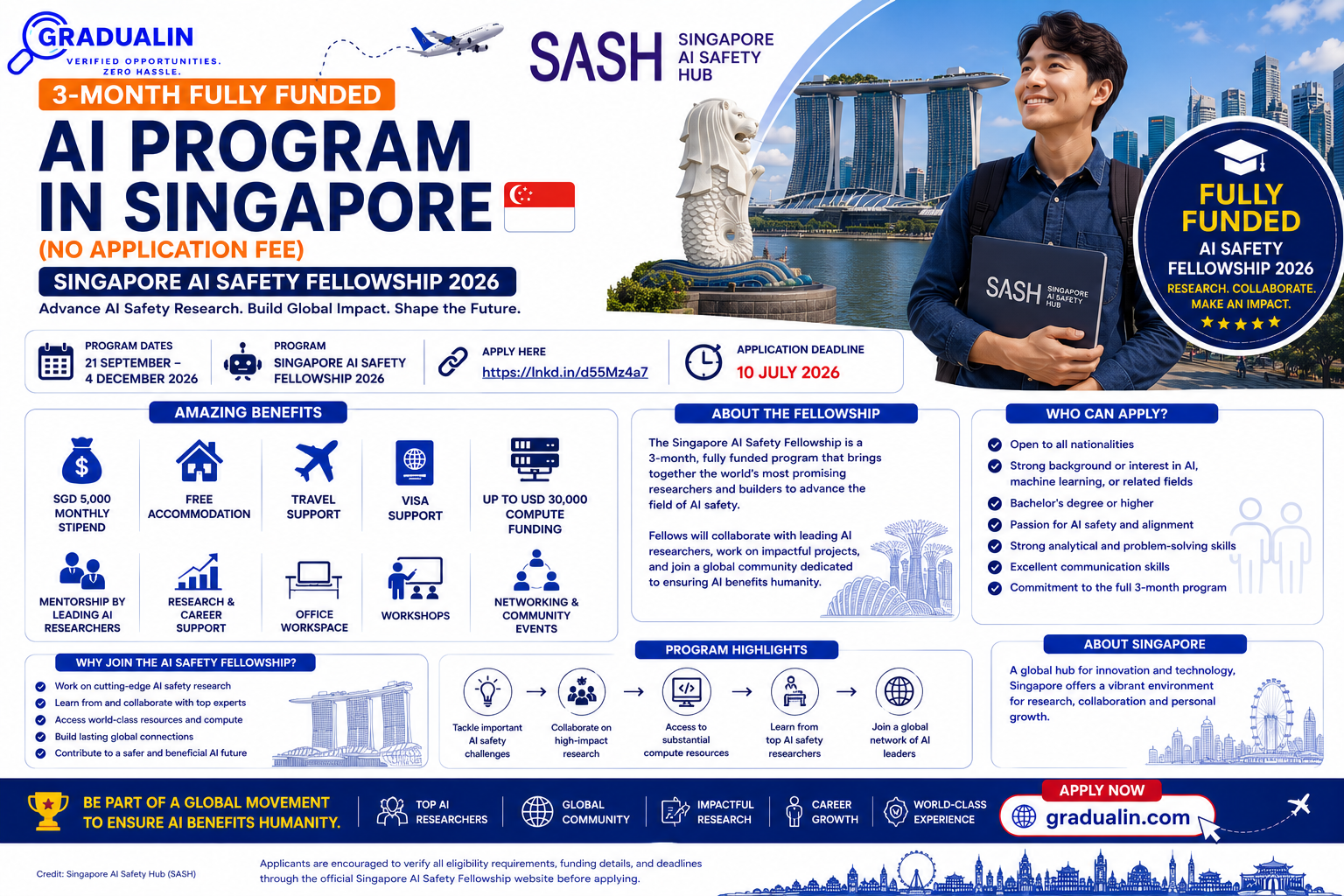
If there is one research opportunity in 2026 that sits at the intersection of cutting-edge technical work and real-world global impact, this is it. The Singapore AI Safety Fellowship — run by the Singapore AI Safety Hub (SASH) — is a fully funded, three-month residential research program in Singapore, offering international researchers a SGD 5,000 monthly stipend, covered housing and travel, and up to USD 30,000 in compute for qualifying projects. The application deadline is July 10, 2026, and the fellowship runs from 21 September to 4 December 2026. If you are a researcher who wants your work to shape how AI develops safely — not just sit on a shelf — read every word of this guide.
| Detail | Information |
| Organization | Singapore AI Safety Hub (SASH) |
| Country | Singapore |
| Program Type | Independent Research Fellowship |
| Duration | 3 months (21 Sep – 4 Dec 2026) |
| Stipend | SGD 5,000 per month |
| Additional Benefits | Housing + travel covered |
| Compute | Up to USD 30,000 per project |
| Application Deadline | July 10, 2026 |
| Open To | International researchers worldwide |
| Official Link | Singapore AI Safety Fellowship |
🎓 About the Singapore AI Safety Fellowship
The Singapore AI Safety Hub (SASH) is an independent organization building a global ecosystem for trustworthy AI. Its flagship program — the Singapore AI Safety Fellowship — connects talented early-career and mid-career researchers with leading mentors across technical AI safety and AI governance, bringing them together for three months of intensive, in-person research in one of the world’s most strategically connected cities.
What makes this fellowship genuinely different from other AI research programs is its deliberate cross-regional design. SASH brings together researchers from East and West to build the kind of trusted relationships that sustained international AI safety collaboration requires. Singapore’s position as a globally connected, policy-engaged hub — bridging Asia’s largest AI actors with Western research institutions — makes it the ideal venue for exactly this kind of work.
The program is advised by Ryan Kidd, Co-Executive Director of the MATS Program — one of the most respected AI safety research mentorship programs in the world. That advisory relationship signals the seriousness of SASH’s research standards and ambitions.
This is not a training course or a reading group. Fellows are expected to produce research outputs — typically a paper, but other formats are open — that contribute directly to the AI safety field while also being grounded in real-world application and policy.
🎓 Benefits and Funding
Here is exactly what accepted fellows receive:
- SGD 5,000 per month — a competitive living stipend for the full three months
- Housing provided — accommodation is covered for fellows relocating to Singapore
- Travel covered — return flights to and from Singapore are arranged for fellows
- Up to USD 30,000 in compute — for projects that require significant computational resources
- Weekly mentor meetings — with established AI safety researchers guiding your project
- Dedicated Research Manager — to remove blockers, track progress, and support your next career steps
- Central office space — SASH’s hub in Chinatown, Singapore’s most storied historic district
- Community events — talks, workshops, and social events with mentors, peers, and AI safety/governance professionals
- Visa support — SASH arranges visas for accepted international fellows
Note: The exact SGD equivalent of the monthly stipend’s purchasing power in Singapore should be verified against current living costs when planning your move (verify on official website).
🎓 Eligibility Criteria
The official eligibility requirements as stated on the SASH website are:
- A track record of strong technical research — prior research output is expected, not just academic credentials
- Genuine interest in steering AI’s development toward good outcomes for humanity — this is a values-aligned program
- Comfort operating across cultures and disciplines — the fellowship is deliberately cross-regional
- Ability to commit full-time and relocate to Singapore for the three-month duration (21 September – 4 December 2026)
English language requirement: The fellowship operates entirely in English, and info sessions are offered in both English and Mandarin. No specific IELTS or TOEFL score requirement is stated on the official website — your research track record and application quality carry the weight. (Verify directly with SASH if a formal language document is required for your visa or application.)
The fellowship is open to international researchers worldwide — no nationality restriction is listed.
🎓 Who Should Apply / Who Shouldn’t
✅ Strong fit if you:
- Have a research background in ML, AI systems, alignment, interpretability, or AI governance
- Want your work to directly inform AI safety practice — not just be published
- Are comfortable working in a cross-cultural, interdisciplinary environment
- Can commit fully to Singapore residency for three months from September 2026
- Are at an early-to-mid career stage and looking for mentorship alongside research output
❌ Not a fit if you:
- Cannot relocate to Singapore full-time — there is no remote or part-time option
- Are looking for a degree program or academic course structure
- Have no prior research experience or publications to demonstrate
- Need a program with more flexibility around side commitments (though small side commitments are mentioned as usually acceptable)
🎓 Research Areas and Mentors
SASH’s fellowship covers the full spectrum of AI safety research — from deep technical work to governance and policy application. Research outputs are expected to bridge both.
Confirmed mentors for the 2026 cohort include researchers from institutions that span continents and disciplines:
- Tsinghua University (China) — Dong Yinpeng, Xu Mengdi
- Fudan University (China) — Pan Xudong
- National University of Singapore — Tan Zhi Xuan, Min-Yen Kan, Mohan Kankanhalli (Director, NUS AI Institute)
- Oxford Martin AI Governance Initiative — Ben Harack
- Hebrew University — Noam Kolt
- Hunter College, CUNY — Konstantinos Krampis
- Anthropic — James Chua (Member of Technical Staff)
- FAR.AI — Lukas Struppek
- Concordia AI — Jinge Wang
- Lucid Computing — Kristian Rönn (Co-founder and CEO)
- International AI Safety Report 2025 — Soren Mindermann (Scientific Lead)
Additional mentors will be announced ahead of the fellowship start date. Applicants rank preferred mentors and research areas when applying; mentors reciprocally rank shortlisted candidates. SASH uses both rankings to make the final match.
🎓 Required Documents
Based on the application process described on the official website:
- Written application — approximately one hour to complete (via Airtable form)
- CV / Academic Resume — highlighting your research track record and publications
- Research area and mentor preferences — ranked in the application form
- Standardized assessments — for shortlisted candidates only
- Mentor-specific work task and/or interview — for candidates reaching the final stage
Always download the application form directly from the official SASH program page to confirm whether any additional documents are required.
🎓 Step-by-Step Application Process
- Read the full program details at the Singapore AI Safety Fellowship page — understand the pillars, mentor profiles, and what is expected of fellows.
- Attend an info session if you can — SASH hosted English and Mandarin sessions on July 1–2, 2026. Check for any additional sessions before the deadline.
- Shortlist your preferred mentors by reviewing each mentor’s research focus on the SASH website.
- Complete the written application via the Airtable application form — budget approximately one hour.
- Rank your research areas and mentor preferences within the application form.
- Submit before July 10, 2026 — there is no indication of rolling review, so do not leave this to the last day.
- Complete assessments and work tasks if shortlisted — these are mentor-specific, so tailor your preparation to the mentor’s published research.
Practical tip: Review at least two or three recent papers by your top mentor choices before applying. Your application will be stronger — and your mentor ranking more credible — if you can speak specifically to how their work connects to yours.
🎓 Important Dates
| Milestone | Date |
| Application Deadline | July 10, 2026 |
| Fellowship Start | 21 September 2026 |
| Fellowship End | 4 December 2026 |
| Duration | 3 months |
📌 Bookmark this page and check back for updates — SASH may announce shortlisting timelines and additional information sessions ahead of the deadline.
🎓 Why Apply — Why Singapore
Singapore is one of the most strategically positioned cities on the planet for AI safety work in 2026. As one of Asia’s leading technology and policy hubs, it sits at the meeting point between the world’s largest AI developers — in the US, China, and Europe — and the international governance conversations happening at the UN, G20, and beyond.
What makes SASH’s approach distinctive is its explicit commitment to East-West research collaboration. Most AI safety fellowships are based in the US or UK and draw primarily from Western research networks. SASH’s mentor roster — spanning Tsinghua, Fudan, NUS, Oxford, Hebrew University, Anthropic, and FAR.AI — reflects something rarer: a genuine effort to build the trusted cross-regional relationships that meaningful AI safety coordination requires.
The fellowship office sits in Chinatown, Singapore — one of the city-state’s most vibrant and historically rich neighborhoods, with excellent connectivity to the rest of the island. Singapore’s world-class infrastructure, safety, and quality of life make the three-month residency a genuinely comfortable experience for international researchers.
From a career perspective, fellows who complete serious AI safety research here will emerge with mentor relationships, international co-authors, and a network that spans the field’s most active organizations — from Anthropic and FAR.AI to the NUS AI Institute and the Oxford Martin School.
🎓 Frequently Asked Questions
Q: Is the application open to researchers from all countries? A: Yes. No nationality restriction is listed. The fellowship is explicitly designed to bring together researchers from diverse global backgrounds.
Q: Can I participate remotely or part-time? A: No. The fellowship is in-person and full-time in Singapore. Small side commitments are usually fine and can be mentioned in the application.
Q: What research output is expected? A: Typically a research paper, though SASH is open to other formats if they better suit the project.
Q: How does mentor matching work? A: You rank preferred research areas and mentors in your application. Shortlisted candidates are then reviewed by mentors, who also rank their preferred candidates. SASH uses both sets of preferences to make the final match.
Q: Do I need to arrange my own visa? A: No. SASH will arrange visas for accepted fellows.
Q: Can fellows work in teams? A: Some mentors work with fellows individually, others in teams. Either way, collaboration between fellows is common and encouraged.
🎓 Official Source
- Fellowship Page: Singapore AI Safety Fellowship — SASH
- Application Form: Apply via Airtable
- SASH Website: aisafety.sg
- Twitter/X: x.com/aisafetysg
- LinkedIn: Singapore AI Safety Hub
🎓 Summary Table
| Detail | Information |
| Organization | Singapore AI Safety Hub (SASH) |
| Country | Singapore |
| Program Type | Independent Research Fellowship (In-Person) |
| Duration | 3 months — 21 Sep to 4 Dec 2026 |
| Monthly Stipend | SGD 5,000 |
| Housing | Provided (for non-Singapore residents) |
| Travel | Covered (return flights) |
| Compute | Up to USD 30,000 per project |
| Visa | Arranged by SASH for accepted fellows |
| Application Deadline | July 10, 2026 |
| Open To | International researchers worldwide |
| Expected Output | Research paper (or alternative format) |
| Application Method | Airtable form (~1 hour) |
Explore More Categories:
Top Standing Posts:
Fully Funded Scholarships in Australia 2026
Fully Funded PhD Scholarships in the UK 2026
Fully Funded Scholarships in the USA 2026
Study in Italy 2026 — Guide for International Students
Finland Scholarships 2026 — Tuition Waivers for International Students
Top 10 Fully Funded Scholarships in Asia 2027
Fully Funded PhD Positions in Switzerland 2026
Top Fully Funded Scholarships in Saudi Arabia 2026
Related Posts:
NIE PhD Scholarship 2026 — NTU Singapore
Top 10 Fully Funded Scholarships in Asia 2027
JSPS Postdoctoral Fellowship Japan 2026
Stay updated with the latest scholarships, jobs, and opportunities at Gradualin.com — your trusted guide to studying abroad for free.