
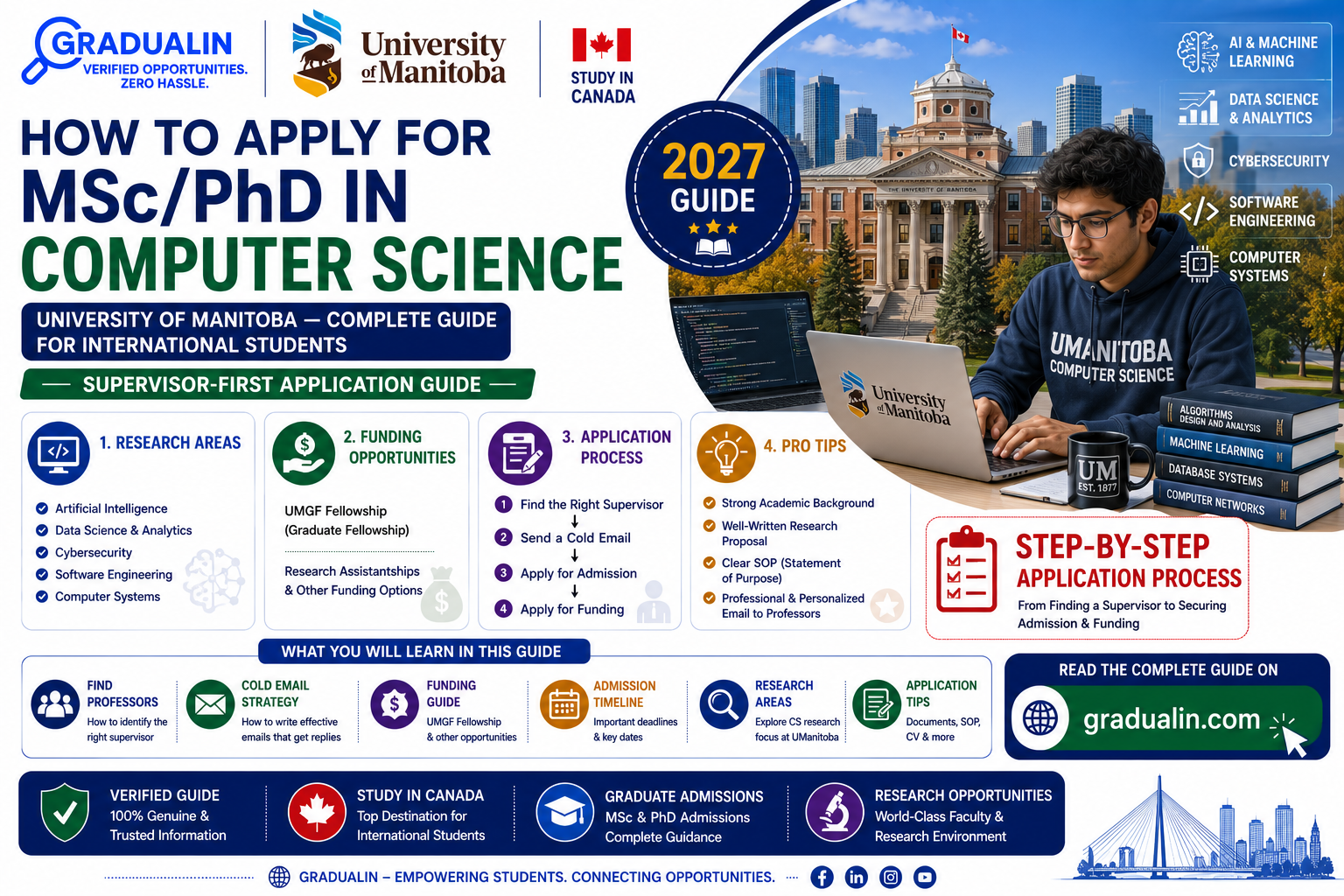
University of Manitoba MSc & PhD in Computer Science 2027 — Complete Guide for International Students
The Department of Computer Science at the University of Manitoba guarantees a minimum funding package to every newly admitted graduate student — CAD 20,000 per year for MSc students and CAD 23,000 per year for PhD students — automatically, without a separate scholarship application. That policy, introduced in September 2023, changes the calculus for international applicants who might otherwise assume that studying in Canada requires independent funding. This guide covers everything you need to know: what the programs look like, how funding actually works, how to find and approach a supervisor, what deadlines apply to international applicants, and what the application itself requires.
| Detail | Information |
| University | University of Manitoba |
| Country | Canada |
| City | Winnipeg, Manitoba |
| Degree Level | MSc (2 years) / PhD (4 years) |
| Funding | Minimum guaranteed stipend (all admitted students) |
| MSc Deadline (International, Fall) | January 15 |
| Winter MSc Deadline (International) | March 15 |
| Open To | International students worldwide |
| Official Link | Apply Here |
📚 About the University of Manitoba Computer Science Department
Established in 1970, the Department of Computer Science at the University of Manitoba has grown into an internationally recognized research centre. Its labs span areas from autonomous agents and bioinformatics to cybersecurity, computational finance, human-computer interaction, and — more recently — responsible AI and computer vision through the CORE AI lab.
The department is part of the Faculty of Science, housed on the Fort Garry campus in Winnipeg, and offers both a thesis-based MSc (two years, expected duration) and a PhD (four years, expected duration). Both are research-intensive programs — there is no course-only pathway for graduate CS at Manitoba.
Unlike programs at larger Canadian universities such as the University of Toronto or the University of British Columbia, where competition for supervisor slots is exceptionally fierce and stipend structures vary widely by lab, Manitoba operates a department-wide minimum funding guarantee and a more transparent admissions process. That makes it a more navigable target for strong international applicants who may be shut out of the top-five research universities by sheer volume of competition.
The research community is active: multiple MSc thesis defences are scheduled for late summer 2026 (August), which signals a healthy and continuously producing graduate cohort.
📚 Funding and Financial Support
Every student admitted to the CS graduate program at Manitoba since September 2023 receives a guaranteed minimum annual funding package — no separate application required at admission. The breakdown:
- MSc students: minimum CAD 20,000 per year for the first two years of their program
- PhD students: minimum CAD 23,000 per year for the first four years of their program
This funding comes from a combination of sources — supervisor research grants, teaching assistantships, grading, sessional instruction work, and competitive scholarships — but the floor is guaranteed as long as a student maintains satisfactory academic progress.
On top of the baseline, the most significant competitive award available is the University of Manitoba Graduate Fellowship (UMGF):
- MSc UMGF: CAD 20,000 per year for up to two years (maximum CAD 40,000 total)
- PhD UMGF: CAD 25,000 per year for up to four years (maximum CAD 100,000 total)
The UMGF is open to both Canadian and international students. Students do not apply for it directly — they are nominated by the CS department, which means getting strong early endorsement from your supervisor matters. The internal CS department deadline for UMGF nominations is February 27 (verify on official website, as this changes annually).
There is also a Computer Science Entrance Award (CSEA) for strong incoming students. Applications for both the UMGF and CSEA go through the graduate program advisor at cs.gradprogram@umanitoba.ca.
Regarding tuition: graduate program fees are assessed in the first two terms, with a smaller continuing fee in subsequent terms. Tuition for international graduate students at Manitoba is considerably lower than at comparable Canadian research universities — one of Winnipeg’s structural advantages. Living costs in Winnipeg are also notably lower than in Toronto, Vancouver, or Montreal; annual living expenses (excluding tuition) are typically in the CAD 22,000–36,000 range depending on accommodation choices.
📚 Eligibility Requirements
The minimum requirements to be considered for MSc or PhD admission:
- A four-year bachelor’s degree (or equivalent) in Computer Science, or a closely related field with a suitable selection of CS courses — for MSc applicants
- For PhD applicants, a master’s degree is the standard entry point, though exceptional bachelor’s graduates may be considered (verify with department)
- Minimum GPA of 3.0 on a 4.0 scale (or equivalent) — some supervisors set higher informal thresholds
- English language proficiency: required for international applicants. Accepted tests include IELTS and TOEFL. The Faculty of Graduate Studies sets minimum thresholds — IELTS minimum 6.5 overall is the typical standard (verify specific sub-score requirements on the official admissions page)
- A confirmed faculty supervisor — this is not optional. Applications without documented supervisor support are not reviewed by the admissions committee
The English test requirement applies to applicants from countries where English is not the primary language of instruction, and may be waived if your prior degree was conducted entirely in English (verify eligibility with the FGS office).
📚 Who Should Apply — and Who Probably Shouldn’t
✅ This is a strong fit if you:
- Have a solid CS bachelor’s with a GPA above 3.2 and genuine research exposure (thesis, publications, or lab work)
- Have already identified 2–3 faculty at Manitoba whose current research aligns closely with your own interests
- Are drawn to Winnipeg’s lower cost of living and want to stretch your stipend further than you could in Toronto or Vancouver
- Prefer a smaller, more accessible department where supervisor relationships tend to be closer than in very large programs
- Are interested in AI, cybersecurity, HCI, bioinformatics, or computational finance — areas where Manitoba’s labs are particularly active
❌ This is probably not the right fit if you:
- Have not yet done any independent research and are unsure which area of CS you want to specialize in — the thesis-based requirement means you need a research direction before you apply
- Cannot commit the time to write individualized, well-researched outreach emails to potential supervisors — generic emails will not result in supervisor agreement
- Are primarily targeting the largest, most internationally ranked CS departments in Canada — Manitoba sits in a solid mid-tier rather than among the top five
- Are seeking a course-based or professional master’s — Manitoba CS does not offer one
📚 Research Areas and Active Labs
The CS department at Manitoba runs eleven active research groups. The most relevant for international applicants seeking funded positions in 2026–2027:
CORE AI Lab (computer vision, optimization, responsible AI, generative models, digital agriculture) — a newer but rapidly growing lab with a clear focus on applied and responsible AI systems.
Autonomous Agents Lab (AAL) — robotics, multi-agent systems, humanoid robots, and human-robot social interaction. One of the department’s flagship and longest-running groups.
FOCUS (Cybersecurity) — transparent and trustworthy computing, network security, intelligent systems. Strong industry relevance.
Computational Linguistics at Manitoba (CLAM) — NLP, AI for digital humanities, interactive language technologies.
Computational Finance (CFD Lab) — machine learning for price prediction, volatility forecasting, and portfolio optimization. A niche but distinct research area.
HCI Lab — technology for learning, older adults, crowdsourcing, human-robot interaction.
Bioinformatics Lab — genomic algorithms, RNA structure prediction, proteomic data analysis.
Database and Data Mining Lab — large-scale data management, knowledge discovery, social media and stream data.
The full faculty and staff list with individual research pages is available at umanitoba.ca/science/directory/computer-science.
📚 The Supervisor-First Rule — and How to Actually Get One
This is the section most guides skip, and it is the make-or-break step for Manitoba CS admissions. The department is explicit: without a confirmed faculty supervisor, your application will not be considered. This is not a formality — it is a hard gate.
Here is how to approach it properly:
Step 1 — Read before you write. Visit each target professor’s lab page and read at least two of their recent papers (from 2023–2026). Look at their current grant projects if listed. Do not cold-email based on a two-line bio.
Step 2 — Write a targeted, specific email. Your subject line should identify you clearly: “Prospective MSc Applicant — Fall 2027 — [Your Research Interest].” The body should be under 300 words: one paragraph on who you are and your academic background, one paragraph on why their specific research connects to your interests (name a paper or project), one paragraph on what you hope to work on and what you bring to the table. Attach your CV and unofficial transcript. Do not use an AI-generated email — professors read hundreds of applications and will recognize it immediately.
Step 3 — Target 3–5 professors, not 20. Sending a generic email to twenty faculty members is less effective than sending five genuinely personalized ones. Quality of connection outweighs volume.
Step 4 — Follow up once. If you have not heard back in two to three weeks, a single short follow-up is appropriate. Beyond that, move on to your next target.
Step 5 — Ask current students. Reaching out to a professor’s existing PhD or MSc students via LinkedIn or email is an underused strategy. They can tell you whether their supervisor is taking students, what the lab culture is like, and whether your profile fits.
One practical note specific to Manitoba CS: the department publishes email guidelines for how students are expected to communicate with faculty. Reviewing these guidelines before you reach out signals professionalism.
📚 Required Documents
- Completed online application (via applygrad.umanitoba.ca)
- Application fee (non-refundable — verify current amount on the FGS website)
- Unofficial transcripts and degree certificate(s)
- Two letters of recommendation (requested through the application system)
- Supervisor support letter (your confirmed supervisor submits this through the application as a recommendation — this is mandatory, not optional)
- Proof of English language proficiency, if required (IELTS, TOEFL, or equivalent)
No personal statement is listed as a separate requirement on the official page, but many supervisors will ask for one before agreeing to support your application — prepare a 1–2 page research statement regardless.
📚 Step-by-Step Application Process
- Browse the faculty directory at umanitoba.ca/science/directory/computer-science and identify 3–5 professors whose active research matches your interests.
- Send personalized outreach emails to each target supervisor — do this 4–6 months before your target application deadline.
- Secure written confirmation from a supervisor that they will support your application. This is a formal step: the supervisor submits a support letter through the application portal.
- Prepare your documents: transcripts, CV, English test scores, and any research outputs (thesis, papers, code repositories).
- Submit your application through the FGS application portal. Supervisor support will be requested from within the application as a recommendation.
- Monitor your application status through the portal and respond promptly to any requests from the admissions office.
- Apply for the UMGF and CSEA through your department once admitted — the internal CS deadline for these is February 27 annually (verify on official website).
One practical tip that genuinely improves outcomes: if your target supervisor does not reply within three weeks, ask a professor or mentor at your current institution to reach out on your behalf. A colleague-to-colleague email carries significantly more weight than a cold student email and can open doors that direct outreach cannot.
📚 Application Deadlines
| Applicant Type | Term | Deadline |
| International | Fall (September) | January 15 |
| International | Winter (January) | March 15 |
| Canadian/US | Fall (September) | May 1 |
| Canadian/US | Winter (January) | September 1 |
| All (scholarship consideration) | Any | February 1 |
Applications open up to 16 months before the start term. For Fall 2027 entry, international applicants should begin supervisor outreach no later than October 2026 and submit their completed application by January 15, 2027.
Bookmark this page and check back for updates — deadlines are confirmed annually by the Faculty of Graduate Studies and may shift slightly.
📚 Why Apply — Why Manitoba, Why Winnipeg
Winnipeg is one of the most affordable cities in Canada for graduate students. While Toronto and Vancouver regularly top cost-of-living indexes for Canadian cities, Winnipeg sits near the bottom among major urban centres. A CAD 20,000 annual stipend stretches meaningfully further in Winnipeg than it would in either of those cities — a practical advantage that does not appear on any university ranking table but affects day-to-day quality of life significantly.
The university itself is Manitoba’s flagship research institution, established in 1877, and one of the most accessible research universities in Canada in terms of acceptance rate relative to peer institutions. The CS department’s active international research profile — with faculty publishing in top-tier venues and running labs with genuine industry relevance — means a Manitoba graduate degree is well-recognized in both Canadian and international job markets.
Career pathways from this program are broad: Canadian tech industry (Toronto, Vancouver, and increasingly Winnipeg itself), government research, academic careers, and post-study work through Canada’s Post-Graduation Work Permit (PGWP), which allows international graduates of eligible Canadian institutions to work in Canada for up to three years after graduation.
Gradualin Editor’s Note: For international students with a competitive academic background (GPA 3.3+, some research exposure, and a clear research interest that aligns with at least one active Manitoba CS lab), this is a genuinely strong option — particularly for those who are not targeting the ultra-competitive top-five Canadian CS departments. The guaranteed minimum funding package removes the financial uncertainty that makes many similar programs risky. Average applicants without prior research experience will find the supervisor-first requirement a significant barrier; this program rewards candidates who have already thought seriously about their research direction.
📚 Frequently Asked Questions
These questions are based on what students most commonly search about this program.
Do I need IELTS to apply to the CS MSc at University of Manitoba? Yes, in most cases. International applicants from countries where English is not the primary language of instruction are required to submit English proficiency scores. The standard minimum is IELTS 6.5 overall (verify sub-score requirements on the official FGS admissions page). Exemptions are possible if your previous degree was conducted entirely in English — confirm your eligibility directly with the admissions office.
Can I apply without a supervisor and get matched later? No. The University of Manitoba CS department explicitly does not accept applications without confirmed supervisor support. This is a hard requirement, not a soft preference. Your application will not be reviewed by the admissions committee without a supervisor support letter. Secure your supervisor first — then apply.
Is the CAD 20,000 stipend guaranteed for all international students? Yes, as of September 2023. All newly admitted students to the CS graduate program at Manitoba are automatically considered for financial support at a minimum of CAD 20,000/year (MSc) or CAD 23,000/year (PhD), provided they maintain satisfactory academic progress. This comes from a combination of sources including supervisor grants, TA work, and departmental awards — but the floor is guaranteed (verify current policy at sci.umanitoba.ca/cs/graduate-programs/tuition-funding/).
How many professors should I email, and when? Target 3–5 professors with genuinely personalized emails. Start outreach 4–6 months before your application deadline — for Fall 2027, that means October–November 2026. Emailing too many professors with generic messages is less effective than a smaller number of well-researched, specific contacts.
Can I switch from MSc to PhD partway through? Program transfers are possible at many Canadian universities, but UMGF conditions specify that students cannot change programs, routes, or departments while receiving UMGF funding. Discuss your long-term goals openly with your supervisor from the outset — some supervisors prefer to admit motivated students directly into the PhD.
What is the UMGF and how do I get it? The University of Manitoba Graduate Fellowship is the department’s most significant competitive award — up to CAD 40,000 for MSc students and CAD 100,000 for PhD students across the duration of the program. You cannot apply for it directly; your department nominates you based on academic performance and research potential. The internal CS deadline for nominations is February 27 annually. Excelling in your first semester and maintaining a strong relationship with your supervisor and the graduate program advisor significantly improves your chances of nomination.
📚 Official Sources and Contact
- Graduate application portal: applygrad.umanitoba.ca
- MSc program page: umanitoba.ca/explore/programs-of-study/computer-science-msc
- PhD program page: umanitoba.ca/explore/programs-of-study/computer-science-phd
- Graduate application guide: umanitoba.ca/science/computer-science/graduate-programs-application-info
- Faculty and staff directory: umanitoba.ca/science/directory/computer-science
- UMGF Fellowship details: umanitoba.ca/graduate-studies/funding-awards-and-financial-aid/university-manitoba-graduate-fellowship-umgf
- General inquiries: queries@cs.umanitoba.ca
- Graduate program inquiries: cs.gradprogram@umanitoba.ca
- Phone: 204-474-8313
Department address: E2-445 EITC, 75 Chancellors Circle University of Manitoba, Winnipeg, Manitoba R3T 5V6, Canada
Office hours: Monday–Friday, 8:30 a.m.–4:30 p.m.
📚 Summary Table
| Detail | Information |
| University | University of Manitoba |
| Country | Canada |
| City | Winnipeg, Manitoba |
| Degree Level | MSc (2 years) / PhD (4 years) |
| Program Type | Thesis-based (research-intensive) |
| Minimum Stipend — MSc | CAD 20,000/year (first 2 years) |
| Minimum Stipend — PhD | CAD 23,000/year (first 4 years) |
| UMGF — MSc | Up to CAD 40,000 total |
| UMGF — PhD | Up to CAD 100,000 total |
| International Deadline (Fall) | January 15 annually |
| International Deadline (Winter) | March 15 annually |
| Supervisor Required | Yes — before applying |
| IELTS Required | Yes (minimum 6.5, verify sub-scores) |
| Open To | International students worldwide |
| Official Apply Link | Apply Here |
For more graduate opportunities in Canada and beyond, explore our full Scholarships listings, Jobs & Internships, Events & Conferences and Guidelines & Resources for international students. You may also find these guides useful:
- Fully Funded Scholarships in the USA 2026
- Study in Canada 2026
- Fully Funded PhD Scholarships in the UK 2026
- Top 10 Fully Funded Scholarships in Asia 2027
Stay updated with the latest scholarships, jobs, and opportunities at Gradualin.com — your trusted guide to studying abroad for free.
Author: Faseeh Sultan — MSIT, PhD Scholar | 7 Years in Education