
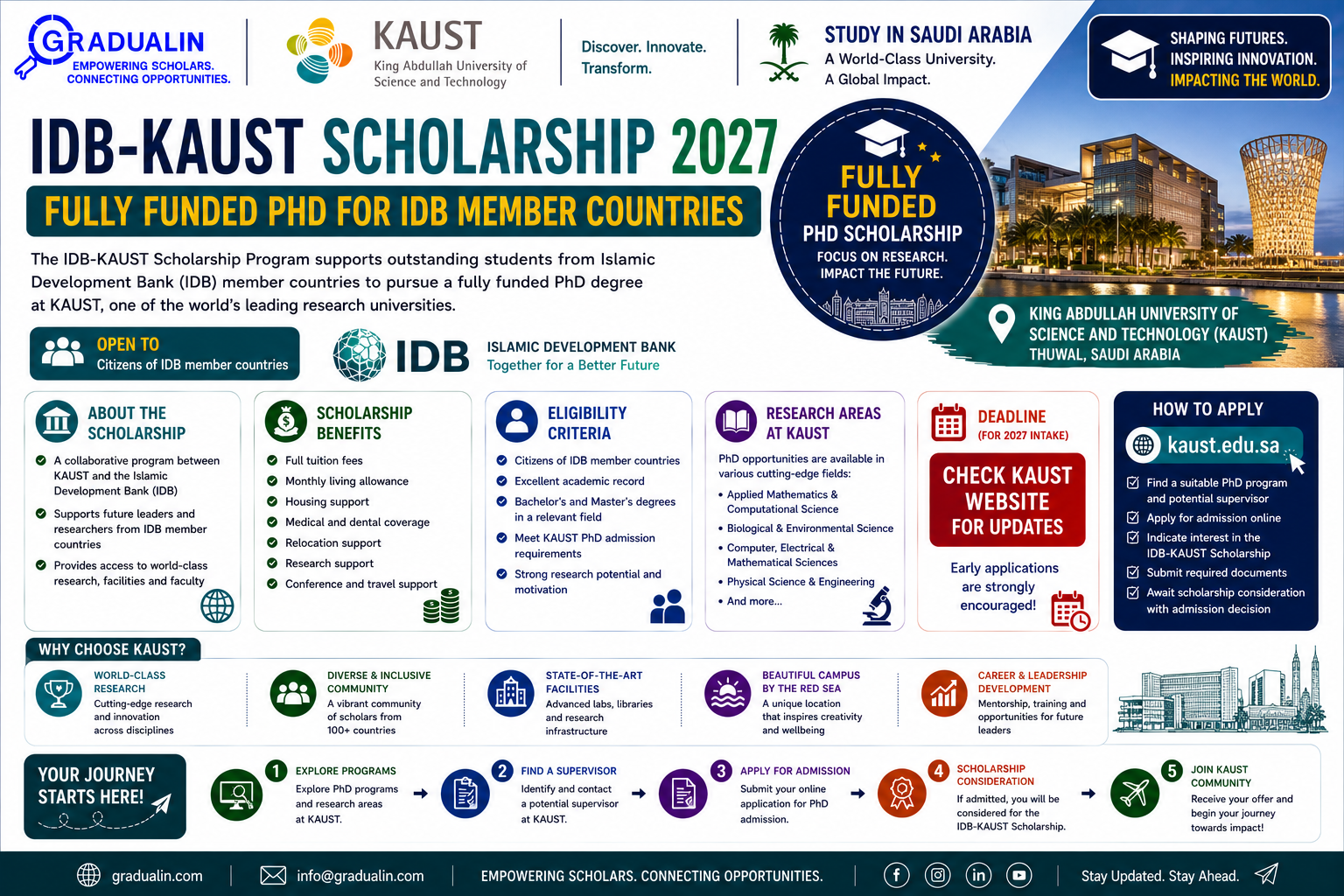
IDB-KAUST Scholarship 2027 — Fully Funded PhD for IDB Member Countries
Five fully funded PhD scholarships. One of the world’s top science and technology universities. And a programme specifically designed for researchers from Muslim-majority nations — including Pakistan. The IDB-KAUST Joint PhD Scholarship Programme is jointly funded by the Islamic Development Bank and King Abdullah University of Science and Technology, and it awards five places annually to citizens of IDB member countries who are currently working as academics or researchers in their home countries. If you meet that profile, this article walks you through exactly how the programme works, what it covers, who genuinely qualifies, and how to navigate the two-part application process that most guides miss entirely.
| Detail | Information |
| University | King Abdullah University of Science and Technology (KAUST) |
| Country | Saudi Arabia |
| Degree Level | PhD (full-time, four years) |
| Funding Type | Fully Funded |
| Scholarship Seats | 5 per year |
| Open To | Citizens of IDB member countries |
| Employment Requirement | Yes — must be employed full-time at an academic/research institution in home country |
| Pakistani Students Eligible | Yes — Pakistan is an IDB member country |
| Official Link | IDB-KAUST Scholarship Page |
🎓 About the IDB-KAUST Joint PhD Scholarship Programme
Established in 2012, the IDB-KAUST Joint PhD Scholarship Programme grew out of a partnership between the Islamic Development Bank’s Merit Scholarship Programme — itself running since 1992 — and KAUST’s flagship PhD programme. The rationale behind the collaboration is straightforward: IDB member countries need scientific and research capacity, and KAUST provides one of the most resource-rich research environments in the world. The scholarship exists to send working researchers back to their home countries as stronger scientists, not to provide a permanent exit route abroad.
KAUST itself was founded in 2009 by royal decree on the Red Sea coast at Thuwal, about 80 kilometres north of Jeddah. It operates as a graduate-only research university — no undergraduate programmes — and consistently ranks among the top research universities in the world for engineering, computer science, and materials science. The university draws students and faculty from more than 60 countries and runs a fully English-language academic environment.
What makes the IDB-KAUST track distinct from the standard KAUST Fellowship is the institutional dimension. While any eligible international student can apply to KAUST and receive the KAUST Fellowship upon admission, the IDB-KAUST programme requires candidates to be nominated by a recognised employer. This is not ceremonial — the nomination represents a formal commitment that the awardee will return to their institution after completing the PhD. The programme is, in effect, a capacity-building mechanism, not a general scholarship.
Unlike the Chevening or Commonwealth scholarships, which select broadly from their eligible nationalities, the IDB-KAUST programme targets a very specific profile: a working academic or researcher at an IDB member country institution who has the academic strength to earn admission to one of the world’s leading STEM universities. Competition across five annual seats is therefore intense but narrowed by the employment requirement.
🎓 Benefits and Funding
The IDB-KAUST Scholarship is described on the official programme page as fully funded in accordance with KAUST’s standard rules and procedures. In practice, this means the awardee receives the full KAUST Fellowship package for the duration of the PhD programme, jointly funded by IDB and KAUST.
The KAUST Fellowship — the same package all admitted KAUST PhD students receive — covers the following (verify current figures on the KAUST Fees and Funding page):
- Full tuition and bench fees for the duration of the PhD programme (bench fees cover research costs and lab access — estimated at up to $35,000 per year)
- Annual living stipend of approximately $25,000–$30,000 for PhD students, paid monthly, subject to satisfactory academic progress
- On-campus housing — furnished accommodation on KAUST’s self-contained campus; utilities typically included
- Medical and dental insurance for the student and eligible dependents living on campus
- Relocation support — visa processing assistance and travel support on arrival in Saudi Arabia
- Access to KAUST’s major research facilities, including core laboratories and one of the region’s most powerful high-performance computing clusters
The total annual package value is widely reported at approximately $70,000–$80,000 per year depending on individual circumstances (verify on official website). For Pakistani researchers, this represents a funding level significantly higher than most European PhD stipends and comparable to top US research fellowships — without the visa uncertainty that accompanies those options.
To make that figure tangible: in Pakistani rupee terms, the annual living stipend alone — at current exchange rates — translates to well over PKR 7 million per year, paid monthly into a Saudi account.
🎓 Eligibility Criteria
The IDB-KAUST programme has two interlocking sets of requirements: those set by KAUST for PhD admission, and those set by IDB for the scholarship itself. You must satisfy both.
IDB Eligibility Requirements (scholarship track):
- Must be a citizen of an IDB member country — there are 57 member states spanning Africa, the Middle East, Central Asia, South Asia, and Southeast Asia; Pakistan is a member
- Age must not exceed 35 years at the time of application
- Must be currently employed full-time at an academic, research, or development institution in your home country
- The employing institution must formally nominate you for the scholarship — individual, self-nominated applications are not accepted under this programme
- Must meet the eligibility criteria of the IDB Merit Scholarship Programme (verify current criteria at the IDB Scholarship Division)
KAUST Admission Requirements:
- A bachelor’s or master’s degree in science, engineering, mathematics, or a related field from a recognised institution
- TOEFL minimum 81 (IBT) or IELTS minimum 6.5 — required for all applicants except those who hold a degree from an accredited institution in the US, UK, Canada, Ireland, Australia, or New Zealand; KAUST’s admissions code is 4107
- GRE is not required — KAUST explicitly does not require the GRE for admission
- A firm KAUST PhD admission offer — you cannot hold the IDB scholarship without first securing KAUST admission
Pakistani students: Fully eligible. Pakistan has been an IDB member country since 1975. Pakistani academics and researchers employed at HEC-recognised universities or research institutions are eligible to apply provided they meet the age and employment criteria above.
Important note on IELTS for Pakistani applicants: Pakistani university degrees are not on KAUST’s exemption list, so IELTS 6.5 or TOEFL 81 IBT is required. British Council and IDP IELTS test centres operate in Lahore, Karachi, Islamabad, and other cities — plan test timing around KAUST’s application deadlines.
🎓 Who Should Apply — and Who Probably Shouldn’t
✅ Strong fit:
- Pakistani or other IDB member country nationals currently serving as lecturers, assistant professors, or researchers at HEC-recognised universities or research institutes
- Applicants in STEM fields aligned with KAUST’s research divisions — computer science, electrical engineering, environmental science, materials science, bioscience, applied mathematics
- Researchers with a publication record or demonstrable research output — competitive applicants for the five annual seats typically have at least one peer-reviewed publication
- Candidates who have already had preliminary contact with a KAUST faculty member in their research area — securing a faculty supervisor before applying dramatically improves admission odds
- Researchers at Pakistani institutions where KAUST alumni are present — these connections often provide the most useful pathway to faculty contact
❌ Not the right fit:
- Fresh graduates with no full-time academic or research employment — the institutional nomination requirement is absolute; this is not a scholarship for recent MSc graduates
- Researchers in humanities, social sciences, or education — KAUST’s programmes are exclusively in science, engineering, and related STEM fields
- Applicants seeking permanent relocation — the IDB component carries an expectation of return to the home country institution after completion
- Candidates without IELTS 6.5 or TOEFL 81 who cannot arrange to take the test before the application deadline
🎓 Available Programmes and Fields of Study
KAUST admits PhD students across four academic divisions. The IDB-KAUST scholarship supports PhD study across all KAUST programmes (verify eligibility for specific programmes on the official admissions page):
Biological and Environmental Science and Engineering (BESE): Environmental Science and Engineering, Marine Science, Plant Science
Biomedical Sciences: Bioscience, Bioengineering
Computer, Electrical and Mathematical Science and Engineering (CEMSE): Applied Mathematics and Computational Science, Computer Science, Electrical and Computer Engineering, Statistics
Physical Science and Engineering (PSE): Chemical Engineering, Chemistry, Earth System Science and Engineering, Materials Science and Engineering and Applied Physics, Mechanical Engineering
For a full list of degree programmes and faculty research areas, visit the KAUST Academic Divisions page. Reviewing faculty profiles in your research area before applying is not just useful — for a five-seat programme, it is practically necessary.
🎓 Required Documents
The IDB-KAUST application runs on two parallel tracks. Both sets of documents must be prepared:
For KAUST Admission:
- Completed online KAUST application via the KAUST Admissions Portal
- Official transcripts from all post-secondary institutions attended
- Three letters of recommendation from academic supervisors or research employers
- Statement of Purpose / Research Proposal — outlining your intended research area and relevant background
- CV / résumé with full academic and professional history
- Official TOEFL or IELTS score report (sent directly from the testing agency; scores from institutional tests are not accepted)
- Passport copy
For IDB Scholarship:
- Formal nomination letter from your employing institution — this must come from the institution, not from you personally
- Evidence of current full-time employment at an academic or research institution
- IDB Merit Scholarship Programme application materials as specified by the IDB Scholarship Division (verify at isdb.org)
- Proof of citizenship of an IDB member country
Note for Pakistani applicants: HEC degree attestation is not listed as an explicit KAUST requirement, but having HEC-attested transcripts is standard practice for Pakistani academics applying abroad and avoids potential document verification delays. Confirm with KAUST Admissions whether additional attestation is required for your specific case.
🎓 Step-by-Step Application Process
The IDB-KAUST programme requires two coordinated applications — one to IDB and one to KAUST. Most guides cover only one side. Here is how both fit together:
- Identify your KAUST research area and target faculty member. Browse faculty profiles at kaust.edu.sa/en/study/faculty. Email a potential supervisor early — briefly introduce your research background, attach a CV and one-page research interest statement, and ask if they are taking PhD students. A positive response from a faculty member is not a guarantee of admission, but it substantially strengthens your application.
- Secure your institutional nomination. Approach your department head, dean, or research director at your employing institution and formally request nomination under the IDB Merit Scholarship Programme for the IDB-KAUST track. Without this, the IDB portion of the application cannot proceed.
- Prepare and submit your IDB application. Contact the IDB Scholarship Division directly at scholar@isdb.org or visit isdb.org for the current application cycle’s requirements and submission process. IDB and KAUST coordinate on candidate selection, but the IDB application is submitted separately.
- Open the KAUST online application at admissions.kaust.edu.sa — applications for 2027 entry open in mid-August 2026. Complete all sections, upload required documents, and indicate IDB-KAUST scholarship interest where prompted.
- Submit official test scores. Send TOEFL or IELTS scores directly from the testing agency to KAUST (admissions code: 4107) well ahead of the deadline.
- Prepare for interviews. KAUST conducts interviews as part of the PhD admission process — expect technical questions about your research area, your proposed dissertation direction, and your reasons for choosing a specific faculty supervisor.
- Await coordinated admission and scholarship notification. Selection under the IDB-KAUST programme happens within the framework of the IDB Merit Scholarship selection process. A firm KAUST admission offer is required before the IDB scholarship can be confirmed.
Practical tip: The KAUST PhD application portal opens in mid-August 2026 for 2027 entry — with Spring 2027 (PhD-only) deadline of approximately October 2026 and Fall 2027 deadline in early 2027. The IDB scholarship cycle may run on a different timeline — confirm current IDB deadlines directly with the IDB Scholarship Division, as the IDB application cycle for 2026–2027 has already closed; the 2027–2028 cycle schedule should be confirmed at isdb.org.
🎓 Important Dates
| Milestone | Date |
| KAUST 2027 Application Portal Opens | Mid-August 2026 |
| KAUST Spring 2027 Deadline (PhD only) | ~October 2026 (verify on official admissions timeline) |
| KAUST Fall 2027 Deadline | ~Early 2027 (verify on official admissions timeline) |
| IDB Scholarship Cycle (2027–2028) | Verify at isdb.org — IDB 2026–2027 cycle closed January 2026 |
Bookmark this page — we update deadlines as soon as changes are announced.
⚠️ Critical note: The IDB scholarship and KAUST admission timelines are coordinated but managed by separate organisations. Confirm current IDB application dates directly with the IDB Scholarship Division (scholar@isdb.org) before beginning your KAUST application, to ensure both tracks align.
🎓 Why Apply — Why KAUST
KAUST’s location on the Red Sea coast of Saudi Arabia is worth addressing directly, because it gives Pakistani applicants something other scholarship destinations do not: straightforward access, familiar cultural context, and the ability to maintain close ties to family. Direct flights from Lahore, Karachi, and Islamabad to Jeddah run frequently. The campus is self-contained and international — English is the operational language across all academic activities.
Beyond the practical, KAUST’s research infrastructure is exceptional by any global measure. The university maintains state-of-the-art core laboratories in imaging, genomics, nanofabrication, clean fuels, and data science. PhD students have access to supercomputing clusters that most European university research groups cannot match. For researchers in areas like water security, renewable energy, and computational biology — fields directly relevant to Pakistan’s national development challenges — KAUST’s resources are hard to replicate elsewhere.
KAUST alumni from IDB member countries have gone on to faculty positions at QS-ranked universities, senior research roles in industry, and leadership positions at national research agencies. For Pakistani researchers, a KAUST PhD carries substantial weight in HEC funding applications and faculty hiring committees.
Gradualin Editor’s Note: The IDB-KAUST programme is prestigious but narrow. Five seats per year across 57 eligible countries means this is not a scholarship to enter casually. The most competitive applicants typically arrive with a strong master’s thesis or research publication, a confirmed supervisor contact at KAUST, and an institutional employer willing to invest in their nomination. For Pakistani academics at HEC-recognised research universities — particularly those working in engineering, computer science, or environmental science — this is a realistic and high-value target. For a lecturer without a strong research record or without an institutional relationship that would support a nomination, a KAUST Fellowship application through the standard admission route may be a more accessible entry point.
🎓 Frequently Asked Questions
These questions are based on what students most commonly search about this programme.
Can Pakistani students apply for the IDB-KAUST scholarship? Yes. Pakistan is one of the 57 IDB member countries, which makes Pakistani nationals eligible for the IDB-KAUST programme. However, the employment and institutional nomination requirements apply equally to Pakistani applicants — you must be currently working full-time at an HEC-recognised university or research institution, and that institution must formally nominate you.
Is IELTS required for the IDB-KAUST scholarship? Yes — for Pakistani applicants. KAUST requires either TOEFL IBT 81 or IELTS 6.5. The exemption for graduates of English-medium institutions only applies to degrees from universities in the US, UK, Canada, Ireland, Australia, or New Zealand. A Pakistani university degree, regardless of its language of instruction, does not qualify for exemption. Plan your IELTS or TOEFL test date early.
Is the GRE required for KAUST PhD admission? No. KAUST explicitly does not require the GRE for admission to any programme. This is a significant advantage compared to many US PhD programmes, which still list GRE scores as a requirement.
What does “institutional nomination” mean in practice? It means your current employer — a university, research institute, or development organisation in your home country — must formally submit a nomination letter supporting your application to the IDB Scholarship Division. You cannot self-nominate. The nomination reflects your employer’s endorsement and implicit commitment to your eventual return. If you are unsure whether your institution qualifies, contact the IDB Scholarship Division at scholar@isdb.org.
Can I apply to KAUST directly without the IDB scholarship? Yes. The standard KAUST Fellowship is open to international students from all countries and does not require IDB membership or institutional nomination. Every admitted KAUST student receives the standard Fellowship package automatically. If you meet KAUST’s admission criteria but not the IDB-specific requirements (age limit, employment requirement), applying directly through the KAUST admissions portal is the appropriate route.
How many IDB-KAUST scholarships are awarded per year? Five — across all 57 IDB member countries. This is a highly selective programme. The small number of annual awards means the applicant pool, while limited by the employment requirement, is still intensely competitive.
🎓 Official Sources and Contact
- IDB-KAUST Scholarship Official Page
- KAUST Admissions Portal
- KAUST PhD Programme Details
- KAUST Admission FAQs
- IDB Scholarship Division — isdb.org
IDB Scholarship Division: Islamic Development Bank, Qasr Khuzam, Al Malik Khalid Road, Jeddah 21432, Saudi Arabia Tel: (9662) 646 6833 / 6835 | Fax: (9662) 646 6887 Email: scholar@isdb.org
KAUST Admissions: Email: admissions@kaust.edu.sa
🎓 Summary
| Detail | Information |
| University | King Abdullah University of Science and Technology (KAUST) |
| Country | Saudi Arabia |
| Degree Level | PhD (full-time, four years) |
| Funding Type | Fully Funded |
| Scholarship Seats | 5 per year |
| Open To | Citizens of IDB member countries |
| Employment Requirement | Yes — current full-time employment at academic/research institution required |
| Pakistani Students Eligible | Yes — Pakistan is an IDB member country |
| Official Link | IDB-KAUST Scholarship Page |
Explore more opportunities on Scholarships — or browse Jobs & Internships, Events & Conferences, and Guidelines & Resources.
Related Opportunities:
- Top Fully Funded Scholarships in Saudi Arabia 2026
- Top 10 Fully Funded Scholarships in Asia 2027
- Fully Funded PhD Scholarships in the UK 2026
- Fully Funded PhD Positions in Switzerland 2026
- Study in Germany 2026 — Guide for International Students
Stay updated with the latest scholarships, jobs, and opportunities at Gradualin.com — your trusted guide to studying abroad for free.
Author: Faseeh Sultan — PhD Scholar & MSIT | 7 Years in Education