
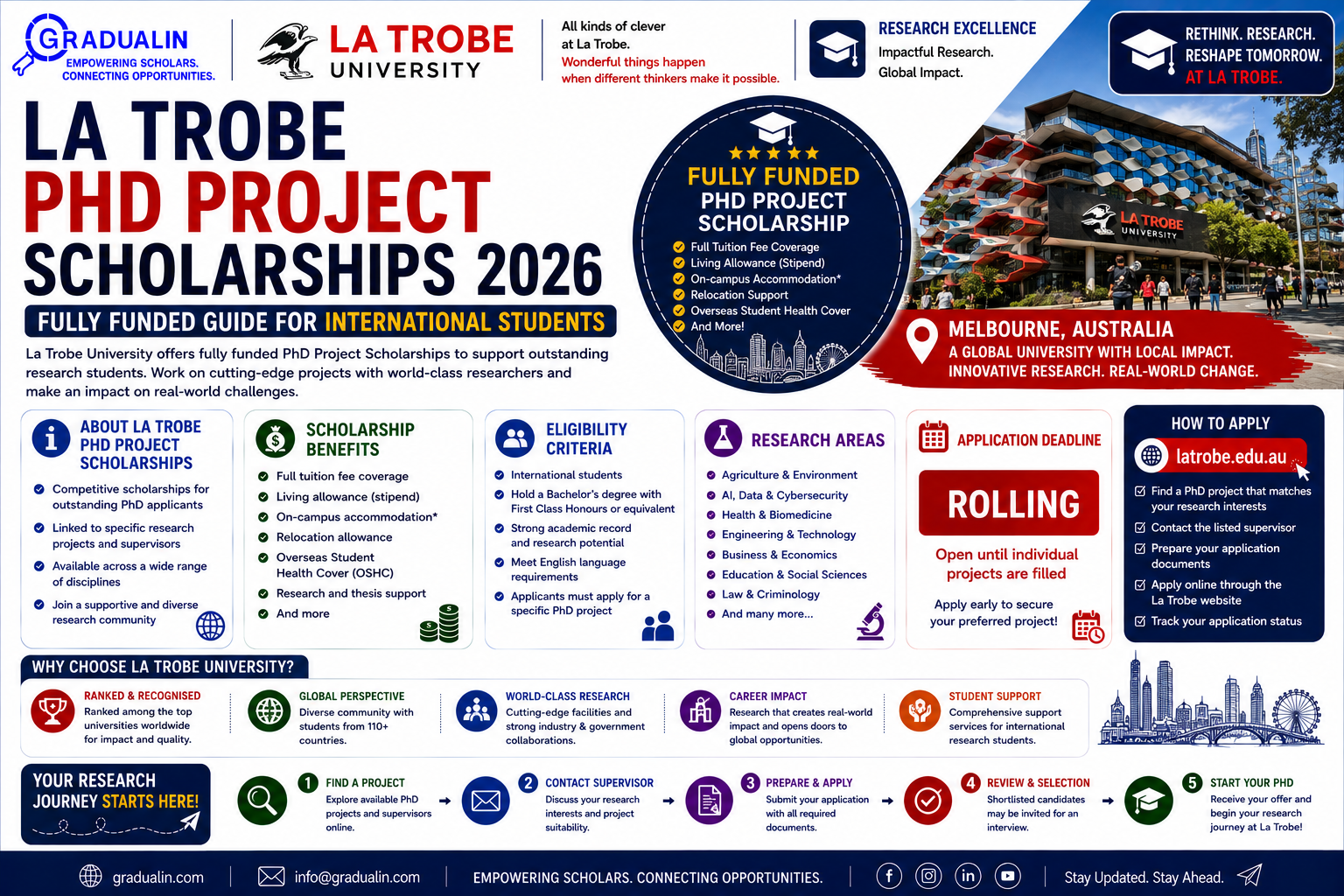
La Trobe PhD Project Scholarships 2026 — Fully Funded Guide for International Students
Most PhD scholarship programs open once a year, close on a fixed date, and offer no flexibility in research direction. La Trobe University’s Project-Based Graduate Research Scholarships work differently — and that difference matters. Applications are open year-round, tied to specific funded research projects across health, engineering, AI, agriculture, cancer medicine, education, and social sciences. Pakistani and international students are explicitly eligible. Successful applicants receive a stipend of AUD $36,000 per year for up to 3.5 years, a full tuition fee scholarship for four years, and additional allowances.
This guide explains how the scholarship works, how to approach a supervisor correctly, and what it genuinely takes to get an invitation to apply — which is the step most candidates miss entirely.
| Detail | Information |
| University/Organization | La Trobe University |
| Country | Australia (Melbourne, Victoria) |
| Degree/Level | PhD (Doctoral) |
| Funding Type | Fully Funded |
| Stipend | AUD $36,000/year for up to 3.5 years |
| Deadline | Rolling — open until individual projects are filled |
| Open To | Domestic and international applicants |
| Pakistani Students Eligible | Yes — international applicants welcome |
| Official Link | La Trobe Project Scholarships |
🎓 About La Trobe University and These Scholarships
La Trobe University is a public research university founded in 1964 — the third university established in the state of Victoria and now among Australia’s leading research institutions, with a main campus in Bundoora, Melbourne, and additional campuses in Bendigo, Albury-Wodonga, Mildura, Shepparton, and Sydney. La Trobe ranks 233rd in the QS World University Rankings 2026, placing it comfortably inside the global top 250 — and three of its subject disciplines rank inside the global top 50, with Nursing ranked 42nd worldwide.
The Project-Based Graduate Research Scholarships are not a general competitive pool where hundreds of students apply and a handful are selected. They are tied to specific, pre-approved funded research projects — each with a named supervisor, a defined research direction, and its own eligibility conditions. This structure has two important implications for applicants: your match to the project matters more than your general academic profile, and the process starts with a supervisor conversation, not an online form.
These scholarships are tied to specific, pre-defined PhD research projects led by established research teams and industry partners. Recipients receive a living stipend, full tuition fee coverage, and allowances for relocation and thesis completion.
Unlike the ANU Research Training Program (RTP) Scholarship — which funds students into a general PhD pool at the Australian National University — or the University of Melbourne Graduate Research Scholarships — which run a single competitive annual round — La Trobe’s project-based model is rolling and project-specific. This makes it more accessible for applicants who identify a good supervisor fit but harder for those applying broadly without a clear research direction.
🎓 Full Scholarship Benefits
All figures are sourced from La Trobe University’s official scholarship listings and verified third-party sources. No amounts have been estimated.
- Stipend: AUD $36,000 per year (2026 full-time rate) — paid for up to 3.5 years for a full-time PhD
- Full tuition fee scholarship — covering up to four years of doctoral study (either through the Research Training Program (RTP) Fees Offset or the La Trobe Full Fee Research Scholarship (LTUFFRS), depending on applicant type)
- Relocation allowance — to assist with moving costs for students joining from another city or country
- Thesis/publication allowance — to cover costs related to thesis submission and publication
- Flexible commencement — successful applicants can commence their PhD at any time with the support of their supervisor — no fixed intake semester
In practical terms: AUD $36,000 per year converts to approximately PKR 7,500,000–8,000,000 annually at current rates (verify at time of application), or roughly USD $23,000. In Melbourne, with tuition fully covered, this is a workable doctoral stipend. It does not cover every living expense — accommodation in Melbourne averages AUD $900–1,500/month depending on location — so applicants should budget accordingly.
RTP vs LTGRS — what’s the difference? The stipend and fee scholarship may be awarded through either the Research Training Program (RTP) — a federal government-funded mechanism — or the La Trobe Graduate Research Scholarship (LTGRS) — a university-funded equivalent. The value is identical for the student. The distinction affects administrative processing and is handled by the university; applicants do not need to choose between them.
🎓 Eligibility Criteria
Applications are open to Australian or New Zealand citizens (domestic applicants), Australian permanent residents (domestic applicants), and international applicants — subject to the eligibility requirements outlined under each project.
Pakistani students: fully eligible as international applicants, subject to meeting the academic and English language requirements below.
Academic requirements — applicants must meet one of the following:
- A Master’s by Research degree completed within the last ten years, assessed at a La Trobe Master’s by Research thesis standard of 70 or above (some projects require 75+, check each project’s specific conditions)
- A Bachelor’s Honours degree or Master’s by Coursework with a minor thesis of 10,000–20,000 words meeting the La Trobe thesis standard of 70 or above
- Demonstrated equivalent research experience — such as lead authorship of a peer-reviewed publication — where the standard academic pathway was not followed
Additional conditions:
- International applicants must meet La Trobe’s English language proficiency requirements for the chosen PhD program (verify IELTS/TOEFL minimums at the official admissions page — thresholds vary by school and project)
- Applicants must not be receiving another scholarship greater than 75% of the stipend rate for the same purpose
- International applicants can nominate only one project in their Research Statement Form — project selection is therefore a critical decision, not a casual one
- Applicants must receive an invitation from the primary supervisor before submitting a full online application — submitting without this invitation is not accepted
🎓 Who Should Apply — and Who Probably Shouldn’t
✅ This scholarship is a strong fit if you:
- Have completed a Master’s by Research or Honours thesis with a strong grade (70+ or equivalent) in a relevant field
- Have identified a specific La Trobe project that genuinely matches your academic background and research experience — not just your general interest area
- Can write a targeted, supervisor-specific expression of interest email (not a generic template)
- Are in health sciences, engineering, AI/computing, cancer research, agriculture, education, or social sciences — the project list is strongest in these areas
- Are comfortable with a rolling application model rather than a fixed annual deadline — this requires proactivity, not patience
❌ This scholarship is probably not right for you if:
- You do not yet have significant research experience (an undergraduate degree alone is typically insufficient — a thesis or publication record is expected)
- You want to propose your own research topic — these are pre-defined funded projects, not open PhD proposals
- You are applying to multiple projects simultaneously with the same generic email — international applicants can only nominate one project, and supervisors recognize mass-apply templates immediately
- You need guaranteed commencement on a fixed date — the rolling model depends on supervisor availability and project readiness
A note for Pakistani applicants: Pakistani candidates from HEC-recognized universities with strong MS thesis grades and a research track record in health, engineering, or computing are genuinely competitive for these scholarships. The project areas — particularly AI, biosensors, cancer research, and agricultural technology — overlap well with research strengths at Pakistani universities. The key differentiator is the quality of your supervisor contact email and the match between your thesis work and the selected project.
🎓 Available PhD Research Projects and Fields
Projects span across the following schools and research areas: Agriculture, Biomedicine and Environment; Allied Health, Human Services and Sport; Cancer Medicine; Computing, Engineering and Mathematical Sciences; Education; Humanities and Social Sciences; Nursing and Midwifery; Psychology and Public Health; and La Trobe Rural Health.
Current and recently listed projects include (verify availability on the official page, as projects close once filled):
Health and Cancer Research: Targeting cancer metastasis and drug resistance, HCK inhibitor development, immunosurveillance of myeloid malignancies, epigenetic variation and X-chromosome biology, DNA damage imaging, and hip dysplasia rehabilitation
Computing and Engineering: Machine learning-driven simulation of synchrotron beamlines, optical biosensors for continuous monitoring, flexible/stretchable pressure sensors for wearable biomedical devices, robotic water tank inspection systems, drone-based pasture classification using machine vision and AI
Agriculture: Edge AI-based wearable sensors for dairy cow behaviour and welfare monitoring, AI-driven precision dairy grazing systems
Education and Social Sciences: Teacher retention in high-turnover schools, family therapy outcomes, alcohol use inequalities, family violence and First Nations families in family court, Australian colonial poetry
Browse the live project list at La Trobe Project Scholarships. New projects are added throughout the year.
🎓 Required Documents
Prepare these before making contact with any supervisor — supervisors will often ask for several of them in the initial email exchange.
- Academic transcripts — all degrees, officially attested for international applicants
- Degree completion certificates — bachelor’s, master’s, or honours as applicable
- Professional CV/resume — highlighting research experience, publications, and lab or fieldwork
- Master’s thesis or honours thesis — translated into English if originally written in another language; this is the single most important document for most projects
- List of publications, if any — even conference papers are relevant
- Preliminary research statement — no more than 300 words explaining your interest in the specific project and your relevant background (unless the project explicitly does not require one)
- Evidence of English language proficiency — IELTS, TOEFL, or equivalent (verify minimum scores per project on the official page)
- Copy of passport — for international applicants
- Research Statement Form — a separate form required from international applicants; must be completed and attached to the full application after receiving supervisor invitation
- Any additional documents specified under the individual project listing
For Pakistani applicants: if your transcripts or thesis are in Urdu or another language, ensure certified English translations are prepared before making contact. HEC-attested documents are strongly recommended for the formal application stage.
🎓 Step-by-Step Application Process
The application does not begin with an online form. It begins with a supervisor email. Most candidates who fail to receive an invitation fail at this step — not because they are unqualified, but because their initial email is generic.
- Browse the official project list. Go to La Trobe Project Scholarships and read through available projects. Read the full project description — not just the title. Note the project code (e.g., PRO-26146).
- Select one project that genuinely matches your background. International applicants can nominate only one project in their Research Statement Form. Choose based on your thesis/publication experience — not just your interests.
- Research the primary supervisor before writing. Look up the supervisor’s recent publications on Google Scholar or the La Trobe research portal. Read at least two of their recent papers. Identify one specific aspect of their work that connects to your own research background.
- Write a targeted expression of interest email. This email should: introduce yourself and your research background in two sentences; reference one specific paper or finding from the supervisor’s work; explain why your thesis or publication experience directly prepares you for this project; and ask whether they are currently accepting applications for this scholarship. Keep it under 300 words. Attach your CV and thesis.
- Wait for the supervisor’s response and invitation. If the supervisor invites you to proceed, they will ask for additional documents and confirm the project code to use in your application.
- Submit the full PhD and scholarship application online. Follow La Trobe’s PhD application instructions. Domestic applicants select “Graduate Research Applicants scholarship.” International applicants select “Project-based PhD Scholarship OR La Trobe Industry Research Scholarship.” Include the project code in your application.
- Complete and attach the Research Statement Form (international applicants only). This form asks you to demonstrate your understanding of the project and your research goals — treat it as seriously as a personal statement.
Practical tip for Pakistani applicants: Many Pakistani candidates hold strong MS theses but underestimate the value of framing their research in terms of the specific project’s methodology and outcomes, not just their general field. A supervisor in cancer medicine does not need to know you are interested in cancer broadly — they need to see that your MS thesis work in molecular biology or pharmacology maps directly onto what their lab is doing. Specificity wins the invitation.
🎓 Important Dates
| Event | Timing |
| Applications open | Year-round — rolling basis |
| Individual project deadlines | Open until filled — no fixed annual deadline |
| Commencement date | Flexible — arranged with supervisor |
| Scholarship duration | Up to 3.5 years (stipend) / 4 years (tuition) |
La Trobe University accepts research candidature applications at any time, but individual scholarship projects may close once they receive suitable applicants. Students should contact the primary supervisor and apply as early as possible.
Bookmark the official project scholarships page — project availability changes throughout the year and new projects are added regularly.
🎓 Why Apply — Why La Trobe, Why Melbourne
Melbourne consistently ranks among the world’s most liveable cities — and for PhD researchers, that quality of life translates into a genuinely supportive environment for multi-year doctoral work. La Trobe’s main Bundoora campus is a large green-campus setting with strong research infrastructure, particularly in health and biomedical sciences.
La Trobe is particularly well known for research in health sciences, agricultural sciences, and computing — disciplines where its project-based scholarship list is strongest. For Pakistani researchers in these fields, La Trobe represents a realistic and competitive target that sits below the ultra-competitive ANU and University of Melbourne scholarship rounds while still delivering a world-ranked degree from an Australian university.
Australia also has a large, established Pakistani diaspora and student community, which matters practically — navigating visa applications, accommodation, and cultural adjustment is meaningfully easier when a community network exists.
The Australian student visa (subclass 500) is open to Pakistani citizens, and PhD scholarship holders are typically eligible to work up to 48 hours per fortnight. Post-study work rights in Australia can extend to two to four years after PhD completion under the Temporary Graduate Visa (subclass 485), giving La Trobe PhD graduates a genuine pathway to Australian research or industry careers.
Gradualin Editor’s Note: La Trobe’s project-based model is underrated by Pakistani applicants who default to targeting ANU or the University of Melbourne — both more competitive and with single annual rounds. La Trobe’s rolling, project-specific model rewards applicants who do the homework: read the project carefully, study the supervisor’s work, and write a targeted email. For a Pakistani MS graduate with a solid thesis in health, engineering, or computing who can do those three things well, this scholarship is a genuinely achievable target — not a long shot.
🎓 FAQ
These questions are based on what students most commonly search about this program.
Can Pakistani students apply for La Trobe University project scholarships? Yes. International applicants are explicitly eligible, subject to the eligibility requirements outlined under each project. Pakistani students must meet the academic requirements (strong master’s thesis or honours thesis), English language proficiency requirements, and must follow the supervisor-first contact process. There is no nationality restriction on most projects — check individual project listings for any project-specific conditions.
Is IELTS required for Pakistani applicants? English language proficiency is required for international applicants, but the specific test and minimum scores vary by school and project. IELTS is commonly accepted; some projects may also accept TOEFL or other equivalent tests. Verify the exact requirement for your chosen project on the La Trobe Graduate Research admissions page before applying. Applicants whose previous degree was taught entirely in English may be eligible for an exemption — confirm this directly with the admissions office.
Can I apply to multiple projects at the same time? Domestic applicants may apply to multiple projects. However, international applicants completing the Research Statement Form can nominate only one project in that form. This makes your project selection a critical decision — choose based on your strongest academic match, not simply availability or interest.
What happens if the project I want is already filled? Project scholarships close once a suitable applicant is found. If a project you want is closed, check the official page regularly — new projects are listed throughout the year. You can also reach out to other La Trobe supervisors about upcoming funded projects that may not yet be listed publicly. Building a supervisor relationship ahead of a project announcement can give you a meaningful advantage.
How competitive is this scholarship — what kind of applicant succeeds? La Trobe does not publish acceptance rates for project scholarships, but the selection is based on academic merit and fit to the specific project. Successful applicants typically have a completed master’s thesis or honours thesis with a grade of 70 or above, relevant publications or research experience, and — critically — a clear alignment between their prior research and the chosen project. Generic applications to projects the applicant has no specific background in very rarely progress past the supervisor stage.
Do I need an HEC equivalency certificate to apply? For the initial supervisor contact and expression of interest, your degree transcripts and thesis are sufficient. For the formal application stage, international applicants should have their academic credentials officially attested — HEC attestation of Pakistani degrees is strongly recommended before applying, as it is commonly required during the verification stage. Contact La Trobe’s Graduate Research team to confirm exact attestation requirements for Pakistani applicants.
🎓 Official Source
- Official Scholarship Page: La Trobe Project Scholarships
- Graduate Research Admissions: La Trobe Graduate Research
- Find a Supervisor Tool: La Trobe Research Portal
- General Research Enquiries: Contact the Graduate Research School via the La Trobe Contact Page
🎓 Summary Table
| Detail | Information |
| University | La Trobe University |
| Country | Australia (Melbourne) |
| Degree/Level | PhD — Doctoral |
| Funding | Fully Funded |
| Stipend | AUD $36,000/year (≈ PKR 7.5–8M/year) for 3.5 years |
| Tuition Fee | Full waiver for up to 4 years |
| Allowances | Relocation + thesis/publication |
| Application Deadline | Rolling — open until filled |
| Open To | Domestic and international students |
| Pakistani Students Eligible | Yes |
| Official Link | Apply Here |
Related Articles on Gradualin:
- Fully Funded Scholarships in Australia 2026
- Top 10 Fully Funded Scholarships in Asia 2027
- Fully Funded PhD Positions in Switzerland 2026
- Fully Funded PhD Scholarships in the UK 2026
- Study in Germany 2026 — Guide for International Students
Explore more funding opportunities by category:
🎓 Scholarships | 💼 Jobs & Internships | 🌍 Events & Conferences | 📚 Guidelines & Resources
Stay updated with the latest scholarships, jobs, and opportunities at Gradualin.com — your trusted guide to studying abroad for free.
Author: Faseeh Sultan — PhD Scholar & MSIT | 7 Years in Education