
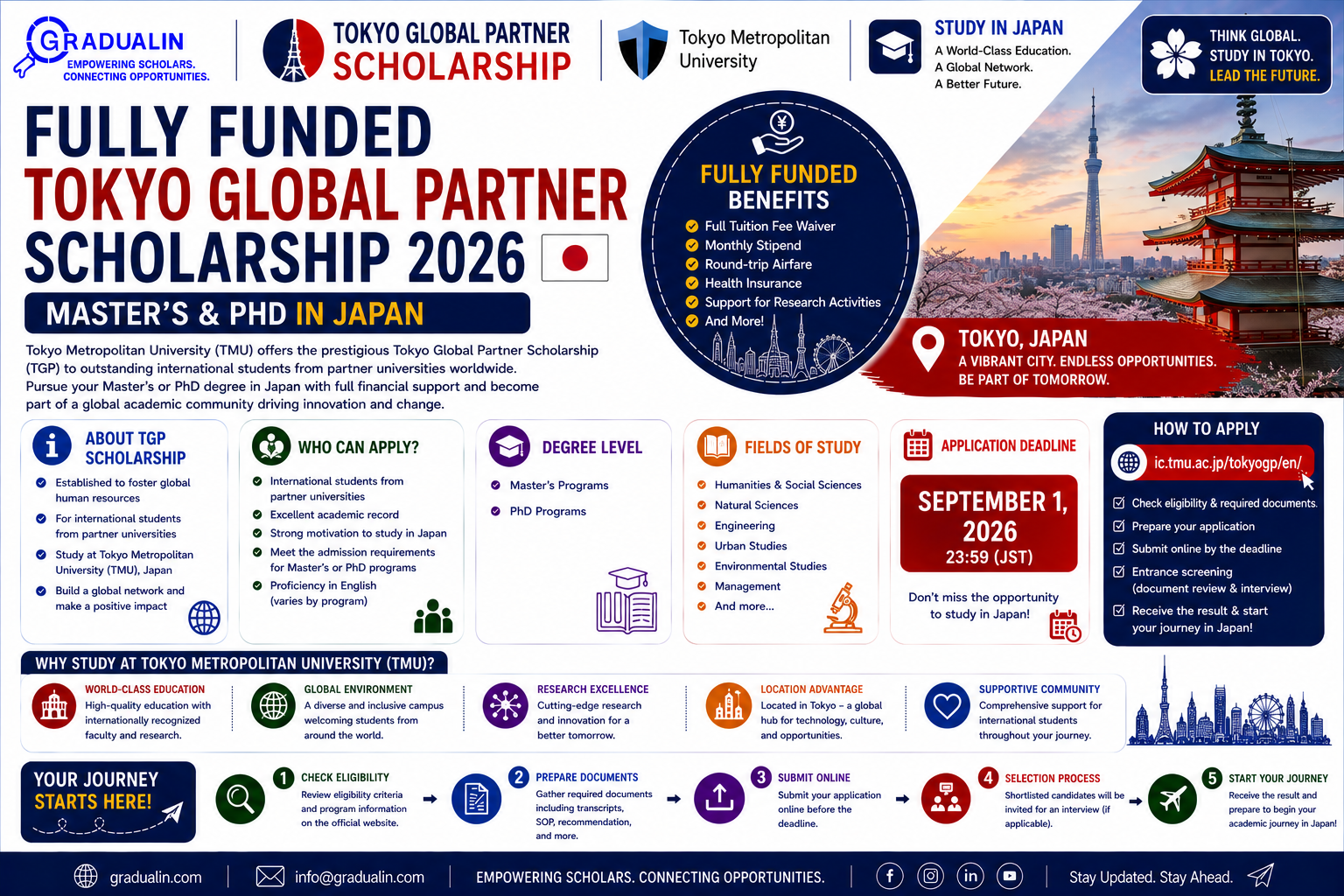
Fully Funded Tokyo Global Partner Scholarship 2026 — Master’s & PhD in Japan
Pakistan is one of 24 Asian countries and regions explicitly named in Tokyo Metropolitan University’s official eligibility list for the Tokyo Global Partner Scholarship Program — yet most scholarship guides online never mention it. If you’re a Pakistani student with a strong academic record looking to pursue a fully funded Master’s or PhD in Japan, this program deserves your serious attention. It covers tuition, a monthly stipend of 150,000 JPY (approximately PKR 450,000+ at current rates), international airfare, and your admission fee — with no bond or service return obligation attached.
This guide covers everything the official TMU page doesn’t: the two-cycle admission calendar, the GPA calculation method, the supervisor contact requirement most applicants miss, and a document checklist with notes specific to Pakistani applicants.
| Detail | Information |
| University | Tokyo Metropolitan University (TMU) |
| Country | Japan |
| Degree / Level | Master’s (2 years) and PhD / Doctoral (3 years) |
| Funding Type | Fully Funded |
| Next Deadline (Fall 2027) | September 2026 (verify on official website per school) |
| Open To | Students and professionals from Asian countries, TMU partner universities, Tokyo sister cities |
| Pakistani Students Eligible | ✅ Yes — Pakistan is explicitly listed in official TMU eligibility documents |
| Official Link | Apply Here |
🎓 About the Tokyo Global Partner Scholarship Program
Tokyo Metropolitan University is not your typical Japanese national university. Unlike institutions administered by Japan’s Ministry of Education, TMU is governed directly by the Tokyo Metropolitan Government (TMG) — the city itself. That distinction matters: the scholarship isn’t a passive government grant but an active investment by Tokyo in building a global research community that feeds back into the city’s development.
The program was designed to attract high-achieving international students to TMU’s graduate schools with the explicit goal of establishing Tokyo as a regional hub for research and cross-cultural collaboration. Unlike the MEXT Government Scholarship, which is applied for through Japanese embassies and is highly competitive at the national level, the Tokyo Global Partner Scholarship is applied for directly through TMU’s individual graduate schools — meaning you target a specific department and faculty, and the process is more research-focused and relationship-driven from the start.
The number of awards per cycle is small — official documents describe it as “a few students” per program per intake. This makes selectivity high, but it also means the scholarship is genuinely prestigious and carries weight in Japan’s academic community.
TMU is ranked within the QS World University Rankings 2026 at #1001–1200 globally. Within Japan, it holds a strong reputation especially in urban sciences, systems design, and applied research disciplines.
🎓 Benefits and Funding
The Tokyo Global Partner Scholarship is fully funded. Selected scholars receive:
- Full admission fee waiver (applied before enrollment)
- Full tuition exemption for the prescribed duration — 2 years for Master’s, 3 years for Doctoral
- Monthly stipend of 150,000 JPY throughout the scholarship period (approximately USD 1,000+ / PKR 450,000+ — verify current exchange rates)
- International airfare — one economy-class return ticket between your nearest international airport and Narita or Haneda Airport in Tokyo
- Housing referral services — TMU connects scholars with cooperating housing companies; note that rent and living expenses are the student’s own responsibility
A few important caveats worth knowing: the return airfare is not provided if you withdraw early, extend beyond the standard program duration, or temporarily return home after your scholarship period ends. If you complete all required credits within the prescribed years — even if you withdraw before formal graduation — the travel expenses are still covered.
(All figures sourced from the official TMU Graduate School of Systems Design application guidelines — verify on the official website as amounts are subject to annual budget approval.)
🎓 Eligibility Criteria
To qualify, applicants must meet all of the following:
- Educational background: A bachelor’s degree (for Master’s applicants) or a master’s degree (for Doctoral applicants). Master’s applicants must have completed 16 years of schooling — the standard Pakistani bachelor’s degree (4-year BSc/BBA/BA) satisfies this requirement.
- Age: At least 22 years at enrollment for Master’s; at least 24 years for Doctoral.
- Institutional affiliation: You must be currently enrolled at (or have graduated within the past year from) one of the following:
- A TMU international partner university
- A university in an Asian country/region (Pakistan is explicitly listed alongside India, Bangladesh, Nepal, Indonesia, China, and 18 others)
- A higher education institution in a Tokyo sister city (New York, Paris, Berlin, Beijing, Rome, London, Seoul, and others)
- Alternatively: You work at a research institution, government agency, or company in any of these locations
- GPA: Minimum 2.30 on TMU’s 3.0 scale — see the GPA conversion section below
- Language proficiency: JLPT N2 or higher in Japanese, OR a CEFR B2-equivalent English qualification (such as IELTS 5.5–6.0 band equivalent, Cambridge B2 First, TOEFL iBT 87+) — the program does not require IELTS specifically, but an English proficiency certificate at B2 level is required if you are applying through an English-medium program
- No double-dipping: Cannot hold another scholarship simultaneously
- No prior MEXT enrollment: Cannot have previously studied in Japan on a Japanese Government Scholarship at the same degree level you are applying for
Pakistani students: ✅ Eligible — Pakistan is explicitly named in TMU’s official Asian countries list. No additional nationality restrictions apply beyond the standard criteria above.
🎓 Understanding the GPA Requirement — A Note for Pakistani Applicants
This is where many Pakistani students either disqualify themselves unnecessarily or misread their eligibility. TMU uses a 3.0 GPA scale, not the 4.0 scale common in Pakistan. The minimum is 2.30/3.0.
TMU’s conversion formula works like this: your grades are mapped to points (3 = Excellent/A, 2 = Good/B, 1 = Fair/C, 0 = Fail), multiplied by credit hours, and divided by total registered credits.
Under Pakistani grading norms, a student with a cumulative CGPA of approximately 2.8–3.0 on a 4.0 scale typically converts to around 2.30 on TMU’s scale — but this depends on how your university structures grades. Students from HEC-recognized universities with a GPA of 3.0+ on a 4.0 scale are generally well-positioned. If your grade system uses percentage marks (80–100 = Excellent, 70–79 = Good, 60–69 = Fair), TMU’s conversion table accommodates that directly.
When in doubt, calculate your GPA using TMU’s formula and confirm with the target graduate school before applying.
🎓 Who Should Apply — and Who Probably Shouldn’t
✅ Strong candidates:
- Pakistani students from HEC-recognized universities with a CGPA of 3.0+ on a 4.0 scale, particularly in STEM, urban sciences, computer science, or applied research fields
- Applicants who have already identified a TMU supervisor and made preliminary contact — this is not just recommended, it is effectively required (see Application Process below)
- Working professionals at research institutions, government agencies, or companies in Pakistan who want to pursue a graduate degree without leaving their career network permanently
- Students with a clear research proposal that connects to Tokyo’s urban development, technology, or social challenges
❌ Less suitable candidates:
- Students who have not yet identified a specific TMU supervisor or research area — without preliminary supervisor approval, the application cannot proceed
- Applicants expecting a fully autonomous lifestyle from the stipend alone — 150,000 JPY covers a modest Tokyo living standard; housing, food, and transport will consume most of it
- Those currently holding another scholarship — the program explicitly prohibits concurrent scholarships
- Students seeking a fast-track process — TMU’s selection involves document screening, oral examinations, and a multi-month review cycle
A note on Pakistani competitiveness: Pakistani students from strong engineering, computer science, and urban planning programs at institutions like LUMS, NUST, UET, COMSATS, and IBA have backgrounds that align well with TMU’s graduate school offerings — particularly the Graduate School of Systems Design and Urban Environmental Sciences. The key differentiator in applications from this region is typically the quality of the research proposal and the supervisor relationship, not the grades alone.
🎓 Available Programs and Fields of Study
The scholarship covers all TMU graduate schools. Key disciplines include:
- Humanities: Sociology, Psychology, History, Philosophy, Cultural Studies, Languages
- Law and Politics: Law, International Relations, Political Science
- Management: Business Administration, Economics, Finance
- Urban Environmental Sciences: Civil and Environmental Engineering, Architecture, Geography, Urban Policy, Tourism
- Systems Design: Computer Science, Engineering, Aeronautics, Industrial Design
- Human Health Sciences: Nursing, Physical and Occupational Therapy, Radiology, Health Promotion
For the full program list by graduate school, visit TMU’s official website.
🎓 Required Documents
The following documents are required (based on Graduate School of Systems Design guidelines — verify with your specific target school):
- Application Form (official TMU form — must include passport-size photo)
- Certificate of Graduation or Enrollment (issued by your university president/registrar)
- Academic Transcripts (all years, from first year of undergraduate onward)
- Research Plan Form (Form 1-2) — field of major and research proposal
- Recommendation Form (Form 2) — from your university president, supervisor, or employer head
- Future Career Plans and Contribution Statement (Form 3)
- Written Pledge (Form 4)
- Certificate of Health (Form 5)
- Housing Inquiry Form (Form 6)
- Passport photocopy — cover page and personal data page
- Enrollment or Employment Certificate (from your institution or employer)
- Pledge for Technical Information (Form 7)
- Passport-size photographs (4cm × 3cm, taken within three months of application)
For Pakistani applicants: Your academic transcripts must clearly reflect your grading system so TMU can apply its GPA conversion formula. If your transcripts are issued in Urdu or do not include English translations, have them officially translated. While TMU does not explicitly require HEC attestation for the initial application, having your degree and transcripts attested by HEC is strongly advisable for visa purposes and final enrollment — factor this into your timeline.
🎓 Step-by-Step Application Process
Important: The TMU Tokyo Global Partner Scholarship requires a preliminary supervisor contact step before the formal application. Skipping this step means your application will not be accepted.
- Identify your target TMU graduate school and supervisor. Browse faculty profiles on the relevant graduate school’s website. Find a faculty member whose research aligns with your proposed study area.
- Make preliminary contact with your prospective supervisor. Email the supervisor directly with your academic transcripts, a brief research outline (within two pages), list of publications (if any), your English or Japanese proficiency certificate, and the completed Form 1-1 and Recommendation Form (Form 2). This must be done before the formal application deadline.
- Receive permission to apply. The supervisor reviews your preliminary documents and grants permission to submit a full application. Without this, you cannot proceed.
- Submit the full application package. Post original documents to the academic affairs section of your target graduate school, and send a copy by email simultaneously.
- Attend oral examination. TMU schedules oral exams between November and December (for Spring intake) or May–June (for Fall intake). These are conducted in your field of specialization — prepare thoroughly on your research proposal.
- Await results. Results are typically announced in December (Spring intake) or June (Fall intake).
- Complete enrollment procedures and obtain a Student visa from a Japanese diplomatic mission in Pakistan before entering Japan.
Practical tip: The single most important factor in this process is the quality of your preliminary contact email. Write a focused, specific research proposal — not a generic interest letter. Supervisors at TMU receive many inquiries; a two-paragraph proposal that names a specific research gap and connects it to the supervisor’s published work stands out far more than a lengthy generic statement.
For Pakistani applicants: Begin your HEC degree attestation and passport renewal early. Japanese student visa processing from Pakistan can take 4–8 weeks; factor this into your post-acceptance timeline.
🎓 Important Dates
| Intake | Applications Open | Applications Close | Exams / Interviews | Results | Studies Begin |
| Spring 2027 (April start) | September 2026 | ~October 2026 | November 2026 | December 2026 | April 1, 2027 |
| Fall 2026 (October start) | February 2026 | ~April 2026 | May–June 2026 | June 2026 | October 1, 2026 |
Note: Exact deadlines vary by graduate school. Always check the specific graduate school’s page on the TMU official website before applying. Bookmark this page — we update deadlines as soon as changes are announced.
🎓 Why Apply — Why Tokyo Metropolitan University
Tokyo is not just one of the world’s most livable cities — it is an active research laboratory. Housing 14 million people with near-zero crime rates, world-class infrastructure, and some of Asia’s most dynamic tech and innovation ecosystems, studying in Tokyo means your research environment extends beyond the campus.
TMU’s direct link to the Tokyo Metropolitan Government gives it something most universities can’t offer: direct pathways into urban policy, government partnerships, and city-scale applied research. For students in fields like civil engineering, environmental sciences, urban planning, computer science, and public policy, this is a genuine career accelerator.
Alumni of this program go on to work at Tokyo-based multinational firms, Japanese government agencies, regional universities, and international research institutions. The post-graduation expectation — that you contribute to “the development of Tokyo and the world” — is a soft one, not a bonded obligation.
For international students, living in Tokyo on 150,000 JPY monthly requires budgeting, but it is manageable — especially with TMU’s housing referral service reducing the friction of finding accommodation as a new arrival.
Gradualin Editor’s Note: This scholarship is well-suited to applicants with a genuine research agenda and the patience to build a supervisor relationship before applying. It is not a good fit for students who want to figure out their research topic after admission. The small intake numbers mean it is selective, but that selectivity works in your favour once you’re accepted — the program carries real prestige and the funding is comprehensive. For Pakistani students with strong STEM or social science backgrounds and a specific research question in mind, this is one of the best Japan scholarship options available today. Average applicants without a clear research narrative will struggle; strong applicants with focused proposals and good preliminary contact will stand out significantly.
🎓 Frequently Asked Questions
These questions are based on what students most commonly search about this program.
Can Pakistani students apply for the Tokyo Global Partner Scholarship? Yes — Pakistan is explicitly named in the official TMU eligibility documentation as one of the qualifying Asian countries and regions. Pakistani students enrolled in a bachelor’s or master’s degree program at an HEC-recognized university, or working at a research institution or government agency in Pakistan, are eligible to apply.
Is IELTS required for Pakistani applicants? IELTS is not specifically required. TMU accepts any English proficiency qualification equivalent to CEFR B2 level — this includes Cambridge B2 First, TOEFL iBT 87+, and other recognized qualifications. If your bachelor’s or master’s program was conducted in English (as is common at many Pakistani public and private universities), you may be eligible under the “English-medium education” provision. Confirm with your target graduate school, as requirements vary by department.
What GPA do Pakistani students need? The minimum is 2.30 on TMU’s 3.0 scale. Pakistani students with a CGPA of approximately 3.0 or above on a 4.0 scale are generally in a safe range, but use TMU’s official conversion formula to calculate your precise GPA before applying.
Do I need to contact a supervisor before applying? Yes — this is a mandatory step, not optional. You must send preliminary documents to a prospective supervisor and receive their permission before submitting a formal application. The official guidelines state this clearly. Students who skip this step cannot proceed.
How competitive is this scholarship? Official documents describe the intake as “a few students” per program per cycle — meaning the numbers are small. However, competition is most intense among students who do not have a clear research proposal or prior supervisor contact. Applicants who approach this strategically — targeted supervisor outreach, focused research proposal, strong academic record — are in a genuinely strong position.
Can I hold another scholarship alongside this one? No. The program explicitly prohibits concurrent scholarships. If you are receiving funding from another source at the time of enrollment, you are ineligible.
🎓 Official Source
- Program Homepage: Tokyo Global Partner Scholarship — Official Page
- TMU Official Website: Tokyo Metropolitan University (English)
- Graduate School of Systems Design (Application PDF): Official Guidelines PDF
- Inquiries (Systems Design): admission-sd@jmj.tmu.ac.jp
- Postal Address: Graduate School of Systems Design, Academic Affairs Section, 6-6 Asahigaoka, Hino-shi, Tokyo, 191-0065, Japan
Note: The 2026/2027 program is subject to approval of the Tokyo Metropolitan Government budget by March 31, 2026 — verify program continuity on the official page before applying.
🎓 Summary Table
| Detail | Information |
| University | Tokyo Metropolitan University (TMU) |
| Country | Japan |
| Degree / Level | Master’s (2 years) and PhD / Doctoral (3 years) |
| Funding Type | Fully Funded |
| Monthly Stipend | 150,000 JPY |
| Covers | Tuition, admission fee, stipend, international airfare |
| Next Deadline | ~October 2026 (Spring 2027 intake — verify on official site) |
| Open To | Students/professionals from Asian countries, TMU partners, Tokyo sister cities |
| Pakistani Students Eligible | ✅ Yes — explicitly listed in official TMU documents |
| English Requirement | CEFR B2 equivalent (not IELTS-specific) |
| GPA Minimum | 2.30/3.0 (TMU scale) |
| Official Link | Apply Here |
Explore more opportunities on Gradualin by category:
Related Articles:
- Top 10 Fully Funded Scholarships in Asia 2027
- Fully Funded PhD Scholarships in the UK 2026
- Fully Funded Scholarships in the USA 2026
- Finland Scholarships 2026 — Tuition Waivers for International Students
- Fully Funded PhD Positions in Switzerland 2026
Stay updated with the latest scholarships, jobs, and opportunities at Gradualin.com — your trusted guide to studying abroad for free.
Author: Faseeh Sultan — PhD Scholar & MSIT | 7 Years in Education