
MEXT Scholarship 2027 at Toyohashi University of Technology — Full Guide
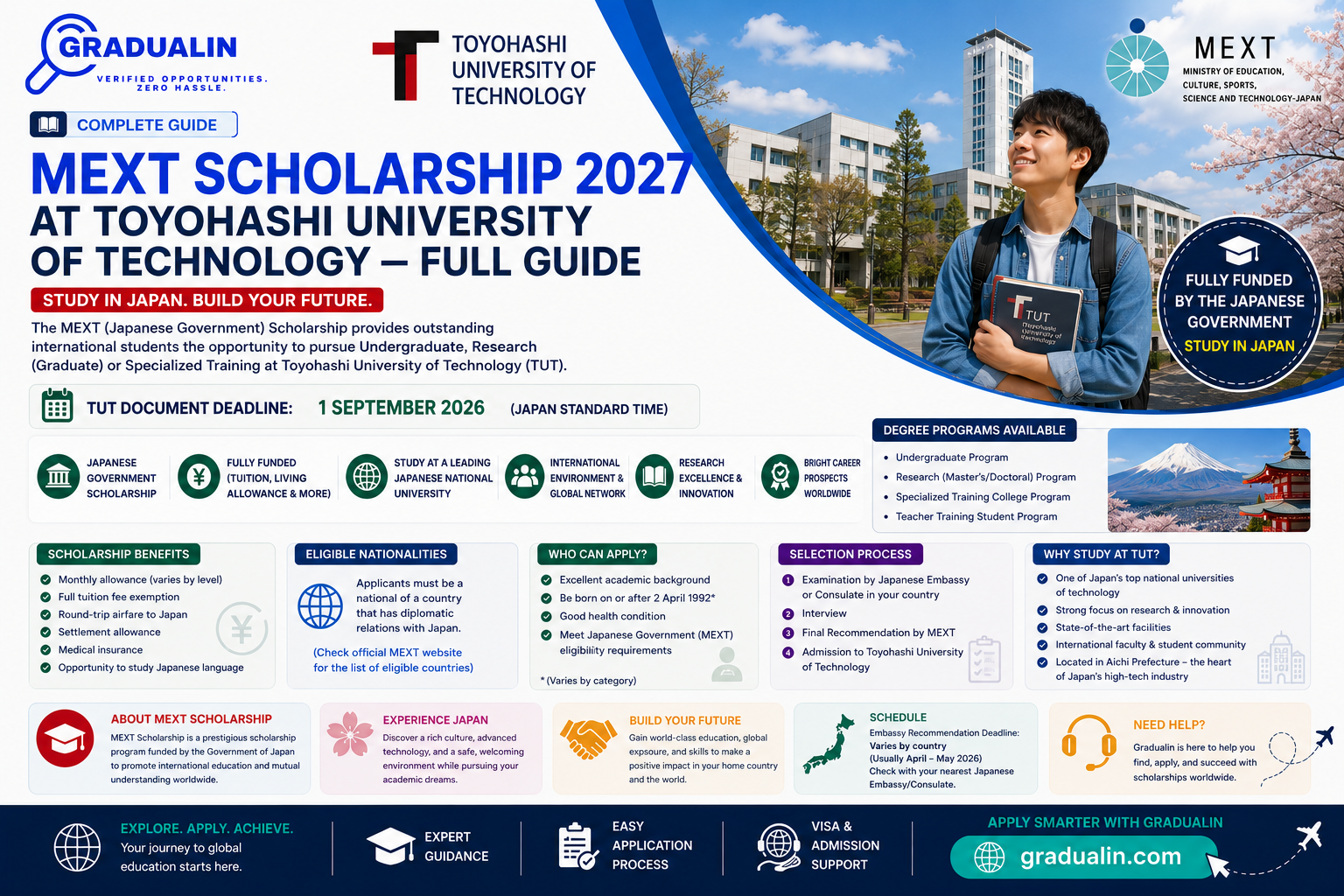
Every year, Japan’s Ministry of Education funds thousands of international researchers to study at Japanese universities with full tuition coverage, a monthly living allowance of ¥143,000–¥145,000, round-trip airfare, and a free Japanese language preparatory course. Pakistani students are eligible, Japan–Pakistan diplomatic relations are strong, and the Japanese Embassy in Pakistan has actively recruited South Asian applicants for decades. This guide covers the MEXT Scholarship 2027 at Toyohashi University of Technology (TUT) — what TUT offers, how to secure a Letter of Provisional Acceptance from TUT specifically, which research fields are available, and what Pakistani and international applicants need to know before the 1 September 2026 deadline for the TUT post-screening submission.
| Detail | Information |
| University | Toyohashi University of Technology (TUT), Aichi, Japan |
| Scholarship | Japanese Government (MEXT) Scholarship — Embassy Recommendation |
| Category | Research Students (non-degree, pathway to Master’s or PhD) |
| Monthly Stipend | ¥143,000 (Research Student) / ¥144,000 (Master’s) / ¥145,000 (PhD) |
| Tuition | Fully waived |
| Airfare | Round-trip economy class included |
| Japanese Language Course | 6-month preparatory course if needed |
| Duration | Up to 3 years (research student period + degree period) |
| Fields Available | Engineering, Computer Science, Life Sciences, Architecture & Civil Engineering |
| TUT Document Deadline | 1 September 2026 (Japan Standard Time) |
| Open To | International students from countries with diplomatic relations with Japan |
| Pakistani Students Eligible | Yes — Pakistan is an active MEXT-participating country |
| No IELTS Required? | No IELTS/TOEFL mandatory at embassy stage — English exam conducted by embassy |
| Official TUT Link | Apply Here |
🎓 About MEXT and Toyohashi University of Technology
The MEXT Scholarship — formally the Japanese Government (Monbukagakusho) Scholarship — is one of the oldest and most respected fully funded government scholarship programmes in the world. Japan has been awarding these scholarships since 1954, covering students from over 160 countries across multiple academic categories. The Research Student category, which this article focuses on, is aimed at those pursuing master’s or doctoral degrees at Japanese universities.
Toyohashi University of Technology is a national university founded in 1976 in Toyohashi City, Aichi Prefecture — Japan’s manufacturing heartland. TUT was designed from its founding to be a graduate-school-first institution, with an academic culture built around applied research rather than large undergraduate programmes. It has approximately 2,200 students in total, of whom around 10–15 percent are international, with most coming from Asia.
The university’s research strength is concentrated in five engineering departments: Mechanical Engineering, Electrical and Electronic Information Engineering, Computer Science and Engineering, Applied Chemistry and Life Science, and Architecture and Civil Engineering. Its research institutes cover intelligent sensing, robotics, agrotechnology, photonic information storage, human-robot symbiosis, and future vehicle technology — areas where TUT has genuine international recognition and industry links in the Tokai manufacturing region.
Compared to larger Japanese universities that MEXT scholars typically target — Tokyo, Osaka, Kyoto — TUT offers something different: a focused research environment where supervision ratios are smaller, laboratory access is more direct, and Toyohashi’s lower cost of living means the MEXT stipend stretches considerably further than it does in Tokyo. Unlike DAAD or Erasmus+ fellowships, which are typically academic-year limited, MEXT covers your full degree programme — not just a semester or research stay.
🎓 MEXT Scholarship Benefits — What Is Actually Covered
- Monthly stipend: ¥143,000 for Research Students / ¥144,000 for Master’s level / ¥145,000 for doctoral level (amounts subject to annual adjustment — verify on official MEXT guidelines)
- Tuition fees: Completely waived for the full scholarship duration, including admission and examination fees
- Round-trip airfare: Economy class between your home country and Japan, at the start and end of the scholarship
- Japanese language preparatory course: A six-month course offered before or at the start of your academic programme, at no cost, with the stipend continuing through the preparatory period
- Duration: Research student periods of typically six months to one year, followed by a master’s programme (two years) or doctoral programme (three years), making the total scholarship period up to four years for a master’s and up to four years for a PhD
- No return-service obligation: You are not required to return to Pakistan or work in Japan after completing your degree
For Pakistani students: ¥143,000 per month converts to approximately PKR 280,000–290,000 at current exchange rates (verify at time of application). Toyohashi’s rent and cost of living are roughly 30–40% lower than Tokyo, meaning this stipend covers accommodation, food, transport, and personal expenses with room for modest savings — a genuinely liveable award.
🎓 An Important Distinction: TUT’s Research Student Status
This is the most critical fact that most articles about MEXT at TUT fail to explain clearly.
TUT will only issue a Letter of Provisional Acceptance with the status of “RESEARCH STUDENT (NON-DEGREE STUDENT).”
This means: when you arrive at TUT under MEXT Embassy Recommendation, you are initially enrolled as a research student — not as a master’s or doctoral student. To formally enrol in a degree programme (master’s or doctoral), you must separately apply for and pass TUT’s entrance examination while you are already enrolled as a research student at TUT.
This is standard practice across Japanese universities and is not a disadvantage — the research student period gives you time to prepare for the entrance exam, work with your supervisor, develop language skills, and understand the department before committing to a specific degree programme. Most students pass the entrance exam within their first year. But applicants need to understand this structure going in: you are not arriving directly into a master’s or doctoral programme. The research student period is a transitional stage, and your MEXT scholarship covers you through both phases.
🎓 Eligibility — Who Can Apply for MEXT at TUT
- Citizen of a country that has diplomatic relations with Japan — Pakistan qualifies fully
- Born on or after 2 April 1992 (must be under 35 at programme start in April 2027) — verify the exact date on the official MEXT 2027 guidelines
- Holds or will hold a bachelor’s degree for the Research Student / Master’s track, or a master’s degree for the Doctoral track, before the programme start date
- Not a Japanese national — dual nationals holding Japanese passports are not eligible
- Not currently receiving another Japanese government scholarship
- Willing to study at a Japanese university under the supervision of a designated faculty member
Pakistani students: Fully eligible. Pakistan has maintained active MEXT participation for decades. The Japanese Embassy in Pakistan (Islamabad) and Consulate in Karachi both administer MEXT applications, and Pakistani applicants are routed based on their CNIC permanent address — confirm which mission covers your home district before applying, as submitting to the wrong channel is a common and disqualifying error.
Language requirement: No IELTS or TOEFL is required at the embassy application stage. The embassy conducts its own written English and Japanese language examinations as part of the screening process. For TUT’s internal review, English proficiency may be demonstrated through certificates from your previous institution where applicable — verify with TUT directly.
🎓 Available Departments and Research Fields at TUT
TUT’s five departments and their key research areas:
Mechanical Engineering — robotics, mechatronics, manufacturing systems, thermal engineering, materials mechanics, vehicle engineering
Electrical and Electronic Information Engineering — sensor devices, semiconductor engineering, power electronics, bioelectronics, communication systems
Computer Science and Engineering — artificial intelligence, machine learning, human-computer interaction, data engineering, network systems, intelligent sensing
Applied Chemistry and Life Science — environmental chemistry, biotechnology, polymer science, agrotechnology, biochemical engineering
Architecture and Civil Engineering — structural engineering, disaster prevention, urban planning, environmental systems, construction materials
TUT also has active interdisciplinary research in IoT, AI, cyber-physical systems, carbon neutrality, and human-robot symbiosis — areas that cut across multiple departments and are especially strong for applicants with interdisciplinary research interests.
For Pakistani students from engineering backgrounds — particularly electrical, mechanical, computer science, and civil engineering — TUT’s department structure maps well onto HEC-recognised degree programmes at Pakistani public-sector universities.
🎓 How to Find a Supervisor at TUT
Before you can request a Letter of Provisional Acceptance from TUT, you must identify a potential supervisor. At TUT, only faculty members with the title of Professor or Associate Professor are eligible to supervise graduate students. Lecturers or Assistant Professors cannot be your academic advisor for MEXT purposes — this is a firm rule that eliminates many first-contact attempts made to the wrong people.
Use these two official TUT resources:
When reaching out to a potential supervisor: send a concise, professional email with your CV, your research interests, your academic background, and a brief explanation that you have passed the MEXT preliminary screening. Professors receive many generic emails from prospective students — a specific, focused message that demonstrates you have read their recent publications is far more effective than a generic inquiry.
Do not contact the supervisors directly to initiate the formal TUT application. Once you have confirmed interest from a potential supervisor, all formal document submission goes to the Educational Planning Section, Educational Affairs Division at TUT, not to individual professors.
🎓 Required Documents for TUT’s Letter of Provisional Acceptance
The TUT application for the Letter of Provisional Acceptance is a two-stage document submission. Contact TUT only after you have already passed the embassy preliminary screening.
Stage 1 — Initial Submission (by email to the Educational Planning Section):
- Completed TUT Application Form (download from TUT’s official form page)
- Copy of your Passing Certificate from the Japanese diplomatic mission’s Preliminary Screening — this document must be stamped by the embassy/consulate
The process will not begin until both documents are received.
Stage 2 — Full Document Submission (after receiving confirmation from TUT):
After TUT sends a confirmation email, submit the following by email:
- CV (including complete educational and employment history)
- Copies of documents submitted to the diplomatic mission (stamped and returned to you by the embassy). These include:
- Application Form
- Field of Study and Research Plan
- Academic transcripts for all years of university attended
- Graduation/degree certificate
- Recommendation letter from university president/dean or academic advisor
- Medical Certificate
- Abstracts of theses (if submitted to the embassy)
- Language proficiency certificate (if submitted to the embassy)
- Employer recommendation letter (if submitted to the embassy)
Do not submit the Placement Preference Application Form to TUT — this stays with the diplomatic mission.
Important rule: You may contact a maximum of two Japanese universities simultaneously. If you receive a rejection from one, you may then approach a third. Contacting more than two at once is prohibited.
🎓 Step-by-Step Application Process at TUT
Step 1: Confirm you have passed the embassy preliminary screening. The TUT page is exclusively for students who have already cleared the embassy stage. If you have not yet applied to MEXT through your embassy, check the current status at the Embassy of Japan in Pakistan — note that the 2027 embassy application deadline in Pakistan was 26 May 2026 and is now closed for the current cycle.
Step 2: Identify a Professor or Associate Professor at TUT whose research matches yours. Use the Faculty Members List and research department pages. Confirm their title is Professor or Associate Professor.
Step 3: Contact the potential supervisor and gauge interest. Send a professional, specific email. Do not mass-email multiple professors with the same generic message — this is immediately visible and counterproductive.
Step 4: Submit the two initial documents to the Educational Planning Section. Email kokuhi@office.tut.ac.jp with the completed TUT Application Form and your embassy passing certificate. Both must be submitted together.
Step 5: Wait for TUT’s confirmation email, then submit full documents. After confirmation, send your complete document set by email as outlined in the required documents section above.
Step 6: TUT conducts internal screening. TUT will inform you by email of the outcome. Note that TUT applies the Toyohashi University of Technology Security Export Control Regulations to all international student applications — this is a standard Japanese national university procedure.
Step 7: Receive your Letter of Provisional Acceptance (PDF). If approved, TUT issues the letter electronically. Submit it to the diplomatic mission as part of your MEXT process.
All documents must reach TUT by: 1 September 2026 (Japan Standard Time).
For Pakistani applicants: begin gathering and scanning your embassy-stamped documents immediately after receiving your passing certificate. September 1 arrives faster than it seems, and the document assembly process for stamped copies takes time.
🎓 Important Dates
| Milestone | Date |
| Embassy preliminary screening (Pakistan, 2027 intake) | Closed — was 26 May 2026 |
| TUT document submission deadline | 1 September 2026 (JST) |
| Start date at TUT | April 2027 (verify with TUT) |
📌 Bookmark this page — we update deadlines as soon as changes are announced.
🎓 Why Toyohashi University of Technology
TUT’s case for graduate researchers rests on four things. First, its engineering research centres — in robotics, sensing, agrotechnology, and photonic systems — produce output that gets published in leading IEEE and Nature-indexed journals, which matters when you are building a research CV. Second, the university’s industry connections in the Tokai region (Japan’s Toyota-country manufacturing hub) create internship and collaborative research opportunities that larger, more urban universities cannot easily replicate. Third, the campus is compact — with fewer than 2,500 students — meaning lab access, faculty contact time, and collaborative research conditions are genuinely better than at overcrowded flagship institutions. Fourth, Toyohashi City’s lower cost of living means MEXT scholars here live more comfortably on the same stipend than their counterparts in Tokyo or Osaka.
TUT has been part of Japan’s Top Global University Project since 2014 — a government initiative to internationalise Japan’s top research institutions. Its bilingual campus infrastructure, English-medium graduate programmes, and active international student support services mean arriving as a non-Japanese speaker is manageable from day one.
Gradualin Editor’s Note: TUT is an excellent choice for engineering and applied science researchers who want serious laboratory access in a focused environment rather than the brand recognition of Tokyo or Kyoto. For Pakistani students from strong technical backgrounds — particularly those from NUST, UET, PIEAS, GIKI, or COMSATS with clear research plans — TUT is genuinely competitive. The MEXT award itself is the most complete funding package available from Japan, and the combination with TUT’s compact research environment makes this a strong option for those who know what they want to work on.
🎓 Frequently Asked Questions
These questions are based on what students most commonly search about this programme.
Can Pakistani students apply for the MEXT Scholarship at Toyohashi University of Technology? Yes. Pakistan maintains active diplomatic relations with Japan, and the Embassy of Japan in Islamabad and the Consulate in Karachi both administer MEXT applications. Pakistani students apply based on their CNIC permanent address — confirm the correct channel before applying. The 2027 embassy application deadline in Pakistan was 26 May 2026 and is now closed; check the embassy website for the 2028 intake cycle when it opens in early 2027.
Is IELTS required for the MEXT Scholarship? No IELTS or TOEFL is required at the embassy application stage. The embassy administers its own English and Japanese language written examinations. For TUT’s internal review, English proficiency may be demonstrated through an institutional certificate from your previous university — verify this requirement directly with TUT’s Educational Affairs Division.
What is the difference between MEXT Embassy Recommendation and University Recommendation? Embassy Recommendation is applied through the Japanese Embassy or Consulate in your home country. It involves document screening, written examinations, and an interview at the embassy, followed by university placement coordinated by MEXT. University Recommendation is applied directly through a Japanese university or professor who nominates you to MEXT. The award is identical under both tracks, but the process differs significantly. TUT offers both tracks — the University Recommendation track at TUT has separate deadlines (typically around May each year for the following academic year).
Why does TUT only issue “Research Student” letters, not Master’s or PhD letters? This is TUT’s standard policy for MEXT Embassy Recommendation applicants. Japanese universities often require applicants to pass a formal entrance examination to enrol in a degree programme — a research student period allows you to prepare for that exam and settle into the academic environment first. Most MEXT scholars at TUT transition to a degree programme within their first year. It is not a disadvantage; it is a structured onboarding process that applies to most MEXT embassy-track applicants at Japanese national universities.
Can I contact TUT if I have not yet passed the embassy preliminary screening? The TUT post-screening page is specifically for students who have already passed the preliminary screening at their country’s Japanese diplomatic mission. If you have not yet cleared that stage, there is no formal mechanism to request a letter from TUT in this track. Applicants who want to approach TUT before the embassy stage should explore the University Recommendation track instead.
What happens if TUT rejects my application during internal screening? TUT will inform you by email. No objections to the internal screening decision are accepted. If rejected by TUT (and by a second university you contacted simultaneously), you may then approach another university. This is why contacting two universities as early as possible after passing the preliminary screening is strategically important — it preserves your options.
🎓 Official Sources
- TUT MEXT Embassy Recommendation page: Toyohashi University of Technology — Embassy Recommendation
- MEXT 2027 Official Application Guidelines: Application Guidelines PDF (MEXT)
- TUT Faculty Members List: Faculty Members
- Embassy of Japan in Pakistan: MEXT Research Scholarship — Pakistan
- TUT Educational Affairs Division email: kokuhi@office.tut.ac.jp (add “.tut.ac.jp” at the end)
- TUT Application Form: Download Form
🎓 Summary
| Detail | Information |
| University | Toyohashi University of Technology (TUT), Aichi, Japan |
| Scholarship | Japanese Government (MEXT) Scholarship — Embassy Recommendation |
| Category | Research Students (non-degree, pathway to Master’s or PhD) |
| Monthly Stipend | ¥143,000–¥145,000 (by degree level) |
| Tuition | Fully waived |
| Airfare | Round-trip economy class included |
| Duration | Up to 4 years (research student + degree period) |
| TUT Document Deadline | 1 September 2026 (JST) |
| Pakistani Students Eligible | Yes |
| No IELTS Required | Correct — embassy administers own language tests |
| Official Link | Apply Here |
Explore more fully funded opportunities in Japan and across Asia through Scholarships on Gradualin. For other top engineering and research scholarship destinations, these guides are relevant to your search:
- Top 10 Fully Funded Scholarships in Asia 2027
- Study in Germany 2026 — Guide for International Students
- Fully Funded PhD Scholarships in the UK 2026
- Fully Funded PhD Positions in Switzerland 2026
- Finland Scholarships 2026 — Tuition Waivers for International Students
- Study in Netherlands 2026 — Guide for International Students
- Study in Canada 2026 — Guide for International Students
For jobs, internships, academic events, and general guides, explore Jobs & Internships, Events & Conferences, and Guidelines & Resources.
Stay updated with the latest scholarships, jobs, and opportunities at Gradualin.com — your trusted guide to studying abroad for free.
Author: Faseeh Sultan — PhD Scholar & MSIT | 7 Years in Education