
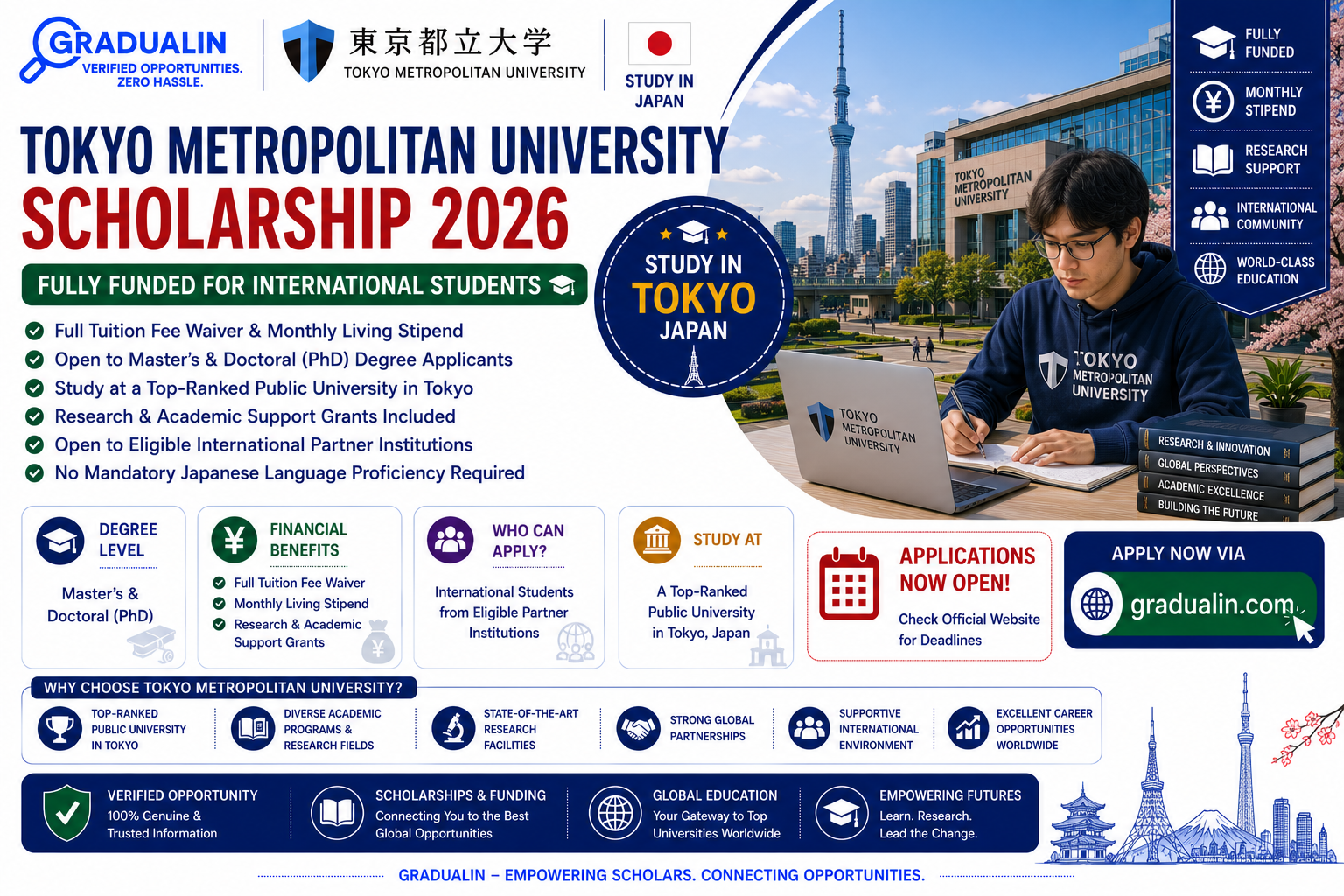
Tokyo Metropolitan University Scholarship 2026 — Fully Funded for International Students
Tokyo Metropolitan University is offering one of Japan’s most comprehensive institutional scholarships to graduate students from Asia and beyond — and unlike most Japanese scholarships, this one comes with a confirmed monthly stipend of ¥150,000, full tuition coverage, and return airfare, all funded directly by the Tokyo Metropolitan Government. The Spring 2027 intake opens for preliminary screening in August 2026, making right now the best time to prepare.
This guide covers everything the official website doesn’t spell out in one place: who realistically qualifies, how competitive it is, what the language requirements actually mean in practice, and how this scholarship compares to other fully funded options in Japan.
| Detail | Information |
| University/Organization | Tokyo Metropolitan University (TMU) |
| Country | Japan |
| Degree/Level | Master’s (2 years) and PhD/Doctoral (3 years) |
| Funding Type | Fully Funded |
| Deadline | August 2026 (Spring 2027 preliminary screening) |
| Open To | International students from Asia, TMU partner universities, and Tokyo’s sister cities worldwide |
| Official Link | Apply Here |
🎓 About the Tokyo Global Partner Scholarship Program
The Tokyo Global Partner (Tokyo GP) Scholarship is not a government-wide program like the MEXT scholarship — it is funded directly by the Tokyo Metropolitan Government and administered by Tokyo Metropolitan University. That distinction matters. Where MEXT competition is national and draws tens of thousands of applicants, Tokyo GP is institutional, meaning you are competing within a much smaller pool of applicants who meet TMU’s specific eligibility criteria.
TMU is a public research university ranked consistently among Japan’s top metropolitan institutions, with particular strengths in urban environmental sciences, systems design, and human health sciences. It operates seven graduate schools, and the Tokyo GP scholarship is open across all of them.
The scholarship is explicitly designed to build a global network of “Japan-friendly” graduates who go on to work in Tokyo-linked industries, research institutions, or public organizations. This is worth understanding upfront: TMU is not simply offering funding out of goodwill — it is investing in applicants who demonstrate a genuine intention to contribute to Tokyo’s development, directly or indirectly, after graduation.
Unlike the MEXT Research Student pathway, which requires applicants to spend an initial research student period before applying for a degree program, Tokyo GP applicants enter directly into a master’s or doctoral degree course. That alone makes it a more time-efficient route for students who already know their field and have a prospective supervisor in mind.
🎓 Benefits — What the Scholarship Covers
The Tokyo GP is genuinely fully funded. Every major cost category is addressed:
- Entrance examination fee: Fully waived at the application stage
- Admission fee: Fully waived upon enrollment
- Tuition: 100% exempted for the prescribed duration — two years for master’s, three years for doctoral
- Monthly stipend: ¥150,000 per month for the full duration of the program (approximately USD 1,000 / PKR 280,000 at current rates — verify on official website)
- Airfare: One-way economy ticket from the nearest international airport to your residence, to Narita or Haneda. A return economy ticket home is provided upon degree completion. Note: travel between the airport and the TMU campus is at your own expense
- Housing referral: TMU’s cooperating company assists with finding accommodation and handling contract procedures. The housing referral service does not guarantee placement that meets all your preferences, and rent is your own responsibility
What is not covered: housing rent, meals, and daily living expenses beyond what the stipend can support. At ¥150,000/month in Tokyo, budgeting is tight — Tokyo is one of the world’s more expensive cities, and rent alone will consume a substantial portion of the stipend, particularly for students who cannot secure International Student House placement (single students only; no family housing available through the program).
🎓 Eligibility Criteria
Tokyo GP has layered eligibility requirements. Read each carefully — the program will reject applications that do not meet all conditions.
Academic level:
- Master’s applicants: Must hold or expect to hold a bachelor’s degree (16-year schooling); minimum age 22 at enrollment
- Doctoral applicants: Must hold or expect to hold a master’s degree or equivalent; minimum age 24 at enrollment
Origin/affiliation (one of the following must apply):
- Currently enrolled at, or graduated within the past year from, a TMU international partner university (100+ institutions listed — check the full list)
- Currently based at a research institution, government body, or company in an Asian country (India, Pakistan, Bangladesh, China, South Korea, Vietnam, Malaysia, Indonesia, Philippines, Sri Lanka, Nepal, and more) or in one of Tokyo’s sister cities (New York, Beijing, Paris, London, Rome, Berlin, Moscow, Cairo, Seoul, Jakarta, São Paulo, New South Wales)
- Currently enrolled in a master’s program in Japan on a Student visa
GPA:
- Minimum 2.30 GPA using TMU’s conversion formula (roughly equivalent to a B average or above). The formula uses a 0–3 point scale; the conversion table is in the Application Guidelines.
Language (one of the following):
- JLPT N2 or higher in Japanese, OR completion of education with Japanese as the primary language
- CEFR B2 or higher in English (equivalent to IELTS 5.5–6.0, TOEFL iBT 72+, or similar), OR completion of education with English as the primary language
This is a nuanced language requirement. It is not a “No IELTS required” program — English B2 proficiency is required for those applying through the English-language pathway. However, students who completed their undergraduate or postgraduate education in English (which includes most Pakistani, Indian, and Filipino graduates) are eligible without a separate test score, subject to the graduate school’s judgment.
Other conditions:
- No active military status
- No simultaneous receipt of another scholarship at time of enrollment
- No prior MEXT-funded enrollment in Japan (for the same degree level)
- Must obtain a Student visa before entering Japan (with limited exceptions for applicants already in Japan)
- Must be willing to learn basic Japanese to conversational level by program completion
- Should intend to work in Tokyo-linked industries, research, or public sector after graduation
🎓 Who Should Apply — and Who Probably Shouldn’t
✅ Strong candidates:
- Master’s or PhD applicants from Pakistan, India, Bangladesh, or other listed Asian countries with a GPA above 2.5 and a clear research focus
- Students already enrolled at one of TMU’s 100+ partner universities worldwide
- Applicants who can demonstrate a genuine connection to Tokyo’s development goals — urban research, health sciences, systems design, engineering
- Professionals working in government or research institutions in Asian countries who want to transition to graduate study
- Students who completed their undergraduate education in English and do not need a separate IELTS/TOEFL score
❌ Poor fits:
- Applicants seeking a purely English-taught environment at TMU — most graduate schools still require functional Japanese, and all students must reach conversational Japanese by graduation
- Students who plan to bring family — the housing program covers singles only; family housing is entirely self-arranged in one of the world’s most expensive cities
- Those already receiving another scholarship at enrollment — Tokyo GP cannot be stacked with other scholarships
- Applicants from outside the listed Asian countries/regions who are not enrolled at a TMU partner institution — geographic eligibility is strict
🎓 Available Programs and Fields of Study
The Tokyo GP scholarship is available across all seven of TMU’s graduate schools:
- Humanities — language, literature, history, philosophy
- Law and Politics
- Management
- Science — mathematics, physics, chemistry, biology
- Urban Environmental Sciences — architecture, geography, environmental studies, urban planning
- Systems Design — engineering, information systems, aerospace, industrial design
- Human Health Sciences — nursing, physical therapy, occupational therapy, radiological sciences
TMU has particular research depth in urban environmental sciences and systems design, and a growing profile in health sciences. For students in STEM and urban/environmental fields, TMU’s research infrastructure is genuinely competitive with much larger national universities.
A complete list of academic programs within each school is available at the TMU English website. Note that some graduate school pages and admission materials are available only in Japanese — this is worth factoring into your research process before applying.
If you are looking for Scholarships in Japan and Asia more broadly, Gradualin’s scholarship category covers the full range of funded opportunities by region and degree level.
🎓 Required Documents
Document requirements vary by graduate school, but the Application Guidelines confirm the following are standard across programs. All documents are typically submitted by postal mail — online submission is not the norm for Japanese university admissions.
- Completed application form (per each graduate school’s format)
- Academic transcripts from all institutions attended
- GPA calculation sheet using TMU’s conversion formula
- Proof of degree (bachelor’s for master’s applicants; master’s for doctoral)
- English or Japanese language proficiency certificate (if not educated in English/Japanese)
- Research proposal or statement of purpose
- Letter(s) of recommendation
- Permission letter or approval from a prospective academic supervisor (this is required before you can apply — finding a supervisor is step one, not an afterthought)
- Housing referral form (mandatory for all applicants regardless of whether you want the service)
- Copy of passport
Specific graduate schools may require additional documents. The current Application Guidelines PDF (version dated July 2026) is available here.
🎓 Step-by-Step Application Process
- Identify your prospective supervisor. Use the TMU researcher database to find faculty whose work aligns with yours. Contact them directly — this step is non-negotiable. Without supervisor confirmation, your application cannot proceed.
- Confirm partner institution eligibility. If you are not from a listed Asian country or Tokyo sister city, verify whether your home institution is on TMU’s partner university list. The list (accurate as of March 2025) is in the Application Guidelines PDF.
- Check your graduate school’s specific timeline. Application timelines and requirements differ between TMU’s seven graduate schools. The Information section of the Tokyo GP page links to each school’s admissions page directly.
- Prepare and submit pre-screening materials. Some graduate schools require a preliminary application or pre-screening before the formal application opens. For the Spring 2027 cycle, preliminary screening begins August 2026 — check your target school’s page immediately.
- Submit the full application. Documents go by postal mail to the relevant graduate school, not to the International Center. Ensure your GPA calculation sheet is completed correctly using TMU’s conversion table.
- Sit for written and/or oral examinations. These are field-specific and administered by the graduate school in November (Spring cycle) or May (Fall cycle).
- Await awards announcement. Results are announced in December for the Spring cycle (studies commence April 1); June for the Fall cycle (studies commence October 1).
Practical tip: Japanese academic supervisors receive a high volume of unsolicited emails from prospective international students. A cold email that opens with your research question — not your credentials — and references one of their recent publications specifically will significantly outperform a generic introduction. Keep it to three paragraphs maximum.
🎓 Important Dates — Spring 2027 Intake
| Milestone | Date |
| Preliminary Screening | August 2026 |
| Application Opens | October 2026 |
| Examinations and Interviews | November 2026 |
| Awards Announced | December 2026 |
| Studies Commence | April 1, 2027 |
Dates above follow the general program timeline. Each graduate school may publish slightly different windows. Confirm with your target school directly.
Bookmark this page and check back for updates.
🎓 Why Study at TMU — and Why Tokyo
Tokyo Metropolitan University is one of Japan’s few fully public metropolitan universities — meaning it is funded by the Tokyo Metropolitan Government, not the national government. This gives it a distinctive urban research focus that sets it apart from national universities like the University of Tokyo or Osaka University.
TMU’s campus in Hachioji (south-west Tokyo) is a full research campus with easy rail access to central Tokyo — you are, in practice, studying in one of the world’s great cities. Tokyo is the world’s largest metropolitan economy, home to the headquarters of companies like Sony, Toyota, Mitsubishi, and Softbank, and a major hub for global research in engineering, urban planning, and health sciences.
For students in fields like urban environmental sciences, systems design, or public health, a degree from a Tokyo-funded institution — with a supervisor network embedded in the city’s infrastructure — carries genuine career weight in Asian government and research circles.
TMU alumni working in Tokyo-linked industries have noted that the post-graduation employment expectation (the program encourages, though does not mandate, employment with Tokyo-connected organizations) creates a useful alumni pipeline into Japanese industry and regional development sectors.
Gradualin Editor’s Note: Tokyo GP is a realistic target for above-average applicants from listed Asian countries — particularly those with a GPA of 2.5 or above, a clear research field, and some ability to identify and contact a supervisor proactively. For applicants from Pakistan, India, Bangladesh, and the Philippines, geographic eligibility is straightforward. The real bottleneck is supervisor contact and the partially Japanese-language application process. Average applicants who have not invested time in identifying a supervisor and confirming fit with a specific TMU faculty member will struggle to proceed past the pre-screening stage. This is a scholarship that rewards preparation more than credentials alone.
🎓 FAQ
These questions are based on what students most commonly search about this program.
Q1. Does the Tokyo GP scholarship require IELTS or TOEFL?
Not necessarily — but some English proficiency evidence is required. If you completed your bachelor’s or master’s degree with English as the primary language of instruction, that generally satisfies the English language requirement for most graduate schools. If not, you will need a test score equivalent to CEFR B2 (roughly IELTS 5.5–6.0 range or TOEFL iBT 72+). Check with your specific target graduate school, as requirements vary. Importantly, the program also accepts Japanese language qualifications (JLPT N2 or above) as an alternative pathway — making this accessible to students who have studied Japanese formally.
Q2. Can Pakistani students apply for the Tokyo GP scholarship?
Yes. Pakistan is explicitly listed among the eligible Asian countries in the Application Guidelines (India, Pakistan, Bangladesh, Nepal, Sri Lanka, and 17 other countries are named). Applicants from Pakistan who are enrolled at a Pakistani university, a TMU partner institution, or working in a research or government setting in Pakistan are eligible. English-medium graduates from Pakistani universities generally satisfy the language requirement without a separate IELTS score, though the final call rests with the graduate school.
Q3. Is this the same as the MEXT scholarship?
No. The Tokyo GP is separate from the Japanese Government (MEXT) scholarship. It is funded by the Tokyo Metropolitan Government specifically and administered by TMU. One key difference: MEXT scholarship holders cannot simultaneously receive Tokyo GP funding. However, if you were previously a MEXT research student (not a degree student), that does not disqualify you — the restriction applies only to prior MEXT-funded degree enrollment at the same level.
Q4. Do I need to speak Japanese to apply?
Not at the application stage — but you will need to reach basic conversational Japanese by the time you complete your program. Many TMU graduate school pages and some faculty profiles are only in Japanese, which makes supervisor identification harder for applicants who do not read Japanese. Practical advice: use Google Translate on Japanese-only pages, or contact the International Center directly for English-language faculty information.
Q5. Is there an age limit?
There is no upper age limit. The only age minimums are 22 years old at enrollment for master’s applicants and 24 for doctoral applicants. The program explicitly welcomes working professionals from Asian countries — this is not a scholarship designed exclusively for recent graduates.
Q6. Can I apply if I am already in Japan?
Yes, with conditions. If you are enrolled in a master’s program in Japan on a Student visa, you may apply for the doctoral program. If you are in Japan under a different visa status (permanent resident, long-term resident, etc.), you must change your status to Student before or by the end of the month prior to scholarship commencement. Japanese citizens, special permanent residents, and those with permanent residence are not eligible.
🎓 Official Sources
- Program Page: Tokyo Global Partner Scholarship Program
- Application Guidelines PDF: Download Here
- Official Brochure: Download Brochure
- TMU English Website: Tokyo Metropolitan University
- TMU Researcher Database: Find a Supervisor
- University Address: 1-1 Minami-Osawa, Hachioji-shi, Tokyo, Japan 192-0397
For graduate school-specific admissions details, contact the relevant school directly — links are in the Information section of the Tokyo GP page.
🎓 Summary
| Detail | Information |
| University/Organization | Tokyo Metropolitan University (TMU) |
| Country | Japan |
| Degree/Level | Master’s (2 years) and PhD/Doctoral (3 years) |
| Funding Type | Fully Funded |
| Stipend | ¥150,000 per month |
| Tuition | 100% waived |
| Airfare | Economy class, both ways |
| Deadline | August 2026 (Spring 2027 preliminary screening) |
| Language Requirement | JLPT N2 (Japanese) or CEFR B2 (English), or equivalent education |
| GPA Requirement | 2.30 minimum (TMU conversion scale) |
| Age Minimum | 22 (Master’s) / 24 (Doctoral) |
| Open To | Asian country applicants, TMU partner university students, Tokyo sister city residents |
| Official Link | Apply Here |
Related Opportunities
If TMU is on your shortlist, you may also want to explore:
- Top 10 Fully Funded Scholarships in Asia 2027 — a broader look at Asia-based funding options at this level
- Fully Funded PhD Scholarships in the UK 2026 — for doctoral applicants considering alternatives to Japan
- Study in Germany 2026 — Guide for International Students — another strong fully-funded destination for Asian graduate students
For more fully funded options by country, visit Scholarships, Jobs & Internships, Events & Conferences, and Guidelines & Resources.
Stay updated with the latest scholarships, jobs, and opportunities at Gradualin.com — your trusted guide to studying abroad for free.
Author: Faseeh Sultan — MSIT, PhD Scholar | 7 Years in Education