
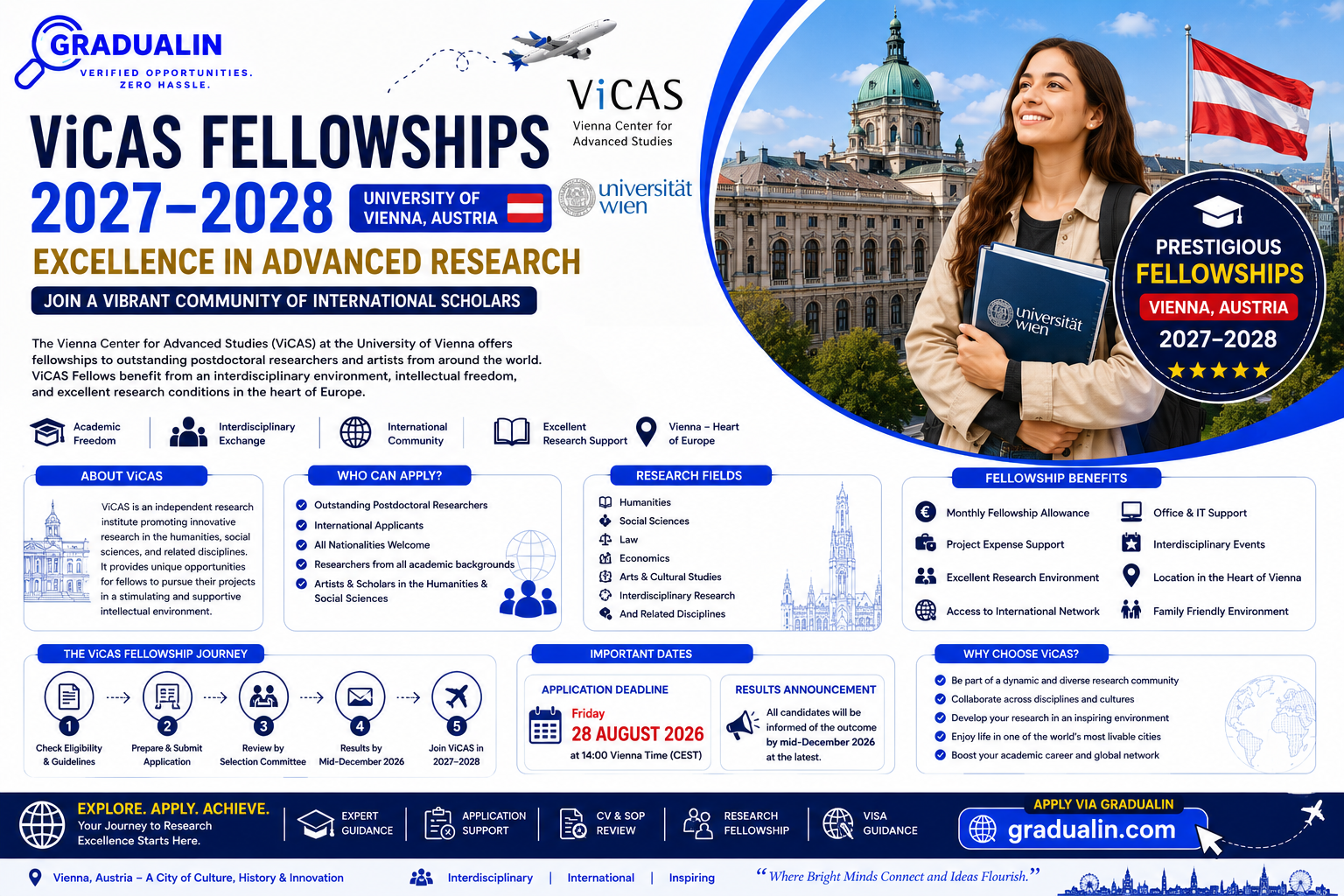
Prestigious ViCAS Fellowship 2027 — University of Vienna, Austria
The University of Vienna has launched one of Europe’s most exciting new academic programmes — and it is now accepting applications from scholars around the world. The Vienna Centre for Advanced Studies (ViCAS) offers up to twenty fellowships per year across two tracks: Senior Fellowships and Early-Career Fellowships. Open to scholars from every academic discipline — from neurobiology to philology, from governance to mathematics — this is a rare opportunity to spend a full academic year doing deep, uninterrupted research in the heart of one of the world’s most celebrated cities. This complete guide explains everything you need to know, including funding details, eligibility, benefits, and exactly how to prepare for the June 2026 application window.
| Detail | Information |
| Institution | University of Vienna — Vienna Centre for Advanced Studies (ViCAS) |
| Country | Austria 🇦🇹 |
| Fellowship Level | Senior Fellowships & Early-Career Fellowships |
| Funding Type | Paid fellowship with salary/financial contribution + accommodation allowance |
| Application Opening | August 2026 (for 2027/28 academic year) |
| Fellowship Duration | Academic year (October 2027 – June 2028, verify on official website) |
| Open To | International scholars from all academic fields |
| Official Link | ViCAS Becoming a Fellow |
🎓 About the Vienna Centre for Advanced Studies
The Vienna Centre for Advanced Studies — known as ViCAS — is a brand-new interdisciplinary research centre at the University of Vienna, one of Europe’s oldest and most prestigious universities, founded in 1365. ViCAS was established to bring together exceptional international minds from every corner of academia — and to give them something increasingly rare in modern research life: uninterrupted time to think.
What makes this centre genuinely different from most postdoctoral or research programmes is its deliberately cross-disciplinary spirit. The inaugural cohort of ViCAS fellows includes scholars working in fields as far apart as neurobiology, genomics, high-performance computing, oriental studies, complexity science, and philology — all under one roof. That kind of intellectual range creates conversations and connections that simply don’t happen in traditional departmental settings.
The University of Vienna’s Rector, Sebastian Schütze, described the centre as an opportunity to attract both renowned academics and talented early-stage researchers to Vienna — and that ambition is visible in the programme’s structure. Up to ten Senior Fellowships and ten Early-Career Fellowships are awarded each year, making this a selective but genuinely attainable opportunity for exceptional scholars worldwide.
🎓 Benefits and Financial Support
ViCAS provides a real, substantive financial package — not a token honorarium. Here is what the fellowship covers:
- Financial Contribution (Salary or Institutional Transfer): Fellows receive a financial contribution intended to cover living costs during their stay. This can be paid directly as a salary by the University of Vienna, or transferred in full to the fellow’s home institution. The exact gross amount has not been published on the official website at the time of writing (verify on official website when the June 2026 call opens).
- Accommodation Allowance: €1,500 per month to help cover housing costs in Vienna. This is included in the total financial package and is subject to Austrian income tax if paid directly to the fellow.
- Child Allowance: Fellows with accompanying children under 18 years old (as of 30 September 2026) can request €500 per month per child. This is also subject to tax if paid directly.
- University Library Access: Full access to the University of Vienna’s libraries and digital publication resources.
- Dedicated Workspace: A private office, internet, standard equipment, and meeting space at the ViCAS premises.
- University Email and Institutional Affiliation: Fellows receive a University of Vienna email address and are formally affiliated with ViCAS for publications and outputs.
- Austrian Public Health Insurance: Fellows employed directly by the university are enrolled in Austria’s public health system. Accompanying family members can generally be co-insured.
Important note: ViCAS does not provide a separate research budget, laboratory facilities, or funding for relocation or travel. Fellows can use their financial contribution flexibly — including for research-related expenses — but there is no dedicated additional fund for this.
🎓 Eligibility Criteria
The ViCAS Fellowship is open to outstanding international scholars from all academic disciplines. Both tracks — Senior and Early-Career — target researchers pursuing ambitious, curiosity-driven projects, including interdisciplinary work.
Key eligibility points based on official information:
- Two Tracks Available: Senior Fellowships (established academics) and Early-Career Fellowships (junior researchers — exact career-stage definition will be clarified in the June 2026 call).
- All Academic Fields Welcome: Humanities, social sciences, natural sciences, STEM, interdisciplinary and emerging fields — all qualify.
- In-Residence Requirement: This is a full in-residence programme. Fellows must live and work in Vienna for the duration. Remote participation is not permitted.
- Home Institution Required: Applicants must have a home institution (a university, research institute, or organisation) where they are formally employed or enrolled.
- No Teaching Obligations: There are no mandatory teaching duties — though fellows may arrange optional teaching through relevant university departments with the Academic Coordinator’s approval.
- Language Requirements: The official fellowship materials are in English. No formal English test requirement is stated on the official website (verify on official website when the call opens).
🎓 Who Should Apply / Who Shouldn’t
✅ This fellowship is right for you if:
- You are an established academic or early-career researcher who wants dedicated time for deep, focused research
- Your work crosses disciplinary boundaries and thrives in a diverse intellectual environment
- You are prepared to relocate to Vienna for the full academic year
- You have a home institution that supports or releases you for a fellowship residency
- You want to build lasting international academic connections in Europe
❌ This fellowship may not be the right fit if:
- You need laboratory space or specialised experimental equipment (ViCAS does not operate labs)
- You cannot commit to full in-person residency in Vienna
- You are currently a student rather than a researcher/academic (verify exact eligibility by career stage when the call opens)
- You are looking for a programme with a dedicated separate research budget
- You need relocation or travel cost coverage from the fellowship itself
🎓 Fellowship Tracks and Disciplines
ViCAS offers two distinct fellowship tracks each year, with up to ten positions in each:
Senior Fellowships — Designed for established academics with a strong publication and research record. What “senior” means in practice will be defined in the official call, but the programme’s framing suggests researchers well into their independent academic careers.
Early-Career Fellowships — Designed for junior researchers who are launching their independent scholarly agenda. This track specifically emphasises collaboration and mentorship opportunities within the ViCAS community.
Disciplines covered include (but are not limited to):
- Natural Sciences: neurobiology, genomics, mathematics, complexity science
- Engineering and Technology: high-performance computing
- Humanities: philology, oriental studies, history, linguistics
- Social Sciences: governance, ethics, political science
- Interdisciplinary and Emerging Fields: any project that transcends traditional boundaries is explicitly encouraged
The diversity of the inaugural ViCAS cohort — spanning five continents and fields from genomics to philology — signals that the selection committee genuinely values intellectual breadth over narrow specialisation.
🎓 Required Documents
The application window opens in June 2026, and the exact document checklist will be published on the official website at that time. Based on the programme’s structure and standard advanced studies fellowship norms, applicants should typically prepare:
- Full academic CV / curriculum vitae
- Research project proposal (description of the project you plan to pursue at ViCAS)
- List of publications and scholarly outputs
- Details of home institution and current affiliation
- Two or three letters of reference from senior academics
- Statement explaining the expected benefit of the fellowship to your research
- Any accessibility or functional needs documentation (voluntary; submit after receiving an offer)
Gradualin Tip: Start drafting your research proposal now — before the call opens. The strongest ViCAS applications will show not just a strong research record, but a clearly articulated project that benefits from an interdisciplinary, in-residence environment. Generic proposals will not be competitive.
🎓 Step-by-Step Application Process
- Monitor the official ViCAS website from June 2026 — vicas.univie.ac.at/becoming-a-fellow — for the opening of the application portal.
- Read the full call carefully when it is published. Note any career-stage definitions, eligibility criteria, and field restrictions that may be specified for your year.
- Draft your research project proposal in advance. This is the centrepiece of your application.
- Secure reference letters — inform your referees early, as busy academics need lead time.
- Confirm support from your home institution — since this is an in-residence programme, you will need your institution’s cooperation for the duration of the fellowship.
- Submit your application through the official ViCAS portal before the stated deadline.
- Prepare for any interview or shortlisting process — advanced studies fellowships at this level typically involve a selection committee review and may include interviews.
- If offered a position, complete the Acceptance Form and notify the Academic Coordinator of any accommodation or accessibility needs.
Contact the ViCAS Academic Coordinator, Dr. Hilde Janssens, at vicas@univie.ac.at if you have specific questions before applying.
🎓 Important Dates
| Milestone | Date |
| Application Window Opens | August 2026 |
| Fellowship Academic Year | 2027/28 (October 2027 – June 2028) (verify on official website) |
| Fellowship Start | Fall 2027 (verify on official website) |
Bookmark this page and check back for updates — the exact deadline will be published when the June 2026 call goes live.
🎓 Why Apply — Why Vienna and the University of Vienna
Vienna is not just a beautiful city — it is one of the most intellectually serious cities in the world. Home to legendary research institutions, world-class museums, and a centuries-old academic tradition, Vienna consistently ranks as one of the top cities globally for quality of life. For a research fellowship that asks you to be fully present, there are few better places to spend a year.
The University of Vienna, founded in 1365, is one of the oldest universities in the German-speaking world and one of the largest in Europe. It is home to dozens of internationally recognised departments and institutes, and its location on the Universitätsring — the grand boulevard encircling Vienna’s historic centre — puts fellows at the literal heart of European academic life.
What makes this different from other European fellowships is the institutional positioning. ViCAS is a new centre with the full backing of the University’s rector and leadership — which means it has institutional weight, genuine resources, and the ambition to build a lasting reputation. Getting in during the early cohorts is a meaningful career signal.
Vienna is also a gateway city for international academic networks across Central Europe, with strong ties to institutions in Germany, Switzerland, and beyond. The city’s affordability relative to London or Zurich, combined with Austria’s public health system and high standard of living, makes the financial package genuinely competitive for a European fellowship of this type.
🎓 Frequently Asked Questions
Q: Is the ViCAS Fellowship fully funded? A: The fellowship includes a financial contribution (salary or institutional transfer), a €1,500/month accommodation allowance, and optional €500/month per child — making it a well-supported, paid fellowship. The exact salary figure is not yet published on the official website, so check the June 2026 call for the confirmed amount.
Q: Do I need to speak German to apply for the ViCAS Fellowship? A: The programme materials and official communications are in English. No formal German language requirement is stated on the official website. However, for practical day-to-day life in Vienna, basic German is helpful (verify language requirements in the official call).
Q: Can I hold a ViCAS Fellowship alongside my current academic position? A: Not straightforwardly — ViCAS is a full in-residence programme. If you accept another position that prevents your continued residency in Vienna, the fellowship and associated payments would generally need to end early. Confirm arrangements with your home institution in advance.
Q: Are there teaching obligations attached to the ViCAS Fellowship? A: No — there are no mandatory teaching duties. If you wish to teach at the University of Vienna during your fellowship, this must be arranged separately with a relevant department and requires discussion with the Academic Coordinator.
Q: Can I bring my family to Vienna during the fellowship? A: Yes. Partners are welcome to attend ViCAS academic events. A child allowance of €500/month per accompanying child under 18 is available. ViCAS does not provide financial support for partners. Fellows are responsible for arranging their own accommodation using the monthly allowance provided.
Q: Is the financial contribution taxable in Austria? A: If the contribution is paid directly to you as a salary, Austrian social insurance and income tax deductions apply. If paid to your home institution instead, no Austrian taxes are due — but your home country’s tax rules may still apply. Use the Austrian gross-to-net calculator at bruttonetto.arbeiterkammer.at (in German) for estimates.
🎓 Official Source
- ViCAS Fellowship Page: Becoming a Fellow — Vienna Centre for Advanced Studies
- Q&A Page: Questions & Answers — ViCAS
- ViCAS Homepage: Vienna Centre for Advanced Studies
- Academic Coordinator: Dr. Hilde Janssens — vicas@univie.ac.at
- Address: Universitätsring 1, 1010 Wien, Austria
🎓 Summary Table
| Detail | Information |
| Institution | University of Vienna — ViCAS |
| Country | Austria 🇦🇹 |
| Fellowship Tracks | Senior Fellowship & Early-Career Fellowship |
| Number of Awards | Up to 10 per track (up to 20 total per year) |
| Funding Type | Financial contribution (salary/institutional transfer) + €1,500/month accommodation allowance |
| Child Allowance | €500/month per accompanying child under 18 |
| Duration | One academic year (verify on official website) |
| Teaching Obligations | None |
| Laboratory Facilities | Not provided by ViCAS |
| Disciplines | All academic fields |
| In-Residence | Required — full-time presence in Vienna |
| Application Opening | August 2026 |
| Contact | vicas@univie.ac.at |
| Official Link | vicas.univie.ac.at/becoming-a-fellow |
Category Links:
Standing Cluster Links:
Fully Funded Scholarships in Australia 2026
Fully Funded PhD Scholarships in the UK 2026
Fully Funded Scholarships in the USA 2026
Study in Italy 2026 — Guide for International Students
Finland Scholarships 2026 — Tuition Waivers for International Students
Top 10 Fully Funded Scholarships in Asia 2027
Fully Funded PhD Positions in Switzerland 2026
Top Fully Funded Scholarships in Saudi Arabia 2026
Related Posts:
CATS Fellowship 2026–2027 | €3,000/Month Research Grant in Berlin, Germany
Fully Funded JSPS Postdoctoral Fellowship Japan 2026
Fully Funded UNESCO Global Fellowship 2026
Stay updated with the latest scholarships, jobs, and opportunities at Gradualin.com — your trusted guide to studying abroad for free.